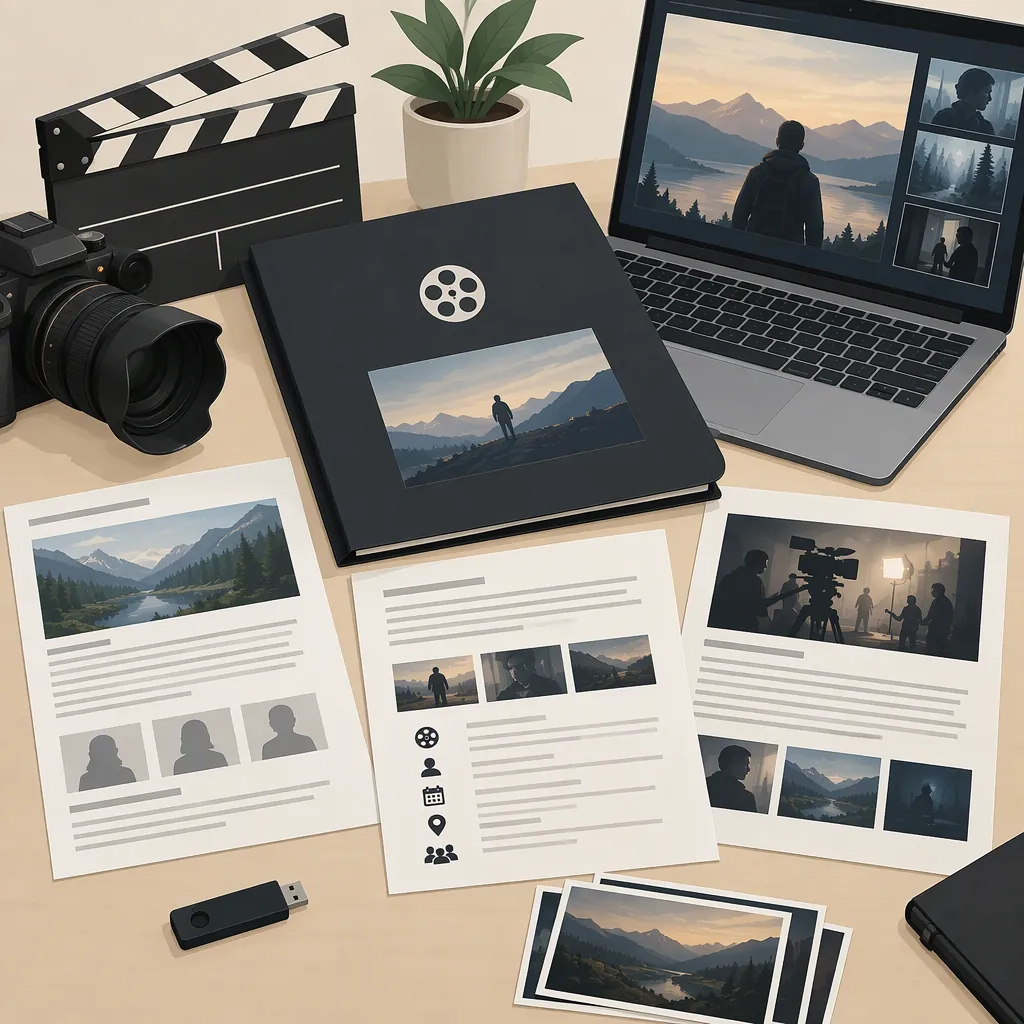
Film Press Kit Template: What to Include in an Epk
A film press kit template organizes the facts, publicity copy, images, and contact details someone needs to understand and cover a film. An EPK is its electronic version. Start with the title, film facts, logline, synopsis, filmmaker information, key credits, stills, and press contact. Add a public trailer, production notes, or verified festival information when relevant. There is no universal section list or required page count; adapt the kit to the recipient. [src-1]
What a Film Epk Does
A film press kit brings core film information and publicity assets together for journalists, festival programmers, distributors, venues, and other industry contacts. EPK stands for Electronic Press Kit: the digital form of that collection. [src-1]
Treat the template below as a starting structure, not a submission standard. The reference describes a flexible set of sections and explicitly notes that not every film needs every section. Its guidance is not evidence of any particular festival's requirements. [src-1]
For a public-facing version, use information and assets approved for public circulation. Keep private screening credentials, personal phone numbers, unreleased announcements, and other restricted material outside the public kit. This is an editorial precaution, not a claim that every recipient uses the same access rules.
Copyable Film Press Kit Template
Copy this outline into a document or public webpage, replace each placeholder with confirmed information, and remove sections that do not apply. The categories follow the reference's suggested film information, story, filmmakers, credits, technical details, media, festival information, and contact sections. [src-1]
The placeholders are prompts, not sample film facts. Do not turn an unknown field into a guessed credit, award, date, or technical specification. For public links, insert only actual destinations approved for publication.
Reusable Public Film Epk Outline
# {Film Title}

Electronic Press Kit
Updated: {Confirmed revision date}

## Film at a Glance
- Title: {Official title}
- Tagline: {Optional approved tagline}
- Project type: {Short, feature, documentary, animation, or other}
- Year: {Confirmed film year}
- Runtime: {Confirmed runtime}
- Genre: {Applicable genre or genres}
- Country of production: {Confirmed country or countries}
- Languages: {Languages used in the film}
- Production company: {Confirmed company, if applicable}
- Film status: {Approved public status}

## Story
Logline: {Concise description of the central story or subject}

Short synopsis: {Brief approved summary for listings and introductions}

Full synopsis: {Longer approved summary, if useful; identify spoilers}

## Filmmakers
Director biography: {Verified background, selected work, and relevant achievements}

Director statement: {Approved explanation of this film's motivation, themes, and creative approach}

Other filmmaker biographies: {Include only relevant, verified biographies}

## Key Cast and Crew
- {Performer}: {Character or credited role}
- {Contributor}: {Confirmed crew role}

## Technical Information
- Runtime: {Same confirmed runtime used above}
- Aspect ratio: {Confirmed ratio, if needed}
- Picture and sound details: {Confirmed specifications relevant to the recipient}
- Subtitles or captions: {Confirmed available versions}

## Publicity Assets
Poster: {Approved public asset location}

Stills:
- File: {Filename or approved public asset location}
- Caption: {Accurate description}
- Credit: {Approved credit line}
- Usage notes: {Confirmed restrictions or permissions, if applicable}

Trailer: {Approved public URL, if available}

## Production Notes
{Verified context about development, research, locations, or creative choices that helps explain the film}

## Festivals and Awards
- {Festival name} — {Year} — {Exact confirmed selection or award wording}
{Remove this section if there is no verified information to publish}

## Press Contact
Name: {Approved public contact name}
Role: {Press contact role}
Email: {Verified email address approved for public use; enter as plain text}
Public film website: {Approved public URL, if available}
Write the Story and Filmmaker Copy
Keep the logline, synopsis, biography, and director statement distinct rather than repeating one paragraph under different headings.
- Logline: As a drafting approach, describe the central character, conflict, or documentary subject in a compact statement. Avoid unsupported praise.
- Short synopsis: Prepare a brief version for introductions or listings.
- Full synopsis: Add context where the recipient needs it. The reference distinguishes short and fuller synopses but does not prescribe a universal word count. [src-1]
- Biography: Explain who the filmmaker is, using verified background and selected work.
- Director statement: Explain why and how this particular film was made, including its motivation, themes, or creative approach. That is different from a career biography. [src-1]
As an editing practice, label a synopsis that reveals major plot developments. Keep promotional language separate from factual descriptions, and omit acclaim, review quotations, or achievements unless their wording and source can be verified.
Prepare Stills, Credits, and Festival Information
Choose representative stills with varied compositions and limited spoilers. The reference favors high-resolution images with useful captions and credits over many similar frames. Its suggestion of three to ten images is a starting point, not a formal requirement. [src-1]
For each image, record the filename, caption, credit line, and any confirmed usage conditions. As a practical organization method, use descriptive filenames and keep the same names in the kit and asset folder.
Include festival selections and awards only when the wording is accurate. The reference also advises having permission to use laurel artwork; a selection or award claim does not by itself establish permission to reproduce that artwork. [src-1]
A public trailer link can be useful, but the reference does not treat a trailer as mandatory. For this public-only template, omit private screener links and passwords. If viewing access must be arranged separately, identify the approved press contact without publishing access credentials. [src-1]
Review the Kit Before Publication
There is no rigid page count for a film press kit. The reference prioritizes clarity and usefulness, and notes that a short-film kit may be more concise than a feature or documentary kit. [src-1]
Use the checklist below as a proposed editorial review, not an industry certification. Check the intended recipient's current instructions separately; this template cannot establish their required format, file size, or submission materials.
Public Epk Review Checklist
- [ ] Replace or remove every placeholder.
- [ ] Confirm title spelling, runtime, year, languages, names, and credits.
- [ ] Keep repeated film facts consistent across sections.
- [ ] Verify biographies, production notes, selections, and awards.
- [ ] Confirm permission for poster, still, and laurel use.
- [ ] Add accurate image captions and credit lines.
- [ ] Test every public asset and trailer link.
- [ ] Remove private credentials and material not approved for publication.
- [ ] Confirm that the public press email is correct and approved for use.
- [ ] Label spoiler-heavy copy where appropriate.
- [ ] Check readability in the final document or webpage.
- [ ] Add a revision date and check recipient-specific requirements.
FAQ
What Is the Difference Between a Film Press Kit and an Epk?
EPK means Electronic Press Kit. It is the digital form of a press kit, and the terms are often used interchangeably for film publicity materials. [src-1]
What Should a Short Film Press Kit Include?
A concise starting set is the title and film facts, logline, synopsis, director biography and statement, key cast and crew, stills, technical details, and press contact. Include accurate festival information when relevant, and adapt the contents to the recipient rather than treating the list as mandatory. [src-1]
How Long Should a Film Press Kit Be?
There is no universal page count. Keep the kit clear and useful; a short film may need less detail than a feature or documentary. Recipient requirements should guide the final version. [src-1]
Who Should Be Listed as the Press Contact?
List the person and approved contact route for questions, interview arrangements, screening access, or publicity materials. For a public kit, confirm that the contact details are approved for publication and write the verified email address as plain text. The reference defines the contact's function but does not require a particular job title. [src-1]