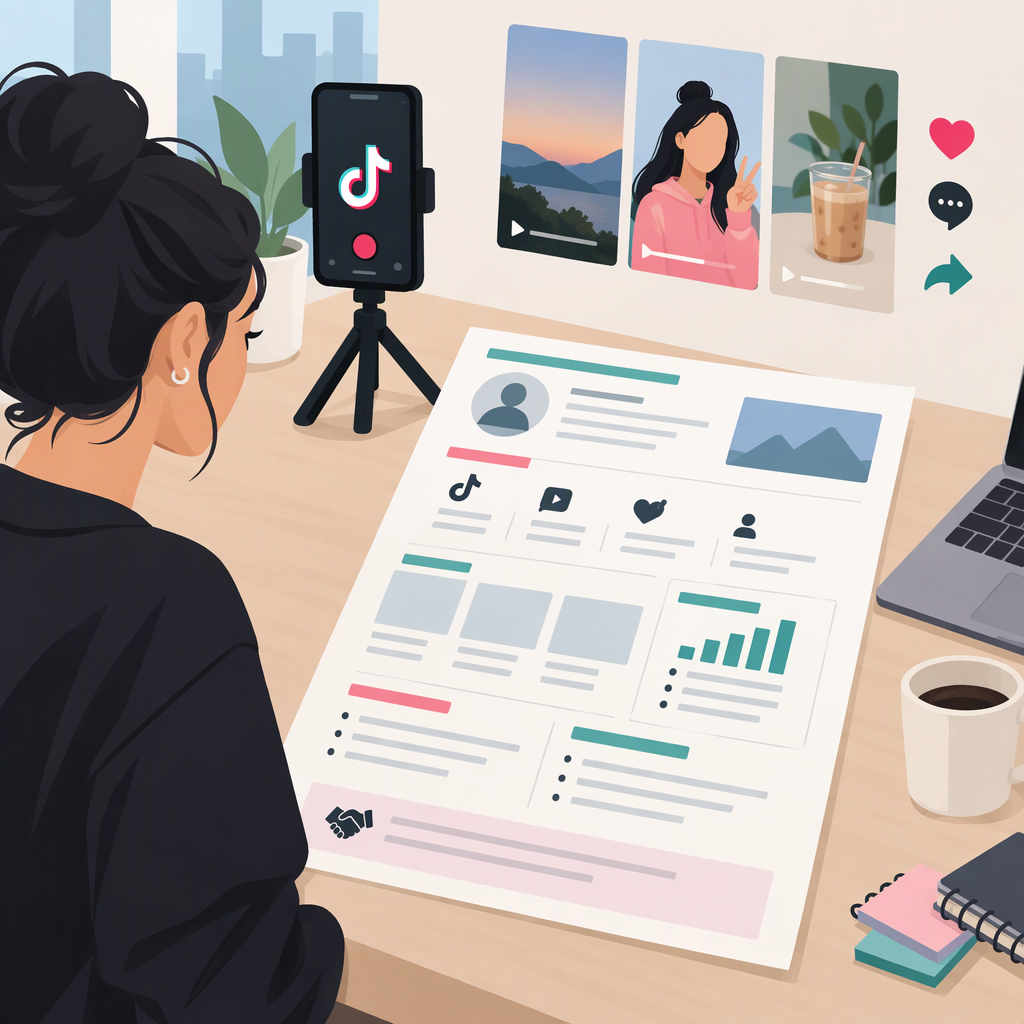
TikTok Media Kit Example: A Fill-In Template for Creators
A useful TikTok media kit gives a prospective brand partner a quick, accurate picture of your content, audience, and possible collaboration. There is no single required format established here; use the fill-in example below as a practical starting point, not an industry standard. Replace every bracketed item with information you can support, or remove the field if it does not apply.
TikTok Media Kit Example: A Fill-In Template
[Creator name or handle]
TikTok: [@handle or profile link]
Contact: [email or preferred business contact]
About
I create [type of content] for [describe the audience you actually reach or serve]. My videos focus on [two or three recurring topics, formats, or areas of expertise].
Account Snapshot
- Followers: [number], as of [date]
- Typical video performance: [metric name and figure], measured over [time period or sample]
- Audience information relevant to this partnership: [available audience detail, measurement period, and source]
Selected Content
- [Video or topic] — [brief description and a link]
- [Video or topic] — [brief description and a link]
- [Video or topic] — [brief description and a link]
Possible Collaboration
For [brand or relevant product category], I could explore [one or two realistic content ideas that fit your usual work]. These are ideas for discussion, not a claim that a campaign has happened or that it will achieve a particular result.
Contact
[Name] · [email] · [optional website or other public profile]
Example wording for a performance figure: “Across [number] recent posts published between [start date] and [end date], the [metric as labeled in your source] was [figure]. Source: [TikTok analytics or other named source], viewed [date].” This is a fill-in example, not a creator’s real performance.
Which Audience and Performance Details Should You Include?
Choose a small set of details that helps a particular partner understand your content and the evidence behind it. You might include account size, a clearly labeled performance figure, or audience information that is both relevant and available to you. Do not treat a follower count as proof that a campaign will reach that many people, and do not promise results based on past performance.
TikTok says TikTok Studio analytics can include total views, net followers, likes, and further insights, including information about individual posts. TikTok also notes that tool availability can vary between app and web experiences, that some features may not be available in every region, and that certain tools have eligibility criteria. Use the metrics actually available to your account, and check their labels rather than assuming every account has the same data. (support.tiktok.com)
For every number you share:
- Name what it measures. Use the label shown in the source; don’t relabel one kind of view, interaction, or audience figure as another.
- Add a date or measurement window. A figure without a timeframe can be hard to interpret.
- Explain the sample when it matters. If you report a figure for selected posts, say how many posts and which dates they cover. If it is a standout post, identify it as one post rather than implying it is typical.
- Keep the source clear. Say whether a figure comes from TikTok analytics or another source. Don’t present estimates as measured account data.
- Avoid unsupported comparisons. Don’t call a result “above average” or claim a typical benchmark unless you have a relevant, defensible comparison.
How to Tailor the Kit to a Prospective Brand
Start with the partner’s likely reason for considering a collaboration, then select the parts of your real work that are most relevant. For a brand seeking recipe content, for example, a creator might feature actual cooking videos and propose a recipe concept—if those genuinely reflect their channel. A creator whose work is mainly tutorials should not imply a history of product reviews just because a brand sells products.
Keep proposed ideas distinct from completed work. If you have not collaborated with a brand, describe what you could make; don’t imply a prior partnership, endorsement, or result. If you do include past work, identify it accurately and use results only when you can substantiate them.
A concise kit may be enough when your content and relevant figures are easy to understand. Add supporting detail when it helps explain a claim or a proposed collaboration. These are practical choices, not universal format rules.
Before Sharing
- Replace or delete every bracketed placeholder.
- Check that each figure matches its stated source, label, and date range.
- Separate a representative sample from a best-performing post.
- Make clear which ideas are proposals and which collaborations, if any, actually happened.
- Confirm your contact details and profile links are correct.
Rates, visual design, and file format can be handled separately if they are relevant to your situation; they are not required to make the example above useful.