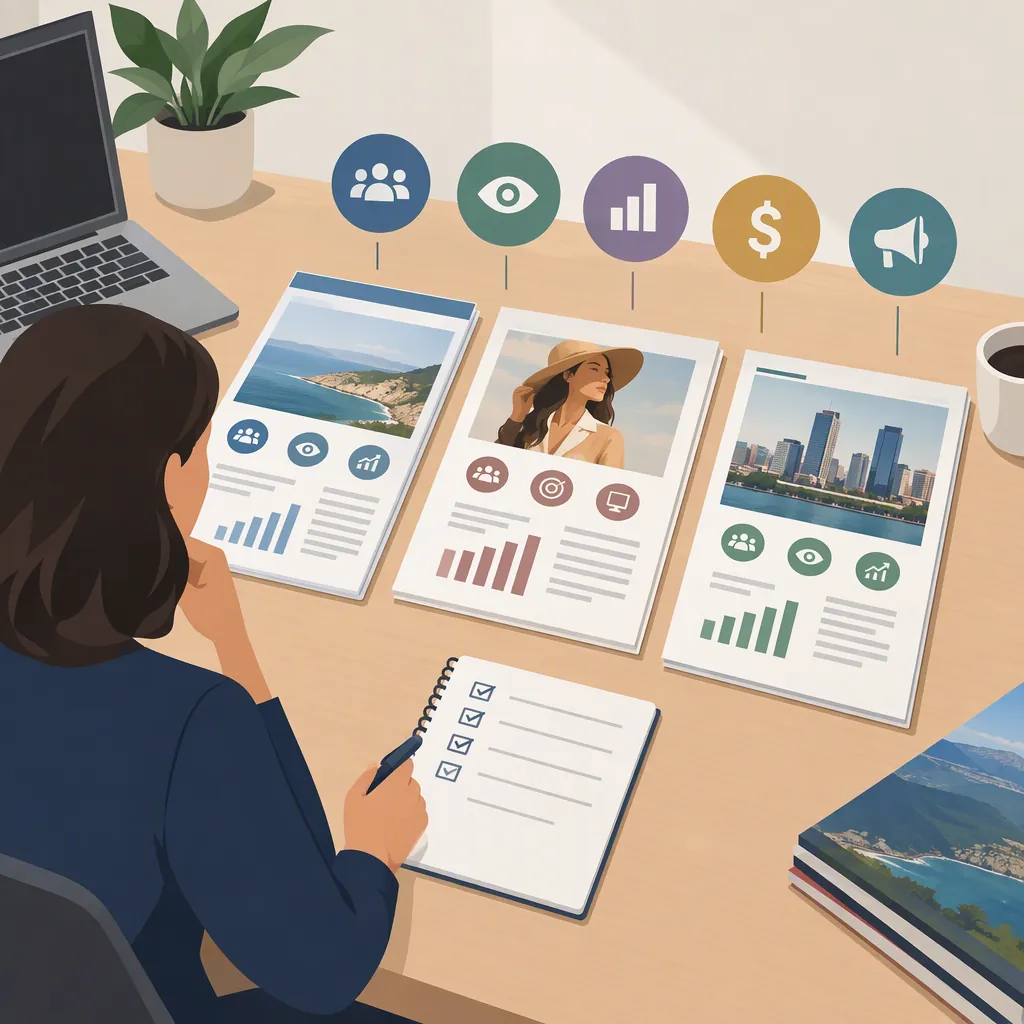
Magazine Media Kit Examples and Publisher Ad Kit Guidance
Useful magazine media kit examples illustrate different parts of a publisher ad kit: audience profiles, publication positioning, advertising options, and contact information. The supplied Wonderslide guide discusses examples from Entrepreneur, People, Inc., Fast Company, Glamour, and National Geographic. These are secondary-source descriptions, not independently verified current publisher kits; use them as structural references rather than evidence of current rates, reach, or availability. [c1]
What a Publisher Ad Kit Needs to Explain
For this article, a publisher ad kit means the advertiser-facing portion of a magazine’s media kit. Its organizing question is: what information would someone need to assess an advertising placement?
The supplied guide distinguishes a broad media kit, which can serve advertisers and partners, from a press kit focused on journalists and PR materials. It identifies reach, audience demographics, engagement metrics, advertising opportunities, and contact information as relevant media-kit content. [c1]
A practical advertiser-facing structure separates three subjects:
- Publication identity: editorial focus, subject areas, and audience context.
- Audience evidence: clearly labeled measures with sources and reporting periods.
- Placement details: available formats, production requirements, scheduling information, and the appropriate contact.
This is a suggested organization, not a claim that every magazine uses the same format. Brand imagery and publication history can supply context, but they should not substitute for the details needed to evaluate a placement.
Magazine Media Kit Examples by Information Type
The following comparison summarizes what the supplied Wonderslide guide highlights. It does not reproduce the publisher kits or establish that those materials remain current. All publisher-specific descriptions in the table come from that secondary source. [c1]
| Magazine | Element Highlighted by the Guide | Useful Comparison Question |
|---|---|---|
| Entrepreneur | Audience demographics and separate slides for different advertising types | Can a reader distinguish audience information from placement options? |
| People | Audience information for potential partners | Are audience figures defined and relevant to the proposed placement? |
| Inc. | Visuals, contact details, simplicity, and organization | Can a reader locate the next necessary detail without searching through decorative pages? |
| Fast Company | A brief company overview | Does the opening explain the publication’s focus clearly? |
| Glamour | A story about its sustainability commitment | Is publication positioning clearly separated from advertising deliverables? |
| National Geographic | A “Walk of Fame” presenting accomplishments and awards | Are reputation signals identifiable as background rather than campaign-performance evidence? |
These examples are useful for comparing information architecture, not for ranking publishers. An audience slide, an advertising-format page, and a publication-history page serve different purposes. A stronger review asks whether each page answers its intended question rather than whether the whole document looks impressive.
How to Evaluate an Example Without Overreading It
Treat a media kit as a document to inspect, not as independent proof of every assertion it contains. For each audience figure, look for a definition, reporting period, source, and channel. Keep circulation, readership, website users, newsletter subscribers, and social followers separate unless the document explains how they are combined.
Likewise, distinguish a publication’s past recognition from evidence about a particular advertising placement. An award or editorial mission statement does not, by itself, establish campaign outcomes.
The supplied guide recommends keeping media kits updated and tailoring information to the intended audience. [c1] The checklist below turns those general recommendations into a repeatable review method. It is an editorial aid, not an industry certification or scoring standard.
Publisher Ad Kit Review Checklist
- [ ] Record the document title, version date, and review date.
- [ ] Identify the publication and channels covered.
- [ ] Record each audience metric with its unit, period, and stated source.
- [ ] Flag missing definitions or unexplained combined totals.
- [ ] Separate editorial positioning from advertising deliverables.
- [ ] List each placement and its stated availability.
- [ ] Check dimensions, file requirements, deadlines, and approval terms where supplied.
- [ ] Note whether pricing is published, dated, or available only on request.
- [ ] Check that the relevant contact is identifiable.
- [ ] Mark unresolved information as unknown rather than estimating it.
A Neutral Publisher Ad Kit Outline
The outline below is an original planning template, not an example from a named magazine. Bracketed fields are placeholders, not publisher facts. Leave unavailable information explicitly unresolved rather than inserting plausible-looking figures.
A short kit can use this order without assigning one page to every item. A longer kit can separate print, website, newsletter, and other channels so that audience measures and production requirements remain easy to distinguish.
The supplied guide supports concise content, advertiser-specific information, accessible digital materials, and clear contacts. [c1] The detailed fields below are suggested additions for organizing an ad-placement review; they are not verified requirements of the magazines discussed above.
Fill-In Publisher Ad Kit Outline
1. Publication Overview
   - Publication: [name]
   - Editorial focus: [description]
   - Channels covered: [list]
   - Kit version: [date]

2. Audience Evidence
   - Metric: [name and unit]
   - Channel: [channel]
   - Reporting period: [period]
   - Source or methodology: [source]
   - Limitations: [known limitations]

3. Advertising Inventory
   - Placement: [name]
   - Included deliverables: [description]
   - Availability: [confirmed information or unknown]

4. Production and Scheduling
   - Dimensions and file requirements: [specifications]
   - Submission and approval dates: [dates]
   - Applicable restrictions: [terms]

5. Commercial Information
   - Pricing status: [published, on request, or unavailable]
   - Effective period: [dates or unknown]
   - Included and excluded items: [details]

6. Contact and Supporting Materials
   - Contact role: [role]
   - Verified contact details: [details]
   - Supporting documents: [document names]
   - Unresolved questions: [list]
Source Limits and Visual Inspiration
The supplied evidence consists of a general media-kit guide and a Pinterest ideas page. The Pinterest excerpt lists categories including magazine, brand, business, and influencer, but provides no substantive publisher-kit details. It therefore cannot verify rates, audience measurements, specifications, or current advertising inventory. [c2]
The Wonderslide guide provides the publisher-specific descriptions used here, but the supplied references do not include the magazines’ own kit URLs. [c1] This article consequently offers a comparison framework rather than a directory of verified current downloads.
Visual inspiration and commercial evaluation should remain separate. Layout ideas may help organize a document; decisions about a specific placement require current, attributable information for that placement.
FAQ
Which Magazine Media Kit Examples Are Discussed Here?
The supplied Wonderslide guide discusses Entrepreneur, People, Inc., Fast Company, Glamour, and National Geographic. This article compares the elements that guide highlights, not independently verified current versions of those publishers’ kits. [c1]
Is a Publisher Ad Kit the Same as a Press Kit?
Not in the distinction used here. A publisher ad kit organizes information for advertising assessment, while a press kit focuses on journalists and PR needs. The supplied guide similarly describes a media kit as broader than a press kit because it can also serve advertisers and partners. [c1]
Do These References Establish Current Magazine Advertising Rates?
No. The supplied guide discusses media-kit content and examples, while the Pinterest excerpt provides only limited category information. Neither supplied excerpt establishes current magazine advertising rates. Treat pricing and availability as unresolved until supported by current publisher documentation. [c1] [c2]