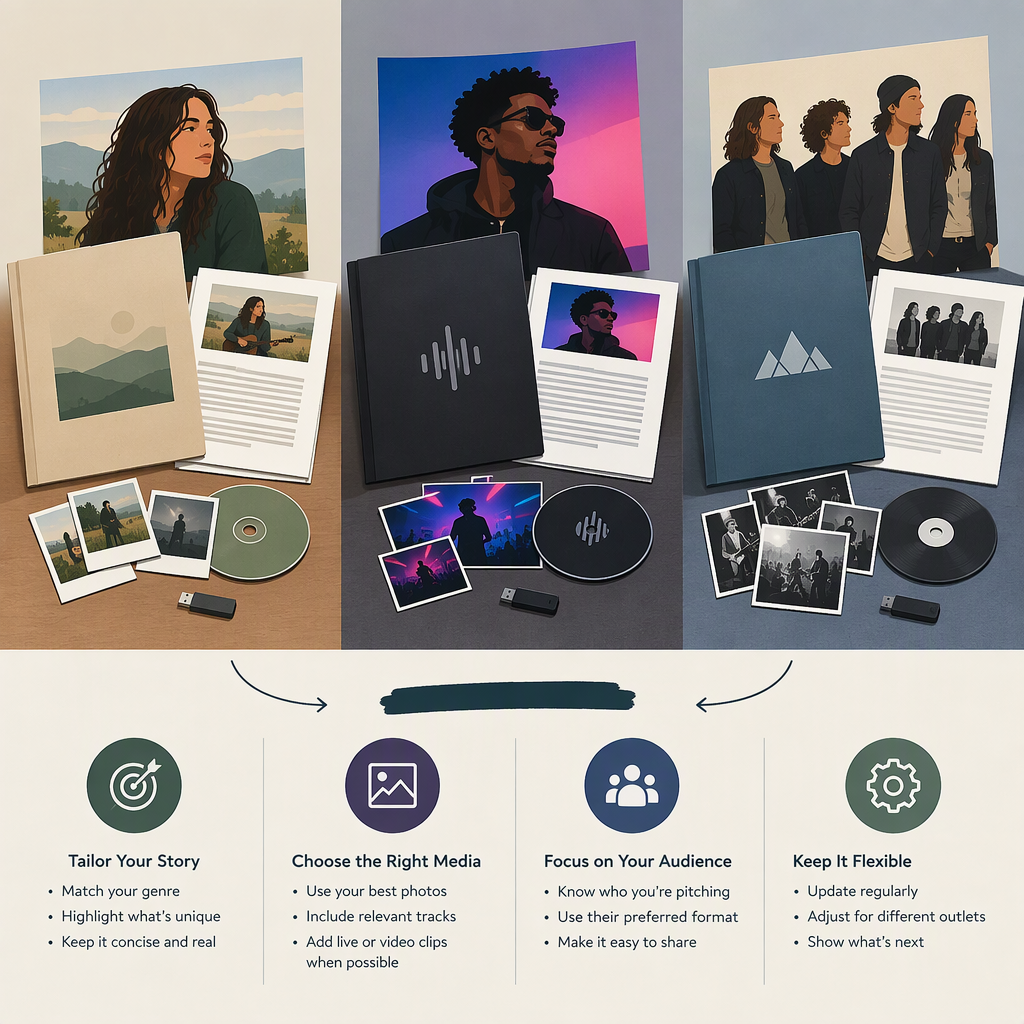
3 Music Artist Press Kit Examples—And What to Adapt
A music artist press kit, or EPK, can take different forms: a web page that puts music and key details up front, a collection of downloadable media assets, or a live-performance kit with practical booking materials. These three examples show those differences. Use them as references—not as one required format—and adapt only the parts that fit your intended recipient and your own verified materials.
Music Artist Press Kit Examples
1. 0Stella: A Music-First Web Epk
Open 0Stella’s press kit. An August 2026 review by music-industry resource Orphiq describes a short sound-positioning line and fact strip near the top, followed by a five-track player; the bio comes below the player. It also reports short, outlet-attributed press quotes and downloadable photos in several orientations, with dimensions and file sizes listed. The page may have changed since that review, so treat the description as a dated snapshot, not a guarantee of what is there now. (orphiq.com)
What to notice: The reported order puts a quick description and music before a longer biography. If you borrow that information hierarchy, make sure the featured tracks represent what you are pitching; do not copy the artist’s wording, claims, or materials.
2. Alan Walker: A Download-Focused Press Kit
Open Alan Walker’s official press kit. The official-site listing describes downloadable press materials, photos, logos, and a biography for media use. This is a different model from a page centered on listening: the emphasis, as described on the page, is on press-ready assets that media can access. (alanwalker.com)
What to notice: If your recipient needs approved images or a biography for publication, clear asset labels and easy downloads may matter more than adding many sections. Share only materials you have the right to distribute, and identify images and credits clearly.
3. Sound Investment Band: A Live-Act Kit with Practical Files
Open Sound Investment Band’s press kit. Its page lists a promo video, direct booking contact, home base and genre, downloadable full and snapshot bios, a stage plot, a sample song list, logo, and promotional photos with pixel dimensions. It also offers downloadable demo tracks. (soundinvestmentcc.com)
What to notice: This example includes materials connected to live performance and booking, such as a stage plot and song list, alongside introductory and promotional items. Those details may be useful for a live-show pitch; they are not automatically necessary for a release-focused media pitch.
What These Examples Show—And What They Don’t
Across the examples, the format and materials differ. The 0Stella description emphasizes music, a concise introduction, press quotes, and downloadable photos; Alan Walker’s official listing emphasizes press assets; Sound Investment’s page includes booking contact and performance-related files. These are observations about the cited pages, not proof that every EPK needs all of those items—or that any particular layout produces better results.
A practical starting point is to ask what the recipient needs to assess or use:
- For a release or music-press pitch: consider featuring the release or representative tracks, a concise artist introduction, and relevant images. CD Baby’s guide recommends putting music near the top and tailoring track selection to the pitch; it also advises making promotional images easy to download and providing only images you have permission to share. (diymusician.cdbaby.com)
- For a live-booking pitch: consider whether a performance video, upcoming-show information, booking contact, or technical materials are relevant. Sound Investment’s page illustrates one kit that includes several such practical items; it does not establish a universal booking checklist. (soundinvestmentcc.com)
- For media use: prioritize accurate, approved assets and any context or credits a publisher may need. Alan Walker’s press-kit listing is one example of a page focused on downloadable press materials. (alanwalker.com)
These are purpose-led suggestions, not mandatory components. CD Baby describes an EPK as a way to bring information and assets together, while recommending that artists choose what is relevant to the pitch. (diymusician.cdbaby.com)
How to Choose and Adapt an Example
- Name the purpose and recipient. A journalist, venue, festival, or other contact may need different information. Don’t assume an example’s audience unless its own page or a reliable description establishes it.
- Compare the relevant examples. Look at what appears first, how the music is presented, whether useful files can be downloaded, and how the contact route is shown. Separate what you can observe from what you’re guessing about the artist’s intent.
- Select only materials you can stand behind. Use current track links, accurate biography details, approved images, and real credits or press quotations. If a section does not help with the purpose you identified—or you do not have reliable material for it—leave it out rather than padding the kit.
- Check the recipient’s instructions. If a venue, publication, festival, or other recipient specifies a format or submission requirements, follow those rather than treating a public example as a template.
- Review the finished kit as a recipient would. Confirm that links and downloads work, information is current, and the most relevant material is easy to find. A public example can inspire a structure; it cannot verify your facts or guarantee a response.
The useful lesson from these press kit examples is not that every artist needs the same checklist. It is that an EPK can be organized around a particular use: listening, media assets, or live-performance information. Choose the example whose visible structure best fits your goal, then adapt the organization—not another artist’s content.