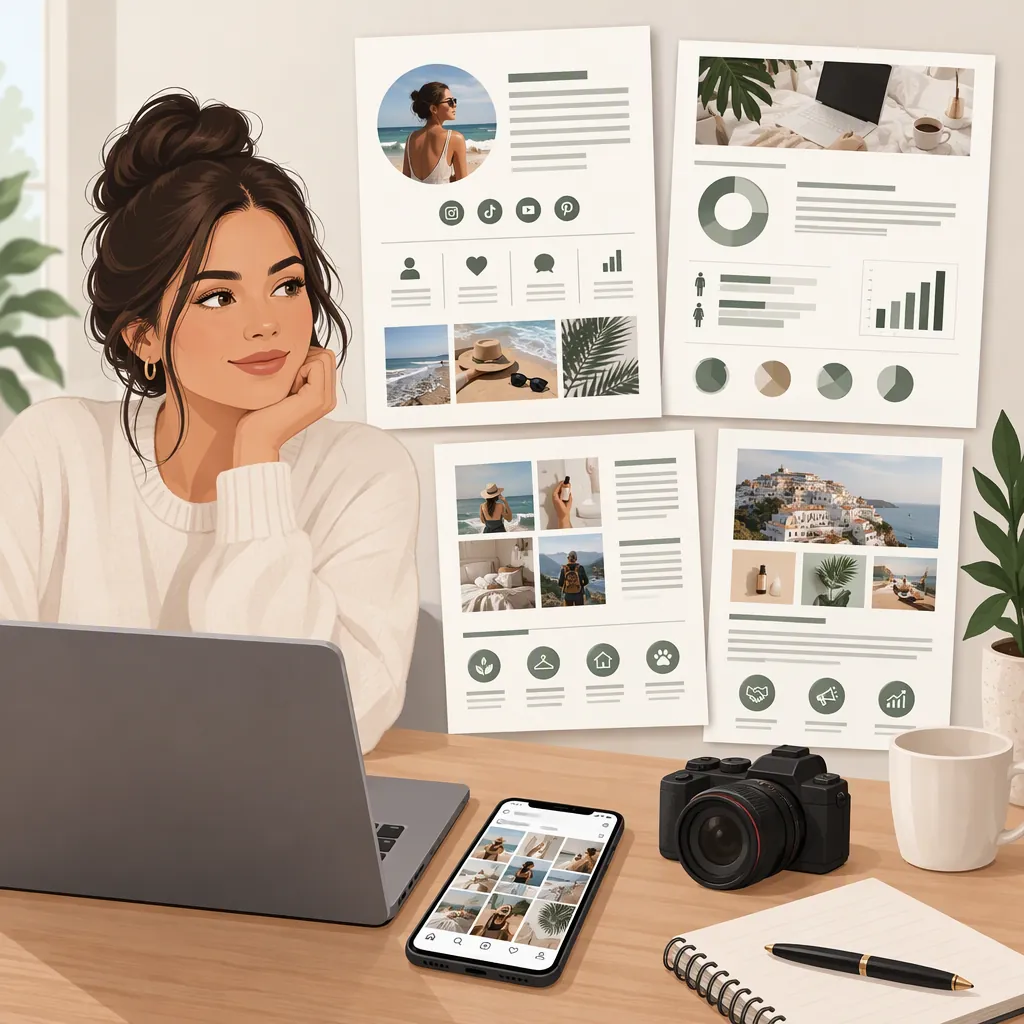
Instagram Influencer Media Kit Examples and Adaptable Outlines
Instagram influencer media kit examples include concise one-page introductions, longer work portfolios, and kits featuring audience analytics or campaign case studies. Business Insider describes one-page kits from Tess Barclay and Eric Stoen, content examples from Brianna Seaberg, and case studies from Marina Mogilko. These are historical examples, not current performance benchmarks. The outlines below are original educational templates, not reproductions of those creators’ kits. [c1]
Reported Instagram Creator Media Kit Examples
A useful way to study media kits is to compare what each example emphasizes rather than copy its appearance. Business Insider’s roundup describes the following approaches. Dates below refer to when the publication obtained the kits, not when their information was last verified. [c1]
| Creator | Reported Kit Emphasis | Possible Adaptation |
|---|---|---|
| Tess Barclay | A simple, one-page media kit, obtained in May 2022. | Use a compact introduction when a longer portfolio is unnecessary. |
| Eric Stoen | A one-page kit intended as a brief introduction, with additional information available on his website; obtained in June 2022. | Keep the summary short and separate supporting work from the main page. |
| Stacy Kim | A short biography, engagement statistics, contact information, and past collaborations; obtained in February 2023. | Pair a concise introduction with clearly labeled audience evidence. |
| Brianna Seaberg | Information about herself, previous collaborations, and content examples; obtained in May 2023. | Include selected work so readers can assess content style. |
| Marina Mogilko | Channel categories, audience analytics, and campaign case studies; obtained in May 2020. | Separate content themes, audience information, and campaign evidence. |
The reported features in this table come from the roundup; the suggested adaptations are editorial guidance. The supplied source does not establish every kit’s full layout or current contents. Its page also identifies the story as subscriber-only, so this article does not claim to have independently inspected the linked full kits. [c1]
Choose a Format Based on Available Evidence
There is no single length established by these examples. The roundup describes one-page kits, Jour'dan Haynes’s three-page kit, and Alexa Collins’s eight-page kit. That variation shows different approaches, not proof that a particular page count produces better results. [c1]
For an original kit, consider these editorial options:
- One-page overview: Use when a biography, audience snapshot, selected work, and contact details fit comfortably without tiny text.
- Short portfolio: Add space when content samples need explanation or several platforms need separate labels.
- Case-study supplement: Add a separate page when you have documented campaign results and permission to share them.
Choose the shortest format that keeps your evidence understandable. A longer document should add context, not repeat the same audience numbers.
If you have no completed brand collaborations, use your own published work as content samples. Label it as independent work rather than implying that a brand commissioned, approved, or paid for it.
An Original One-Page Media Kit Outline
The following outline combines an introduction, audience evidence, and selected work. Those elements appear in several kits described by Business Insider, but this outline is not a copy of any creator’s document. [c1]
Replace every placeholder with information you can verify. Remove any field you cannot support rather than filling it with an estimate presented as fact. Keep Instagram metrics separate from other platforms, and date the audience snapshot.
Treat content formats as a description of what you can produce, not a promise of reach or sales. If you include pricing, state the deliverables and scope it covers instead of presenting an unexplained package price.
Copyable One-Page Outline
# [Creator Name] — Instagram Media Kit

Updated: [Date]
Instagram: [Handle]

## Creator Overview
[Two sentences describing your content themes, perspective, and intended audience.]

## Audience Snapshot
- Followers: [Verified count and snapshot date]
- Audience geography: [Supported breakdown and data source]
- Audience demographics: [Supported breakdown, or omit]
- Content performance: [Metric, format, measurement period, and sample size]
- Engagement calculation, if used: [Formula and denominator]

## Selected Work
- [Published sample title or identifier]: [Your role and what the sample demonstrates]
- [Published sample title or identifier]: [Your role and what the sample demonstrates]

## Available Content Formats
[Formats you can produce, with brief scope descriptions.]

## Collaboration Evidence
[Verified past work and permission status, or omit if unavailable.]

## Business Contact
[Verified business email in plain text]
An Original Campaign Case Study Outline
Business Insider describes campaign case studies and audience analytics in Marina Mogilko’s kit. That provides a reported example of using past work as evidence, but it does not establish a universal case-study format. [c1]
For your own case study, separate the assignment, your contribution, and the measured outcome. Reach, interactions, clicks, and sales are different measures; do not use one as a substitute for another. If sales attribution is unavailable, say so rather than calling the campaign a sales success.
Avoid implying that a media kit caused a collaboration or that content caused an outcome unless you have evidence for that specific conclusion. Historical creator examples also should not be treated as current rate cards.
Copyable Campaign Evidence Outline
# [Campaign or Project Name]

## Context
- Project dates: [Start and end dates]
- Relationship: [Paid collaboration, gifted collaboration, or independent work]
- Objective: [Documented objective]
- Disclosure permission: [What may be shared publicly]

## Your Contribution
- Deliverables: [Formats and quantities]
- Responsibilities: [Concept, production, editing, publishing, or other verified work]
- Published work: [Public sample identifiers]

## Results
- Metric: [Exact metric name]
- Result: [Verified value]
- Measurement period: [Dates]
- Source: [Analytics export or authorized report]
- Distribution context: [Organic, paid, mixed, or unknown]

## Limitations
[Unavailable attribution, incomplete data, or other relevant constraints.]

## Supported Takeaway
[One conclusion justified by the evidence above, without promising future results.]
Review Metrics, Permissions, and Readability
The reported examples include audience demographics and engagement statistics, making metric clarity a useful review priority. [c1] The following checklist is editorial guidance, not an Instagram requirement:
- Date the numbers. Identify the snapshot date and performance measurement period.
- Define calculations. For an engagement rate, state the interactions counted and the denominator used.
- Separate formats. Avoid combining unlike measures into an unexplained average.
- Label relationships accurately. Distinguish paid, gifted, and independent work.
- Check sharing permissions. Exclude private correspondence, confidential results, and audience-level personal information.
- Use readable evidence. Provide text labels alongside charts or screenshots, and remove unrelated private details.
- Verify contacts. Include only an accurate business contact intended for public distribution.
- Remove unsupported claims. Replace broad promises with specific, dated evidence.
A final review should make it possible to distinguish what you create, who your audience is, what work you have completed, and what the available data actually supports.
FAQ
How Many Pages Should an Instagram Media Kit Have?
The source reports formats ranging from one page to eight pages; it does not establish an optimal length. As editorial guidance, use one page for a concise overview and add pages only when samples or documented case studies need more context. [c1]
Are There Media Kit Examples from Small Instagram Creators?
Yes. Business Insider includes historical examples from creators with relatively small Instagram audiences, including Kayla Compton and Stacy Kim. Their inclusion shows that media kits are not limited to large accounts; it does not establish a minimum follower requirement or guarantee collaborations. [c1]
Do Instagram Media Kits Need to Include Rates?
The roundup says creators sometimes include pay rates, so pricing is not presented as a universal feature. If you choose to include rates, this article recommends defining the deliverables, usage scope, and assumptions. Historical rates in the source should not be treated as current pricing benchmarks. [c1]
Are These Templates Copies of the Creators’ Media Kits?
No. The templates are original educational outlines. The creator descriptions are based on Business Insider’s reported summaries, not independent inspection of the full kits or verification of their current contents. [c1]