When a Sponsor Offers Product Instead of Cash: How to Evaluate the Deal
Think free product offers are always a waste of time?
Here is something that might surprise you: occasionally, a product-only deal makes real financial sense. The important question is whether the requested work and rights make sense for you.
So how do you decide when to say yes and when to pitch a paid rate?
Here is the bottom line: Consider a product-only offer when the product is genuinely useful to you and the requested work and rights are small enough to justify it. Set your own boundaries before agreeing.
Before accepting any unpaid offer, run it through this quick checklist:
- True Utility: Does the product directly replace an out-of-pocket expense you planned to buy anyway?
- Production Effort: How much time will production, review and publishing take?
- Usage Rights: Are rights restricted strictly to organic posts on your personal feed (with no ad whitelisting or ad usage)?
- Category Exclusivity: Does the offer leave your account open to take paid deals in the same niche later?
If an offer fails even one of these checks, you should either pivot to a paid rate or pass.
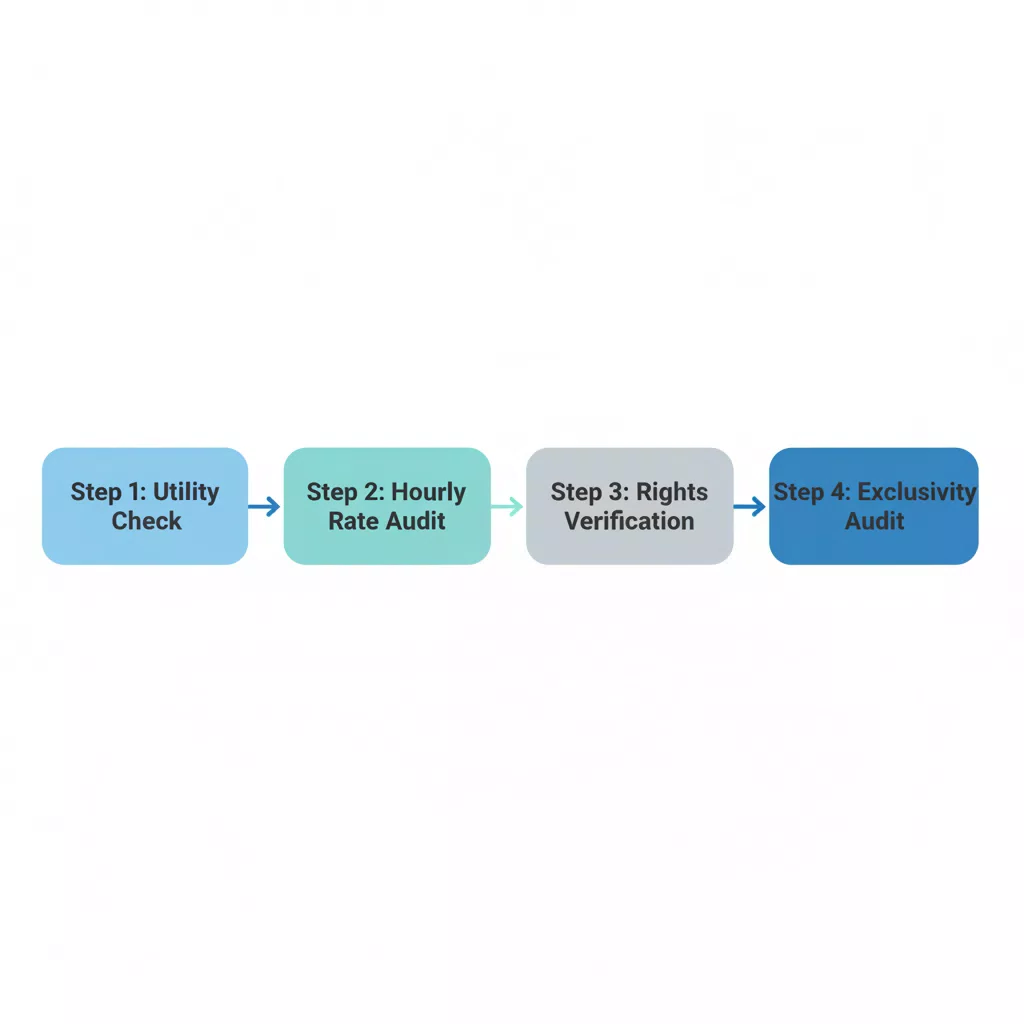
Here is the step-by-step decision framework to evaluate gifted offers, audit usage rights, and turn free product pitches into paid deals.
The 4-Step Decision Framework for Gifted-Product Offers
When a brand reaches out offering "free product in exchange for a post," it is easy to feel flattered. But free product does not pay your rent.
To make smart business choices, you need a quick system to filter out bad offers and protect your time.
Calculate True Product Utility Vs. Retail Value
Never evaluate a deal based on the item's MSRP. A high sticker price does not equal cash in your bank account.
Instead, calculate the item's True Product Utility. Ask yourself one question: Would I buy this exact item with my own cash within the next 30 days if the brand didn't give it to me?
- Direct Replacement: If a brand offers a $300 microphone that you were already planning to purchase this week, that gift may avoid up to $300 of a planned personal expense; it is still not cash income.
- Unneeded Luxury: If a brand offers a $500 designer jacket that you would never buy on your own, its utility value is $0. You cannot pay your internet bill with a coat.
Audit Deliverable Scope and Operational Hours
Once you know the true utility value, compare the personal-use value per hour with the time required to produce, edit, publish, and manage the content. This is a decision aid, not a cash hourly rate or a fee you can spend.
Here is how the math breaks down across different scenario types:
| Offer Type | Estimated personal-use value (not cash) | Production & editing hours | Personal-use value per hour (not cash) |
|---|---|---|---|
| Scenario A: High effort / low utility | $0: an unneeded $50 skincare set | 4 hours (script, shoot, edit) | $0 / hr |
| Scenario B: Medium effort / moderate utility | Up to $150: a camera light you planned to buy | 3 hours (unboxing + story) | Up to $50 / hr |
| Scenario C: Low effort / high utility | Up to $400: a monitor you planned to buy | 0.5 hours (quick organic mention) | Up to $800 / hr |
These ratios help compare offers, but none of them pays your bills. If the work requires a cash fee, quote that fee separately; if the product does not replace a purchase you would make, its personal-use value may be close to zero.
Evaluate Usage Rights and Perpetual Licensing Risks
Brands often hide massive commercial requests inside gifted agreements. Never grant ad whitelisting or expansive usage rights for free items.
If a brand wants to put ad spend behind your video or post it on their own commercial website, that requires cash payment. Free products cover organic personal feed placement only.
Assessing Opportunity Cost and Audience Fatigue
Every unpaid post you publish carries a hidden financial penalty. Your content calendar has limited real estate, and your audience has limited attention.
Analyze Exclusivity Clauses and Category Locks
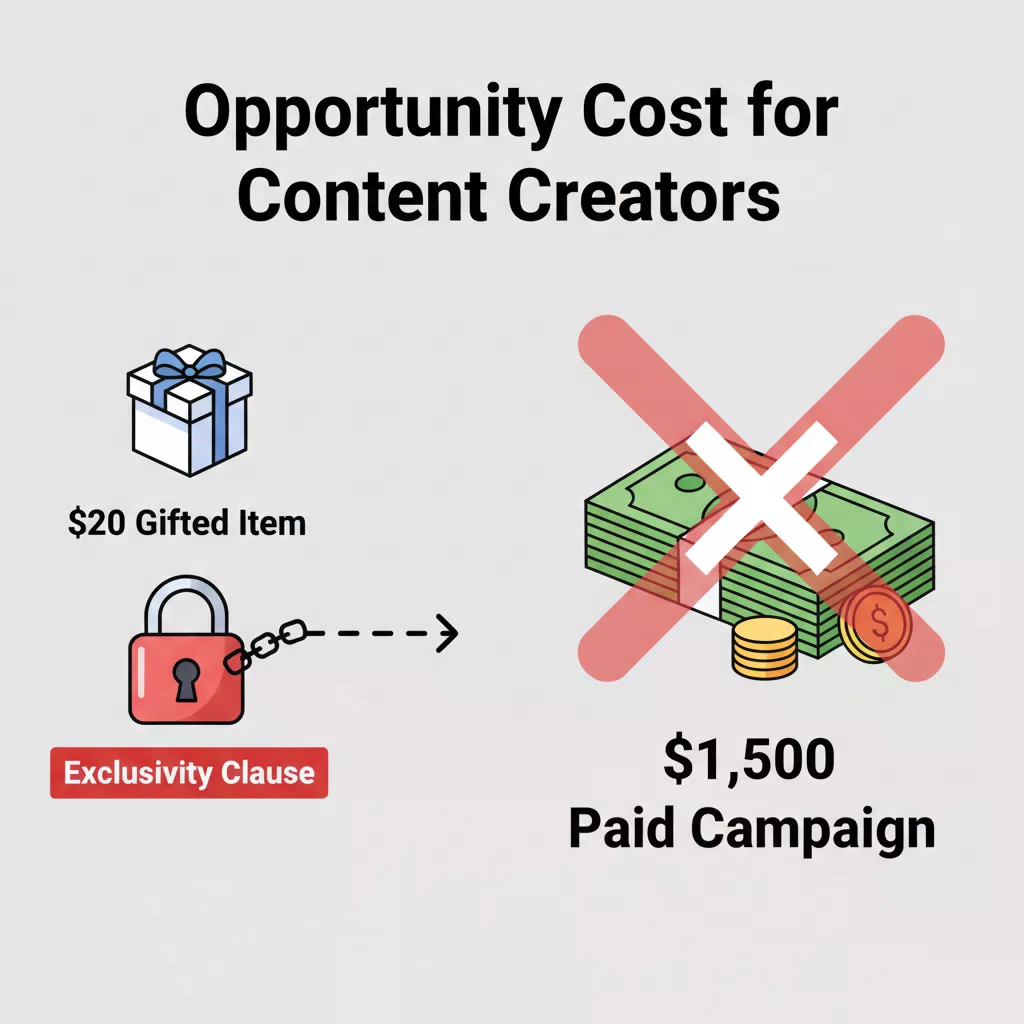
Be extremely careful with category exclusivity clauses. An exclusivity clause forbids you from working with competing brands in the same niche for a set period.
Illustrative Scenario: Imagine accepting a gifted $20 organic lip balm. If the contract includes a 90-day beauty exclusivity clause, you legally cannot accept a $1,500 paid campaign from a major cosmetics line during those three months. Accepting that $20 item just cost you $1,480 in lost revenue.
Always strike out exclusivity clauses in product-only agreements.
Establish Hard Boundaries for Unpaid Content Slots
Publishing too many sponsored or gifted reviews dilutes your credibility. Your followers will notice if your feed turns into a continuous commercial stream.
Set a hard monthly cap. For instance, limit your account to a maximum of two gifted items per month, and only when they hit your highest utility criteria.
Response Templates for Converting Gifted Pitches into Paid Deals
Most brands pitch gifted products simply to see if you will work for free. You can politely pivot these pitches into paid packages.
Template: Pivoting Product Proposals to Paid Sponsorship Packages
Use this response when a brand offers a gifted product, but you require cash compensation for dedicated content creation:
Example Pivot Response: "Hi [Brand Name] Team,
Thank you for reaching out! I love your line of [product type] and would be excited to feature [Product Name] on my channel.
Because of the production time and audience engagement required for a dedicated post, I am currently only accepting gifted items alongside paid sponsorship packages. My integration rates start at $[Your Base Rate] for an organic dedicated feature.
I would love to send over my media kit and recent performance metrics to see if we can build a campaign together! Let me know if that works for your budget.
Best, [Your Name]"
Template: Accepting Product Seeding Without Guaranteed Deliverables
If you want the product but refuse to guarantee posts or commit to deliverable deadlines, send a clear no-strings statement:
Example Seeding Response: "Hi [Brand Name] Team,
Thank you so much for offering to send over [Product Name]! I would love to try it out.
You can send the package to: [Your Mailing Address]
Please note that I receive gifted items on a no-obligation basis. I only share products on my feed if they genuinely fit into my daily routine, so I cannot guarantee coverage or specific timelines. If you are looking for guaranteed content deliverables and full commercial rights, I would be happy to share my paid rate card!
Warmly, [Your Name]"
Compliance and Administrative Workflow for Gifted Collaborations
Working with gifted products still requires professional legal compliance and disciplined record-keeping.
Apply FTC Endorsement Disclosures for Gifted Items
The Federal Trade Commission requires clear disclosures whenever there is a financial or material relationship between a creator and a brand. A free product counts as a material relationship.
- Visual Clear Callouts: Place
#giftedor#adat the very beginning of your caption text, before the "More" button cut-off. - Verbal Announcements: If posting a video story or video clip, state clearly out loud: "Brand X sent me this item for free to try out."
- No Hidden Hashtags: Avoid burying
#giftedinside a block of twenty generic tags at the bottom of the post.
Streamline Brand Deal Tracking and Communication
Managing dozens of brand emails, product shipping numbers, and pitch counters manually drains hours every single week.
Using CreaSeed allows creators to centralize pitch evaluation, account valuations, and brand messages inside a unified chat interface. Instead of spending twelve hours a week manually drafting counters and logging offers, you can quickly evaluate product value, generate negotiation responses, and track your deal pipeline without missing revenue opportunities.
For any requested reposting or advertising rights, use the creator usage rights checklist before agreeing. CreaSeed can help keep the offer, your reply and the follow-up in one creator business workflow.
Decision Summary for Gifted Vs. Paid Sponsorships
Before signing or agreeing to any product-only offer, run down this quick checklist:
- Utility Test: Does this item directly replace a planned cash purchase?
- Hourly Wage Check: Does the utility value divided by production time equal an acceptable rate?
- Zero Exploitative Rights: Are usage rights, whitelisting, and exclusivity strictly removed?
- Clear Boundaries: Have you disclosed the gift properly and protected your calendar from audience fatigue?
When in doubt, pivot to paid rates or keep your content slots open for higher-value opportunities.