Two Brand Offers for the Same Week: How to Choose the Better Deal
How to Pick the Best Deal When Deadlines Overlap
When two brands want the exact same publishing slot, picking the offer with the bigger upfront payout is often a trap.
To find the true winner, you need to calculate your effective hourly rate by factoring in total production hours, revision limits, usage rights, and category exclusivity restrictions—not just the upfront flat fee.
For example, a $1,500 deal requiring 12 hours of labor and 90 days of strict niche exclusivity works out to $125 per estimated hour before expenses and tax while locking you out of future sponsorships. Meanwhile, a $900 deal taking only 4 hours with zero exclusivity works out to $225 per estimated hour before expenses and tax and leaves your calendar open for additional income.
Quick Comparison
| Metric | Offer A (High Upfront) | Offer B (Low Restrictions) |
|---|---|---|
| Upfront Fee | $1,500 | $900 |
| Labor Hours | 12 hours (3 revision rounds) | 4 hours (1 fast review) |
| Category Exclusivity | 90 Days (Locked) | None (Open) |
| Effective Hourly Rate | $125/hr | $225/hr |
| Other considerations | Exclusivity may limit future work | Fewer stated restrictions |
Here is the exact 5-point framework and decision matrix to evaluate competing brand proposals in under 10 minutes without burning relationships.
The 5-Point Offer Evaluation Framework
Evaluating a sponsorship proposal requires looking past the gross fee. To protect your earnings and schedule, you must evaluate five hidden variables: total labor hours, revision scope, usage rights, category exclusivity, and opportunity cost.
Calculating Effective Hourly Rate and Production Scope
In this example, Offer A's $1,500 flat payout covers 12 hours of scripting, filming, revisions, and communication. That is $125 per hour before expenses and tax. To get your effective hourly rate, divide the total payout by every single hour spent on the deal.
That means counting total time spent across four distinct phases:
- Pre-production: Scripting, mood boards, and concept approval.
- Production: Setup, lighting, filming, and editing.
- Revisions: Reviewing brand notes, re-shooting, and re-editing.
- Administration: Emailing contracts, invoicing, and checking links.
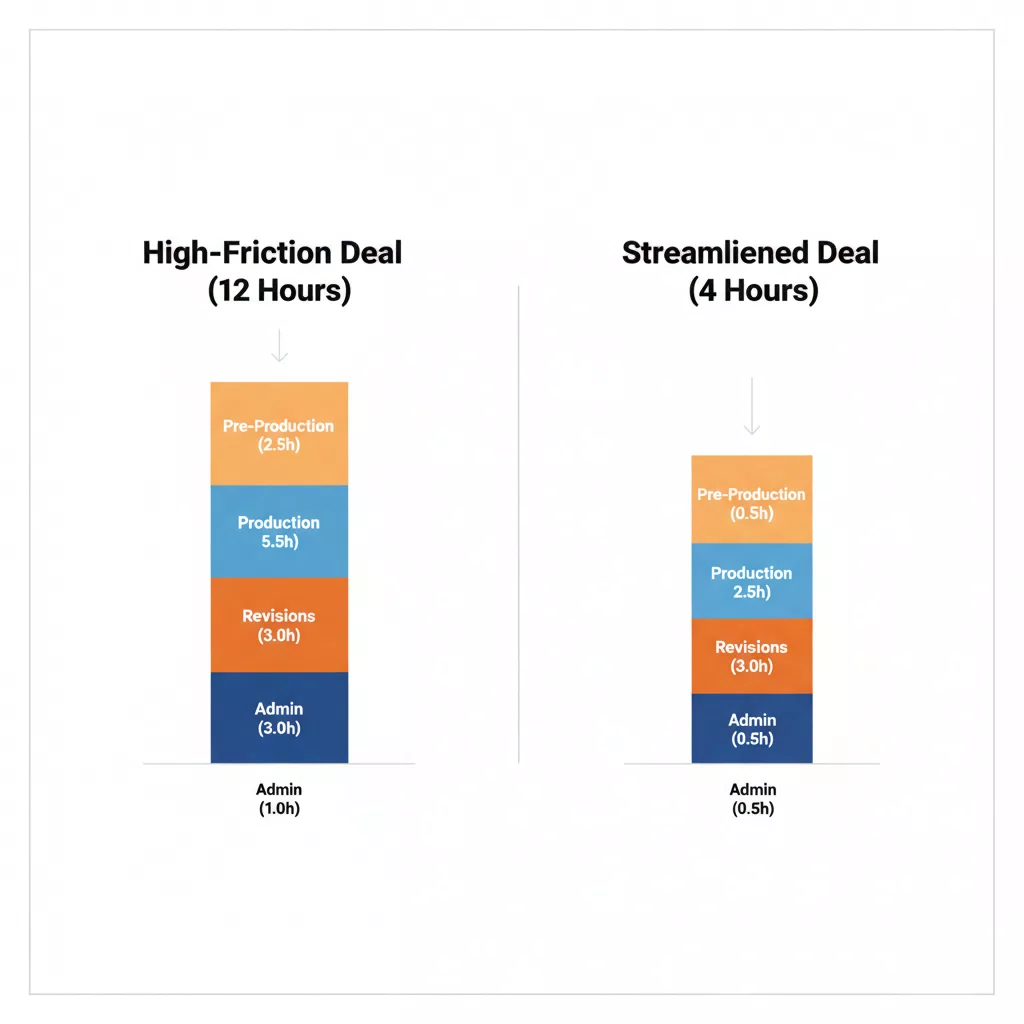
| Production Phase | High-Friction Deal (Hours) | Streamlined Deal (Hours) |
|---|---|---|
| Concept & Brief Review | 2.5 | 0.5 |
| Filming & Editing | 5.5 | 2.5 |
| Revision Rounds | 3.0 | 0.5 |
| Admin & Communication | 1.0 | 0.5 |
| Total Labor Hours | 12.0 hours | 4.0 hours |
When you map out your calendar, short review turnarounds and capped revisions preserve your hourly income.
Evaluating Usage Rights and Exclusivity Penalties
The biggest financial traps in sponsorship contracts are hidden legal restrictions.
A strict exclusivity clause prevents you from accepting sponsored deals from competitor brands within your niche for 30, 60, or 90 days. If a skincare brand pays $1,500 but locks you out of signing three other $1,000 skincare deals over the next quarter, that contract actually cost you $1,500 in net revenue.
Similarly, granting paid whitelisting rights allows a brand to run paid ads directly from your account. If you grant perpetual ad permissions without extra licensing fees, you sell away valuable account equity for free.
Worked Example: Comparing Two Competing Offers
Let's walk through a realistic scenario with two beauty brands reaching out for the exact same launch date next Friday.
Offer A: $1,500 Flat Fee with Heavy Exclusivity
Brand A offers $1,500 for a single 60-second integrated YouTube video segment.
The catch? Their contract requires:
- 3 rounds of mandatory revisions.
- 90 days of strict category exclusivity across all personal care products.
- Full paid whitelisting rights for 60 days across Meta platforms.
Offer B: $900 Flat Fee with Minimal Restrictions
Brand B offers $900 for a single 60-second organic integration.
Their terms are minimal:
- 1 standard revision round limited to factual errors.
- Zero category exclusivity.
- Organic posting only with no paid usage rights.
The Verdict: Why Offer B May Fit Better
On paper, Offer A looks like it pays $600 more. But let's run the actual math.
- Offer A: $1,500 payout ÷ 12 labor hours = $125 per hour. Plus, you lose the ability to accept any skincare or beauty sponsors for the next 3 months, missing an estimated $3,000 in potential pipeline revenue.
- Offer B: $900 payout ÷ 4 labor hours = $225 per hour. Your calendar stays clear, allowing you to accept other deals next week.
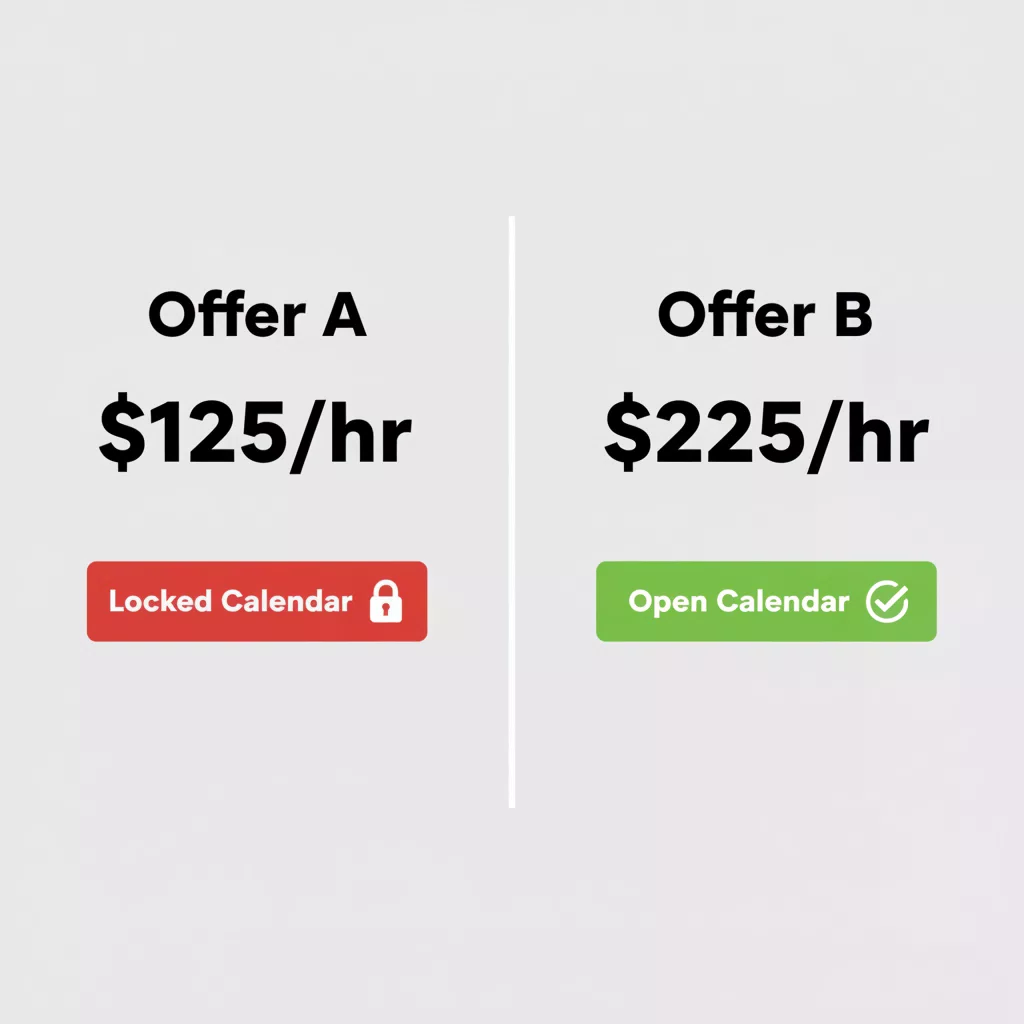
Offer B generates 80% higher hourly earnings while preserving thousands of dollars in future deal capacity.
How to Retain Both Deals Without Burning Bridges
Having two interested sponsors is a great situation. You do not need to reject either brand outright. Instead, reschedule one deal or negotiate better terms on the other.
Negotiating a Revised Publication Schedule
Most brand managers operate on flexible campaign windows. If Brand B is your top choice for this Friday, ask Brand A to shift their integration date back by 10 to 14 days.
Here is a straightforward email response to shift the timeline:
"Thanks so much for sending over the proposal! We are super excited to collaborate. Our publishing calendar for this upcoming Friday is fully committed, but we can secure an exclusive integration slot for your team on [Date, 2 weeks out]. Let me know if that publication date works for your launch timeline, and I will reserve it right away!"
Using Offer B to Leverage Higher Rates on Offer A
If you prefer Offer A's visibility but cannot accept its exclusivity penalties, use Offer B as leverage to adjust the terms or rate.
Send a polite counter-offer focusing on the exclusivity clause:
"Thank you for the contract details! I would love to work together on this launch. However, the requested 90-day category exclusivity blocks several confirmed upcoming campaigns in my pipeline. To accommodate this exclusivity window, my rate for this package is $2,800. Alternatively, we can remove the exclusivity clause and proceed at the original $1,500 rate. Let me know which option fits your budget best!"
Summary: Key Steps for Fast Decision-Making
When choosing between overlapping sponsor offers, follow this quick checklist:
- Calculate production hours: Add up scripting, filming, editing, and communication time.
- Find the effective rate: Divide upfront payout by total expected hours.
- Price out exclusivity: Deduct potential lost pipeline revenue from the total payout.
- Check usage rights: Ensure paid ad permissions are priced separately from organic posts.
- Counter or reschedule: Shift launch dates or counter-offer for restrictive terms before turning down any deal.
For a deeper review of channels, duration and permissions, use the creator usage rights checklist. Once you choose an offer, CreaSeed can help organize the brand conversation, negotiation and deal follow-up.
FAQ
What Should I Do If Both Brands Refuse to Move Their Launch Deadline?
If neither brand will adjust their timeline, prioritize the deal with the higher effective hourly rate and lower exclusivity restrictions. You can also offer the secondary brand a shorter content format (such as a quick Story plug or community post) that fits your current schedule without delaying their launch.
How Much Extra Should I Charge for Category Exclusivity?
There is no universal exclusivity surcharge. Estimate the work you may need to turn down and price the restriction around its scope and duration. If exclusivity locks you out of a high-earning season or niche, charge enough to cover the average revenue of missed sponsorship opportunities during that window.