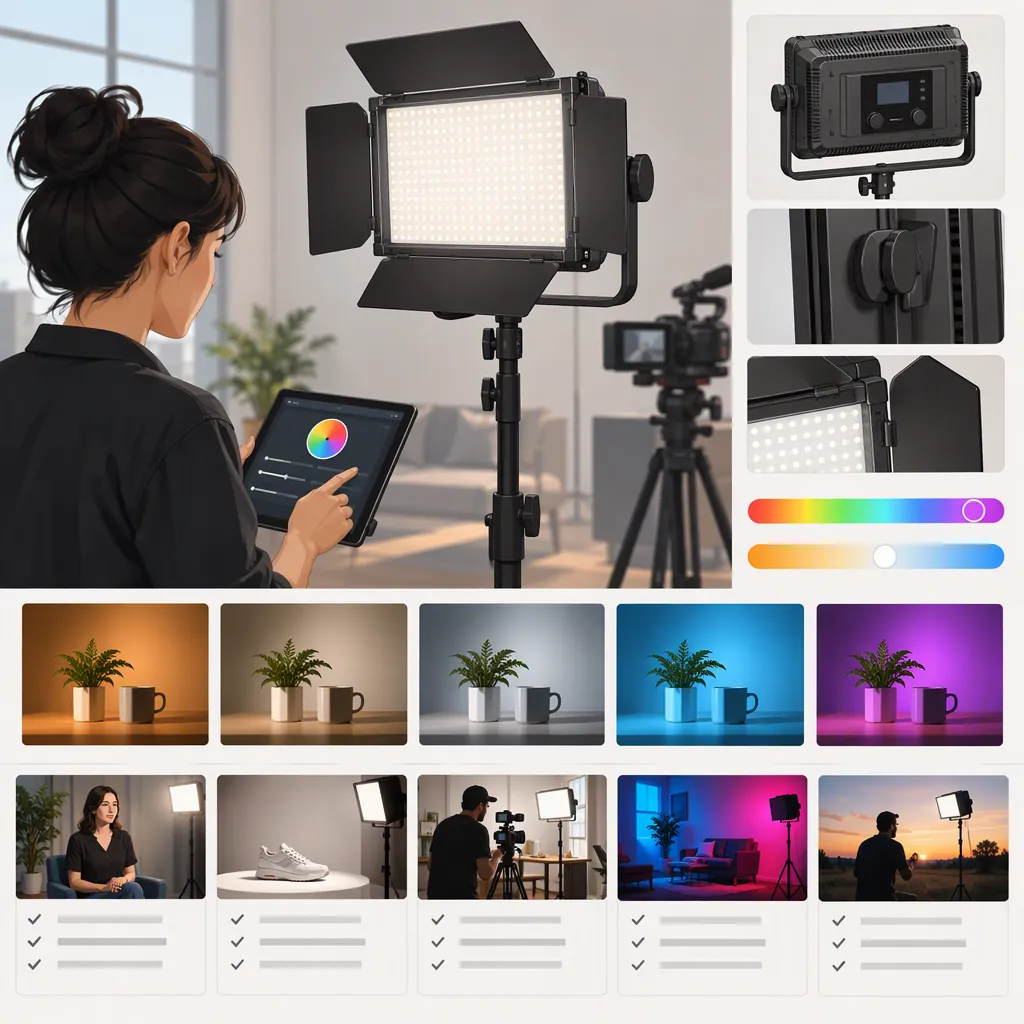
How to Evaluate the Godox Led1000c for Filming
Evaluate the Godox LED1000C by confirming the exact model and testing it at your intended subject distance, camera settings, and diffusion arrangement. The supplied selection guide discusses LED1000C, while the supplied retailer page identifies LED1000W; neither provides direct manufacturer documentation or independent LED1000C performance measurements. A suitability decision should therefore remain provisional until your essential requirements are verified. [c1] [c2]
Establish What the Sources Can Support
Start by separating evidence about the model from advice about evaluating a light. The supplied selection guide discusses LED1000C and summarizes retailer specifications, but it also states that the manufacturer page it references covers LED1000Bi II and LED1000D II rather than LED1000C. Those underlying pages are not supplied directly here. Treat the guide as secondary context, not direct verification of a particular fixture. [c1]
The other supplied reference is a retail listing explicitly labeled LED1000W. It does not establish LED1000C specifications or show that the two model names are interchangeable. [c2]
This article consequently does not assert LED1000C output, color accuracy, flicker performance, noise level, runtime, or included accessories. Its purpose is to provide a selection procedure, not a tested product recommendation.
Evidence Record
| Question | Evidence to Record | Status |
|---|---|---|
| What model is being evaluated? | Exact fixture label | Confirmed / Unverified |
| Does the documentation match? | Manual title and model designation | Confirmed / Unverified |
| Are specifications directly documented? | Matching source and relevant section | Confirmed / Unverified |
| Has performance been tested for this shoot? | Test conditions and recorded result | Confirmed / Unverified |
Define the Shot Before Comparing Lights
Write down what the light must accomplish before reviewing model names or headline specifications. Treat the following as planning questions, not promises about the LED1000C.
For an interview, define the framing, subject position, background appearance, and acceptable facial shadows. Include glasses or other reflective objects in the test if they will appear in the recording.
For tabletop filming, define the working area, camera position, and surfaces whose reflections need attention. For a wider scene, identify every position that must remain usable on camera rather than judging only one nearby subject.
Also record practical constraints: available space, mounting arrangement, access to controls, power availability, and the duration of the planned recording. An unknown requirement should stay marked as unknown rather than being treated as satisfied.
Shot Requirements Worksheet
- Shot type and framing: ______
- Subject or working area: ______
- Intended light position and distance: ______
- Camera settings to keep fixed: ______
- Diffusion arrangement to evaluate: ______
- Acceptable shadows and reflections: ______
- Background appearance: ______
- Mounting and space constraints: ______
- Power arrangement and required recording duration: ______
- Conditions that would rule out a candidate: ______
Run a Repeatable Camera and Audio Test
Use a representative scene and record the setup so another candidate can be evaluated under comparable conditions. This is a proposed test procedure, not a report of hands-on experience.
Set the camera to the frame rate, shutter setting, aperture, ISO, and white balance intended for the shoot. Record the fixture position, subject distance, brightness setting, color setting, and any diffusion used. Test each operating combination you expect to need, rather than assuming one successful recording covers all settings.
Review the recorded footage for the exposure and appearance you require. Inspect shadows, reflections, visible brightness variation, and banding. Record sound with the microphone in its intended position and listen for unwanted noise. If portable power is essential, document the power configuration and test the required recording duration using equipment confirmed as compatible with the exact fixture.
The supplied selection guide explicitly leaves flicker performance, measured color accuracy, acoustic performance, battery runtime, and output after diffusion unverified. A practical footage check can inform a particular shooting decision, but it should not be presented as a laboratory specification. [c1]
Repeatable Test Log
1. Record the exact fixture model and matching documentation.
2. Record camera, lens, frame rate, shutter setting, aperture, ISO, and white balance.
3. Record light position, subject distance, controls, diffusion, and ambient conditions.
4. Capture the representative subject and full intended frame.
5. Repeat for each required operating setting.
6. Review footage and record audio at the intended microphone position.
7. Record power configuration and tested duration where relevant.
8. Save the clips with the setup notes.
9. Repeat with comparison lights, documenting unavoidable differences.
10. Mark every requirement as pass, fail, or unverified.
Make a Conditional Selection
Use the test results to make a decision for the defined shoot, not a universal ranking. Keep source-derived information separate from observations made during your own evaluation.
A useful decision rule is to retain a candidate only when its identity is confirmed, its documented power and mounting requirements fit the setup, and the recorded result meets your stated criteria. If an essential property remains unknown, mark the decision provisional. Do not substitute a specification from LED1000W or another similarly named model for missing LED1000C evidence. The supplied references do not establish that substitution as valid. [c1] [c2]
When comparing alternatives, note differences in placement, diffusion, settings, or ambient conditions alongside the result. This makes the limits of the comparison visible.
Selection Decision Table
| Requirement | Acceptance Criterion | Evidence or Observation | Result |
|---|---|---|---|
| Exact model | ______ | ______ | Pass / Fail / Unverified |
| Exposure and appearance | ______ | ______ | Pass / Fail / Unverified |
| Shadows and reflections | ______ | ______ | Pass / Fail / Unverified |
| Visible recording artifacts | ______ | ______ | Pass / Fail / Unverified |
| Recorded sound | ______ | ______ | Pass / Fail / Unverified |
| Power and duration | ______ | ______ | Pass / Fail / Unverified |
| Mounting and available space | ______ | ______ | Pass / Fail / Unverified |

Decision for this shoot: Suitable / Unsuitable / Provisional.
Unresolved requirements: ______.
FAQ
Is the Godox Led1000c Suitable for Interview Filming?
The supplied evidence does not establish interview suitability. Test the exact unit with your framing, subject distance, ambient conditions, diffusion, camera settings, and microphone placement. Keep the decision provisional if an essential requirement remains unverified. [c1]
Can an Led1000w Listing Verify Led1000c Specifications?
Not from these references. The supplied retailer page identifies LED1000W, while the selection guide discusses LED1000C. Neither establishes that their specifications are interchangeable. Use documentation that matches the fixture label. [c1] [c2]
Do the Supplied Sources Verify Flicker-Free Recording or Battery Runtime?
No. The supplied selection guide explicitly leaves flicker performance and battery runtime unverified. Evaluate the recording settings and power arrangement required for your shoot, and distinguish those observations from independently measured specifications. [c1]