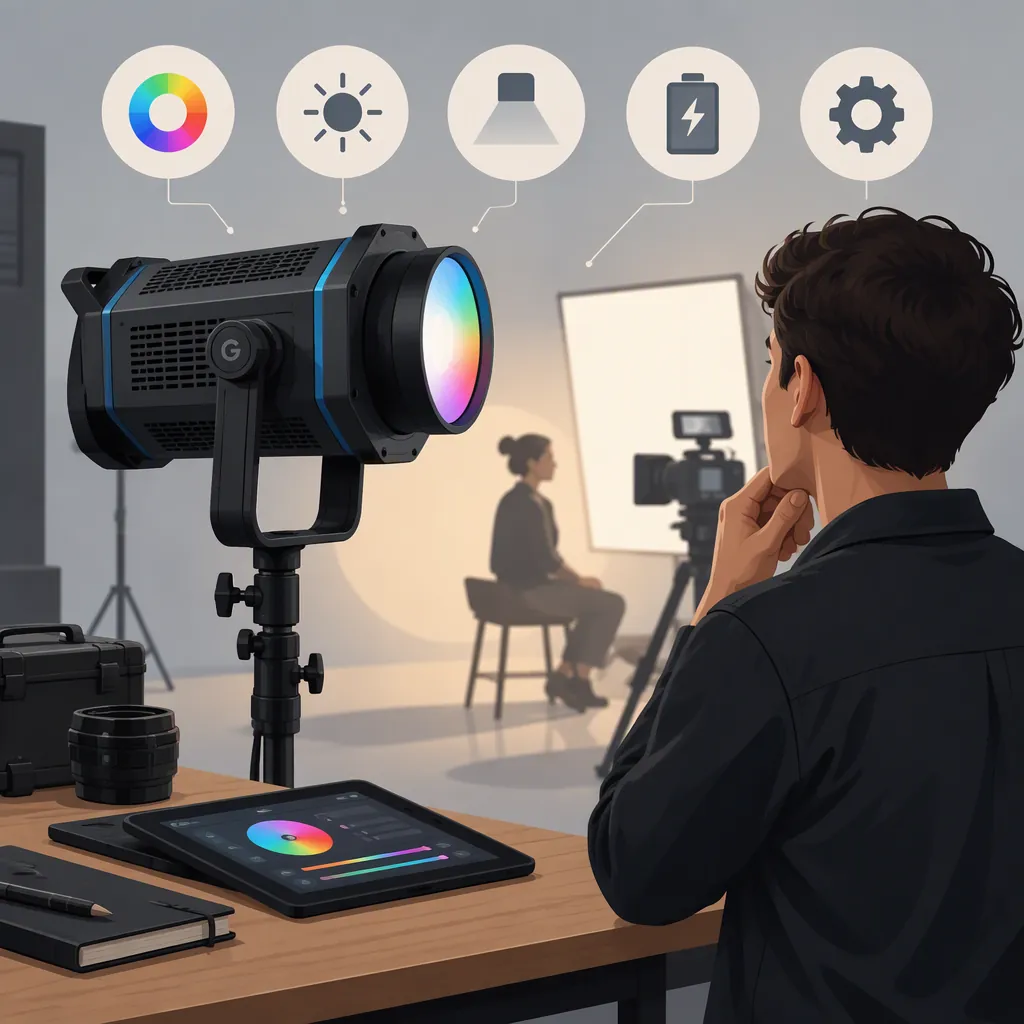
Godox 1000C: How to Evaluate It for Your Filming Setup
To evaluate the Godox 1000C for filming, first confirm that the unit is the LED1000C, then assess it at your intended distance, camera settings, and diffusion setup. The supplied retailer references describe an adjustable-color-temperature LED panel, but they do not establish its suitability for your particular shoot. The provided Godox page covers LED1000Bi II and LED1000D II, not LED1000C, so it should not be used to verify the C model’s specifications. [c1] [c2] [c3]
Confirm the Exact Model
Start with the model label rather than the search term “godox 1000c.” GimbalGo identifies its listed unit as LED1000C Changeable Version, while Qatar4Cam calls its listing Godox LED 1000C dual Light(White/Yellow). Both describe a panel with 1,024 LEDs and adjustable brightness or color temperature. These are retailer descriptions, not independent performance measurements. [c2] [c3]
The supplied manufacturer page is titled LED1000Bi II/LED1000D II and provides download entries for those models. It does not establish that their specifications, accessories, or controls apply to LED1000C. Keep these model names separate when checking documentation. [c1]
Before evaluating a particular unit, record its exact label and obtain documentation matching that label. Treat a mismatch between the listing, label, and manual as an unresolved question.
Model Verification Record
- Model printed on the fixture: ______
- Model printed on the matching manual: ______
- Power requirements shown on the fixture: ______
- Adapter model and output label: ______
- Accessories physically present: ______
- Unresolved differences between listing and unit: ______
Read the Listed Specifications with Caution
GimbalGo lists the LED1000C with a 3300–5600K ±300K color-temperature range, 10–100% brightness adjustment, and maximum 32W power. Do not interpret the “1000” in the model name as a 1,000W rating. These figures are attributed to that retailer and are not verified by the supplied manufacturer page. [c2]
The same listing reports 4,400 lux at 1 meter and 4200K, versus 2,200 lux at 1 meter and either 3300K or 5600K. Even within this listing, the reported output differs by color-temperature setting. Do not treat the highest figure as output available at every setting or as a measurement of your intended setup. The supplied text does not explain whether diffusion was fitted during measurement. [c2]
For power, GimbalGo lists a 13–16.8V DC supply and a separately sold 14.8V battery described as a Sony BP-L model. Its package description includes a power adapter, RC-A5 remote, and diffusion filter. Verify the actual unit’s requirements and included items; a retailer package description is not confirmation of what accompanies another unit. [c2]
Test Against Your Actual Filming Requirements
Use the following as an evaluation procedure, not a claim that the LED1000C will pass. Choose a representative subject, framing, and lighting position. Record the camera settings and keep them unchanged while comparing candidate lights.
For a talking-head setup, inspect facial exposure, shadow shape, reflections in glasses, and the background. For tabletop filming, inspect surface reflections, small details, and whether the fixture obstructs the camera position. For a wider scene, test the full area that must remain usable on camera rather than only the nearest subject.
Test the intended color-temperature and dimming settings, with the diffusion you expect to use. Review recorded footage for visible banding or brightness variation at the frame rates and shutter settings you plan to shoot. Record room sound with the intended microphone position and inspect the result for unwanted noise.
The supplied references do not establish flicker performance, measured color accuracy, acoustic performance, battery runtime, or output after diffusion. Mark these as unverified until you have suitable documentation or a relevant test. [c1] [c2] [c3]
Repeatable Filming Test Checklist
1. Record the camera, lens, frame rate, shutter setting, aperture, ISO, and white balance.
2. Record the light-to-subject distance, fixture position, color-temperature setting, brightness setting, and diffusion.
3. Capture a representative subject and the full intended frame.
4. Repeat at every dimming and color-temperature setting needed for the shoot.
5. Inspect recorded footage for exposure, shadows, reflections, color differences, and visible brightness artifacts.
6. Record audio at the intended microphone position.
7. Repeat with each comparison light under the same setup.
8. Mark each requirement as pass, fail, or unverified; record the reason.
Make a Requirement-Based Selection
Define your requirements before comparing the LED1000C with another light. Use the same camera settings, subject position, diffusion approach, and acceptance criteria wherever practical. Compare the usable result, not just the model number or a single listed brightness figure.
A reasonable decision rule is to keep a candidate under consideration only when its exact identity and power requirements are confirmed, it meets your required exposure and visual result, and its mounting, controls, and power arrangement fit the setup. If an essential property remains unverified, label the decision provisional rather than assuming the light meets it.
The provided sources support a limited description of the LED1000C and identify a separate manufacturer page for other models. They do not support a universal recommendation, a tested ranking against alternatives, or a claim that the LED1000C is sufficient for every filming environment. [c1] [c2] [c3]
Lighting Decision Worksheet
| Requirement | Your Target | Observed Result | Status |
|---|---|---|---|
| Exact model and documentation | ______ | ______ | Pass / Fail / Unverified |
| Exposure at working distance | ______ | ______ | Pass / Fail / Unverified |
| Shadow and reflection control | ______ | ______ | Pass / Fail / Unverified |
| Color appearance on camera | ______ | ______ | Pass / Fail / Unverified |
| Recording artifacts and sound | ______ | ______ | Pass / Fail / Unverified |
| Power arrangement and runtime | ______ | ______ | Pass / Fail / Unverified |
| Mounting and available space | ______ | ______ | Pass / Fail / Unverified |
FAQ
Is the Godox 1000C a 1,000W Light?
The supplied GimbalGo listing identifies LED1000C and lists maximum power as 32W, not 1,000W. Treat that as a retailer-listed specification and confirm the rating on the exact unit and matching documentation. [c2]
Is Led1000c the Same Model as Led1000bi Ii?
Do not treat the names as interchangeable. The retailer references identify LED1000C, while the provided Godox page covers LED1000Bi II and LED1000D II. The supplied sources do not establish equivalence or interchangeable specifications. [c1] [c2] [c3]
Is the Led1000c Enough for Interview Filming?
The supplied references do not establish that. Evaluate it with your subject distance, framing, ambient lighting, diffusion, and camera settings. Check exposure, facial shadows, reflections, recorded image artifacts, and audio before making a suitability judgment. The retailer’s one-meter lux figures are not a test of your interview setup. [c2]