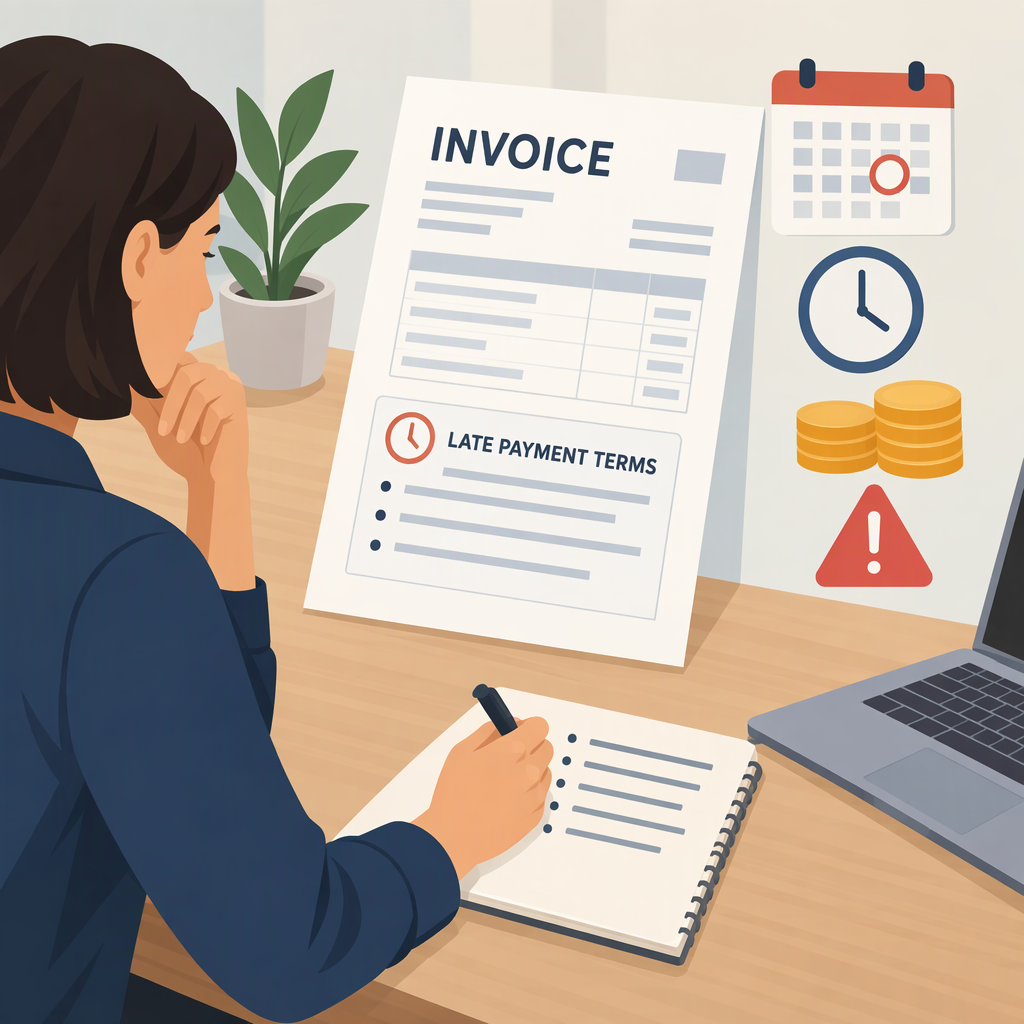
Invoice Late Payment Terms: What to Include and How to Write Them
Invoice late-payment terms should make three things clear: when payment is due, whether a grace period applies, and whether a charge may begin after that period. A deadline-only term is an option; adding a fee or interest is a separate decision that may depend on the governing law, the transaction, and the parties’ agreement. There is no universally valid late-charge rate or clause for every U.S. invoice.
What Invoice Late-Payment Terms Mean
Late-payment terms explain what happens if an invoice is not paid by its due date. Keep these dates and concepts distinct:
- Due date: The date payment is owed. State a calendar date or define how to calculate it—for example, a specified number of days after the invoice date.
- Grace period: Any additional time allowed after the due date before a late charge can begin. Say whether there is one and when it ends.
- Charge start date: The earliest date a specified fee or interest could apply. State it directly rather than leaving readers to infer it.
Hypothetical example: An invoice is due on September 30. The terms allow a grace period through October 5, and a specified charge, if applicable, begins October 6. This example illustrates how to separate the dates; it does not recommend a charge or establish that one is lawful.
What to Specify in a Late-Payment Clause
Use this checklist to identify the decisions your terms address. It is a drafting aid, not a list of legally required terms.
| Term to decide | What to make clear |
|---|---|
| Payment deadline | The due date or an unambiguous way to calculate it. |
| Grace period | Whether one applies and its final date. If none applies, avoid suggesting that one does. |
| Late charge | Whether any charge applies at all. A deadline can be stated without adding a charge. |
| Calculation | If a charge is proposed, say how it is calculated and, if relevant, how often it accrues and what balance it applies to. |
| Notice | Whether the parties choose to require notice before a charge begins, and how that notice will be given. |
A fixed fee and a rate-based charge work differently; either can leave questions unanswered if the calculation, timing, or balance is unclear. Decide which, if any, you intend to propose, then check applicable requirements before relying on it.
Should You Charge a Late Fee or Interest?
Consider the simpler option first: state a clear payment deadline without adding a charge. If you propose a charge, make its amount or calculation and start date explicit, and check whether it is permitted for the particular transaction before including or applying it. Do not assume the same rule applies to consumer and business transactions, or that a term is enforceable just because it appears on an invoice.
The governing jurisdiction and transaction details matter. For example, California Civil Code section 1671 addresses the validity of certain contract provisions liquidating damages and sets out different standards for specified consumer transactions and residential leases. That provision is not a universal rule for every invoice charge; it illustrates why the transaction and applicable law should be checked. (california.public.law)
Before choosing a charge, identify the governing law, whether the customer is acting as a consumer or a business, the type of transaction, and the relevant contract terms. Check current authoritative sources for that context or get qualified legal advice if the amount or consequences matter. This guide does not identify a lawful default rate.
A Placeholder-Based Clause to Adapt
Payment is due on [specific date or defined period after the invoice date]. [A grace period applies through [date] / No grace period applies.] If payment remains outstanding after [date], [a late charge of [amount or calculation] may apply to [specified balance] at [stated frequency], subject to applicable law]. [State any notice condition, if agreed.]
This is schematic wording, not a reviewed legal form. Fill in only the terms the parties intend to use; remove inapplicable options. Before relying on a charge, verify its calculation and timing against the law and agreement relevant to the transaction.
Communicate and Document the Terms
Make the terms visible in the agreement or other communication where the parties settle the payment arrangement, and keep a copy along with the invoice and any later communications. Do not assume that adding a new charge to a later invoice, by itself, changes an existing agreement. If the parties change their terms, document what they agreed and when.
If an invoice is overdue, start by checking the agreed due date, any grace period, and the payment record. Keep any reminder factual and consistent with the terms you can document. This article is general educational information, not legal advice; the governing law and transaction-specific facts may affect the result.