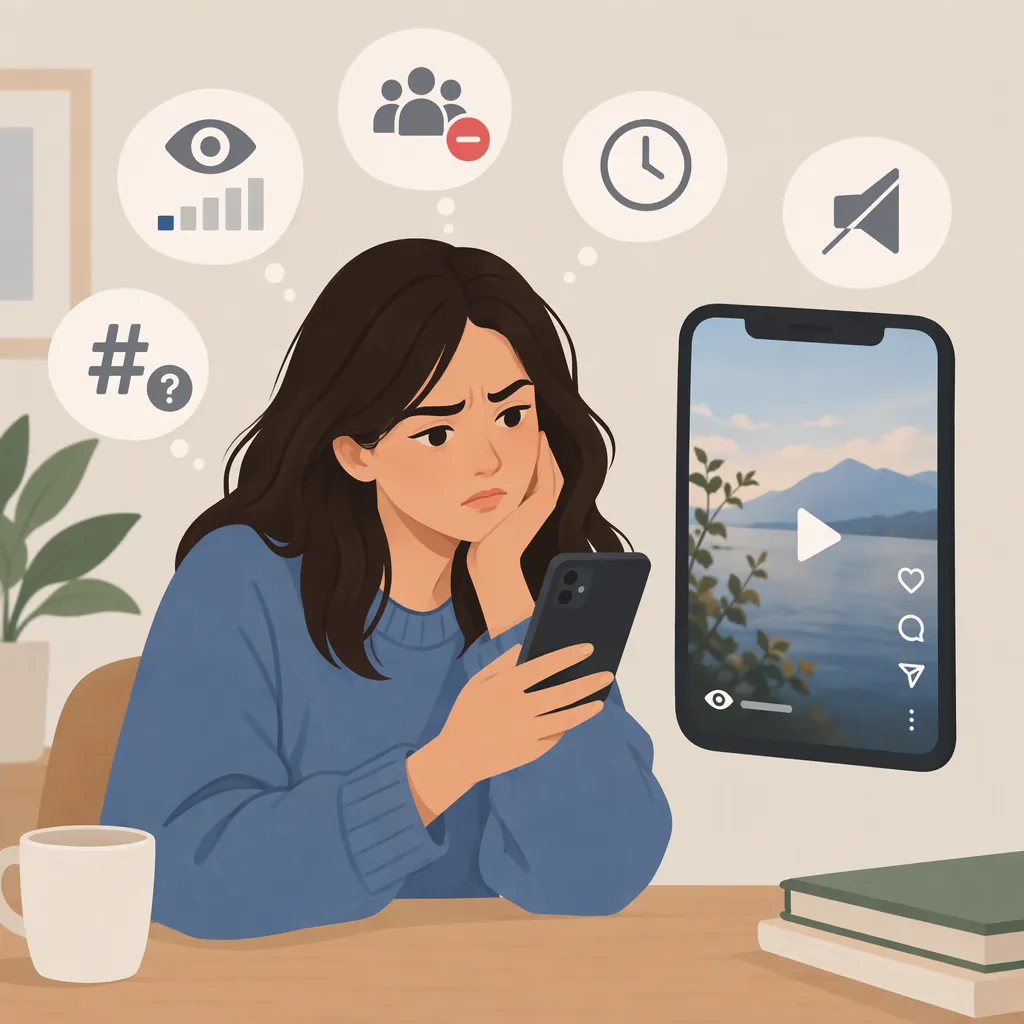
Why Is My Instagram Reel Not Getting Views?
Low views alone cannot tell you why an Instagram Reel is underperforming. First check that it is published, plays correctly, and is accessible to your intended audience. Then compare it with similar Reels at the same time after publication. Use that comparison to decide whether to investigate this Reel’s opening and audience fit or a pattern across several posts.
The goal is to turn “my Reel is not getting views” into a specific, testable question—not to assume an account restriction or an algorithm problem.
Check Visibility Before Changing Your Content
Start with these checks:
- Confirm that the Reel is published on the intended account and plays correctly.
- Review the account’s privacy settings and whether they match the audience you want to reach.
- Check for any account or content notices shown by Instagram. Read the specific notice rather than inferring a restriction from low views.
- Distinguish a literal zero-view result from a count that is simply below your usual range.
- Record how long the Reel has been published before judging its result.
Choose Your Next Step
These branches establish a troubleshooting order, not confirmed causes of low views.
| Observation | Priority check | Next step |
|---|---|---|
| The Reel is missing from the intended account or does not play correctly | Publication and playback | Resolve the visible publishing or playback issue before evaluating content performance. |
| Privacy settings do not match the audience you intend to reach | Audience accessibility | Decide whether those settings are intentional. Address the mismatch before assessing broader audience growth. |
| Instagram shows an account or content notice | The specific notice | Read it and follow any applicable instructions. Do not assume it explains every low-performing post. |
| The Reel shows zero views, but publication and playback appear correct | Elapsed time and comparable results | Record the result and recheck at a consistent comparison point. Zero alone does not identify the cause. |
| One Reel is below your usual range | That Reel’s topic and execution | Review its opening, audience fit, delivery, cover, and caption. |
| Several comparable Reels remain below your usual range | Shared changes | Look for changes in topic, format, intended audience, opening style, or posting schedule. Test one plausible explanation. |
Preserve the results before deleting or replacing the Reel. Otherwise, you lose part of the record needed to evaluate a revision.
Initial Troubleshooting Record
- Reel topic:
- Publication date and time:
- Elapsed time when checked:
- Displayed view count:
- Intended audience:
- Published on the intended account: Yes / No
- Playback checked: Yes / No
- Privacy settings reviewed: Yes / No
- Account or content notice, if any:
- Priority check from the table:
- Next action:
Review the Opening and Audience Fit
Once accessibility checks are complete, examine what the Reel offers someone unfamiliar with your account.
- Opening: Is the subject and intended value clear immediately?
- Audience: Who is this for, and what question, interest, or problem does it address?
- Delivery: Does the video deliver what the opening promises without an unnecessary introduction?
- Cover and caption: Do they accurately describe the content rather than promise something the video does not provide?
In-Gear Media recommends reviewing video thumbnails and captions and discusses engagement and relevance as possible visibility factors. Use those suggestions as review prompts, not as proof of why a particular Reel received few views. [citation-1]
Write a hypothesis that points to an editable feature. For example:
“The opening does not make the tutorial’s outcome clear to a first-time viewer.”
That is more useful than “the algorithm dislikes my account,” because it identifies a change you can make and an observation that could challenge your explanation.
Compare Similar Reels at Similar Ages
Compare the Reel with posts that have a similar topic, intended audience, and format. Record their results at the same elapsed time after publication. A new Reel and a much older Reel are not a useful like-for-like comparison.
Use your own comparable posts as the baseline rather than an unsupported universal view target.
Comparable Reel Review
| Reel | Topic / audience | Time since posting | Views | Other displayed results | Main difference |
|---|---|---|---|---|---|
| Current Reel | Fill in | Fill in | Fill in | Fill in | Fill in |
| Comparison A | Fill in | Fill in | Fill in | Fill in | Fill in |
| Comparison B | Fill in | Fill in | Fill in | Fill in | Fill in |
Also record:
- Audience-growth goal:
- Repeated pattern observed:
- Hypothesis to test:
- Evidence that would weaken the hypothesis:
If only one Reel is lower, prioritize its subject and execution. If several comparable Reels are lower, check what they share. Neither pattern proves a particular ranking mechanism.
Separate Views from Audience Growth
Choose the outcome you are trying to improve before choosing an experiment.
| Goal | What to record | How to use it |
|---|---|---|
| More viewing | Displayed views at a consistent elapsed time | Check whether the revised Reel performs differently from comparable posts. |
| More conversation | Any relevant interaction results your account displays, using the app’s exact labels | Evaluate conversation separately from views; a higher view count does not answer the interaction question. |
| More followers | Any relevant follow-related result available to your account | If no Reel-specific result is available, do not attribute an account-level follower change to that Reel alone. |
Only record measures Instagram actually makes available to your account. If a result is unavailable, mark it as unavailable rather than estimating it. Keep the same outcome and measurement approach across comparisons.
Test One Clear Change Next
Choose one revision that addresses your strongest hypothesis. Keep other features as similar as practical and compare results at a consistent elapsed time.
Example 1: The Opening Is Unclear
Observation: One tutorial Reel has fewer views than comparable tutorials. Its opening is a general introduction that does not name the result.
Hypothesis: First-time viewers may not understand what the tutorial offers.
Change to test: Replace the broad introduction with a clear statement or demonstration of the outcome. Keep the topic, intended audience, and format similar.
What to compare: Record displayed views at the same elapsed time as the comparison Reels. If your account displays a relevant viewing-duration or completion measure, record it using the app’s exact label; otherwise, do not infer how long people watched.
What would weaken the hypothesis: Similar revised Reels show no consistent improvement in the chosen outcome, or other Reels with equally broad openings perform within your usual range. That would be a reason to investigate another feature, not proof that openings never matter.
Example 2: The Topic Does Not Fit the Intended Audience
Observation: Several recent Reels target a broader or different audience than your earlier comparable posts, and results are below your usual range.
Hypothesis: The recent topics may be less relevant to the audience you intend to serve.
Change to test: Make the next comparable Reel address one specific question from that intended audience. Keep the opening style, format, and posting conditions as similar as practical.
What to compare: Record views and the available result that matches your growth goal. For example, if the goal is conversation, review relevant interaction results separately from views.
What would weaken the hypothesis: Audience-specific Reels continue to perform similarly to the broader-topic Reels, or earlier posts aimed at the same audience also show the decline. Reconsider whether another shared change better explains the pattern.
These are informal comparisons, not controlled experiments. One improved or worse result cannot isolate every influence.
Treat Posting Time as a Separate Experiment
In-Gear Media also recommends consistent posting and considering when an audience is active. That is a possible experiment—not a universal best hour or a guaranteed fix. [citation-1]
If you test timing, keep the content approach similar and compare results at the same elapsed time after publication. Avoid changing the opening, topic, length, caption, and posting time together if your purpose is to learn which adjustment might help.
Evidence Limits
In-Gear Media’s “Cracking the Code: Why Your Instagram Videos Aren’t Getting Views and How to Fix It,” published February 16, 2024, is a general Instagram-video article. It offers suggestions about presentation, engagement, relevance, consistency, and timing, but does not provide account-specific diagnostics, controlled results, or current Instagram documentation. Its advice cannot establish your Reel’s cause of low views, a guaranteed view target, or Instagram’s current ranking rules. [citation-1]
The checklists and examples above are troubleshooting methods, not claims that a particular change will increase views.
FAQ
Do Low Reel Views Mean I Am Shadowbanned?
No—not on that evidence alone. Check the Reel’s accessibility and any specific account or content notices in Instagram before attributing the result to a restriction. The In-Gear Media article does not provide a shadowban diagnostic. [citation-1]
Why Does My Reel Have Zero Views?
A zero-view count does not identify the cause. Confirm publication, playback, privacy settings, and any visible notices first. Then record the elapsed time and compare at a consistent point with similar posts. If you find a specific issue, address it before changing the content.
Will Posting at a Different Time Fix Low Views?
It is a hypothesis to test, not a guaranteed fix. In-Gear Media recommends considering audience activity, but does not establish a universal posting time or show that timing caused your result. Keep other features similar and compare posts at the same elapsed time after publication. [citation-1]
Should I Delete and Repost an Underperforming Reel?
First preserve its results and identify what you would change. The In-Gear Media article does not establish that deleting and reposting improves views. If you test a revised version, record the hypothesis and the change so the comparison has a clear purpose. [citation-1]
What If My Views Increase but My Follower Growth Does Not?
Treat those as separate outcomes. Record any relevant follow-related result available to your account and review whether the Reel serves the audience you want to build. If only account-level follower changes are visible, do not assume one Reel caused them. More views alone do not establish that your audience-growth goal has been met.