User-Generated Advertising Examples: Formats and Creative Plans
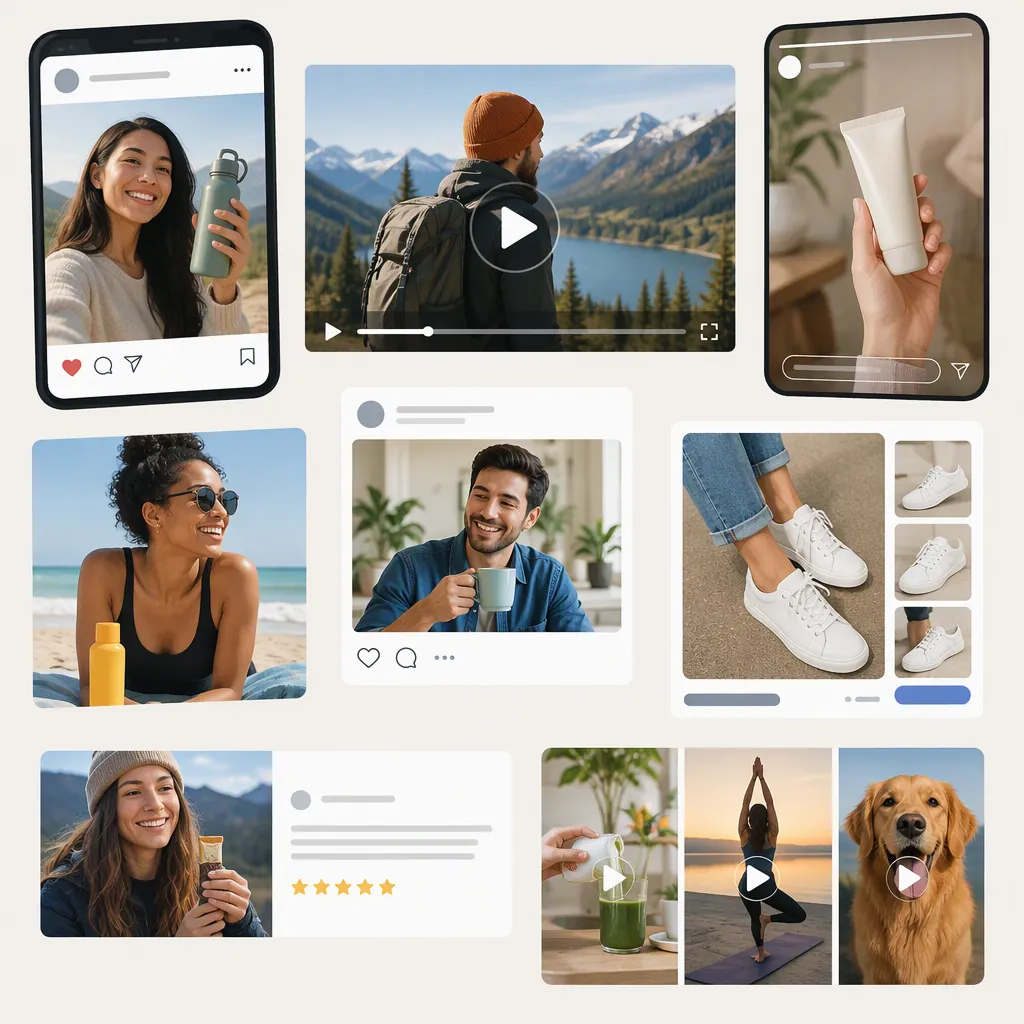
User-generated advertising examples include customer reviews, unboxing videos, product demonstrations, tutorials, and creator-led stories adapted for advertising. Business.com lists reviews, unboxings, and tutorials as UGC types; Noovid groups its examples into first impressions, testimonials, lifestyle demos, trend-style videos, how-to guides, and comparisons. Distinguish genuine customer contributions from commissioned creator-style ads: a casual presentation alone does not establish an independent customer experience. [c1] [c2]
What Counts as User-Generated Advertising?
Business.com defines user-generated content as content customers create about a brand, including written reviews, images, and videos. Zeely uses the term more broadly in paid social to describe creator-style videos that resemble content in social feeds. These definitions overlap, but they are not identical. [c1] [c3]
For a clearer creative brief, separate three categories:
- Customer-originated UGC: Content a customer created about their own experience, later considered for advertising reuse.
- Commissioned creator content: A video made for a brand under a brief. It may demonstrate a product without being an independent customer review.
- Synthetic creator-style content: Generated imagery or narration using the visual conventions of creator videos. Do not present it as evidence that a real customer used a product.
These categories are a practical working framework, not a universal industry classification. Keep content origin, compensation, and the basis for any experience claim visible in production records. A handheld camera, informal delivery, or bedroom setting is a presentation choice—not proof of authenticity.
Published Brand Examples to Study
Zeely's roundup discusses the following brands and creative patterns. These are secondary-source descriptions, not independent reviews of the original advertisements. The supplied material does not establish comparable performance results or confirm that every example originated with an unpaid customer. [c3]
| Example Discussed by Zeely | Pattern Described | Question for Creative Analysis |
|---|---|---|
| Fenty Beauty | Early product visibility and creator-led framing | How quickly does the viewer understand what is being shown? |
| RMS Beauty | Routine language and visible product use | Does the sequence show use rather than rely on praise? |
| Cardina Fashion | Try-on content addressing fit questions | Which fit details are visible, and which remain subjective? |
| VERO MODA | Occasion-based styling | Does the setting explain when someone might wear the item? |
| Triumph Arcade | Gameplay-led demonstration | Can the interaction be understood without a long explanation? |
| BLIK | Episodic storytelling | Which recurring elements connect the individual videos? |
Use these descriptions to identify structures worth examining, not to rank brands or infer that a format will improve results. Zeely's interpretation of a campaign is not a substitute for reviewing its actual footage, disclosures, placement, and measurement context. [c3]
Six UGC Ad Formats with Illustrative Shot Plans
Noovid organizes its examples around first impressions, testimonials and reviews, lifestyle demonstrations, trend-style videos, step-by-step instructions, and comparisons or before-and-after content. [c2]
The plans below are original, hypothetical production exercises—not accounts of real customers or campaigns. Any experience statement would need to come from an actual participant and remain accurate after editing.
First Impressions
Illustrative subject: A desk organizer.
Show the unopened package, unpack its contents, and capture an uninterrupted look at its compartments. End with a factual recap of what was included. Keep first impressions separate from claims about durability or long-term usefulness.
Experience-Based Review
Illustrative subject: A reusable bottle.
Invite a real user to describe their use context, demonstrate one feature, and explain a limitation in their own words. Do not supply a favorable personal history for them to recite. Identify subjective preferences as preferences.
Lifestyle Demonstration
Illustrative subject: A storage pouch.
Film the items being packed, the pouch being closed, and its placement in a bag. Show the actual arrangement rather than imply that every item or bag will fit the same way.
Trend-Style Video
Illustrative subject: An outfit-styling sequence.
Use an original recurring visual device, such as matching each outfit to a different everyday setting. Keep the garment visible and use only cleared audio. Borrow a storytelling convention rather than reproduce another creator's footage or script.
Step-By-Step Tutorial
Illustrative subject: A note-taking app.
Record a demonstration account creating a note, assigning a label, and retrieving it. Pair each screen action with a short caption. Remove personal information and label demonstration data clearly.
Comparison
Illustrative subject: Two packing arrangements.
Keep the objects, camera angle, and available space consistent. Label what changed. Treat the result as a demonstration under those conditions, not proof that every user will get the same outcome.
Reusable Demonstration Storyboard
Hypothetical production template:
1. Viewer question: Identify one concrete task or uncertainty.
2. Context shot: Show the object, setting, or interface.
3. Action shot: Record the task without concealing relevant steps.
4. Detail shot: Show the feature or observable result being discussed.
5. Limitation: State the conditions or unanswered question.
6. Final frame: Summarize the demonstration without a purchase prompt.
Review gate: Confirm that each caption matches the footage and that no personal experience has been invented.
Turn an Example into a Brief and Edit Plan
Zeely recommends learning from creative structure rather than copying exact footage and emphasizes early product visibility, natural delivery, and product use in context. Treat these as editorial suggestions, not established performance guarantees. [c3]
A neutral adaptation process is to:
- Choose one viewer question. For example, whether an item fits in a particular space or how an interface task works.
- Specify observable evidence. List the shots needed to answer that question. Separate visible facts from opinions and claims requiring other support.
- Identify the speaker's role. Record whether they are a customer, paid creator, employee, or demonstrator.
- Capture context. Include relevant setup, dimensions, settings, or demonstration conditions.
- Edit for comprehension. Remove repetition without changing meaning, add readable captions, and keep demonstrations legible.
- Review the final export. Check disclosure visibility, caption accuracy, private information, audio rights, and any claims introduced through text overlays.
For a simple creative comparison, change one element at a time—for example, an opening question versus an opening demonstration—while retaining the same core evidence. This makes the difference easier to interpret, although it does not eliminate audience or delivery effects.
Fill-In Creative Brief
Viewer question: [Enter one specific question.]
Content origin and participant role: [Record customer, commissioned creator, employee, or demonstrator.]
Observable fact to show: [Describe what the footage can establish.]
Required shots: [List context, action, detail, and limitation shots.]
Unsupported statements to exclude: [List claims without evidence.]
Disclosure plan: [Specify wording, placement, and review owner.]
Permissions record: [Record approved uses and restrictions.]
Edit variants: [Name the single element changed between versions.]
Final review owner: [Assign responsibility before publication.]
Check Permissions, Disclosures, and Results
Business.com advises obtaining permission before using UGC in marketing, crediting creators, and disclosing material connections such as staff or brand relationships. It also discusses disclosure within video content rather than relying solely on a description. This is secondary guidance, not a complete legal analysis of a particular campaign. [c1]
Use a review checklist that records:
- Permission for the intended advertising use, not merely permission to repost.
- Approved channels, duration, edits, and any creator-account delivery arrangements.
- Relevant consent for identifiable people and a review of private information.
- Clearance for music, images, and other third-party material.
- Accurate experience statements and substantiation for factual claims.
- A disclosure approach reviewed against applicable law and platform rules.
Creator credit should not be treated as a substitute for permission. Likewise, permission to use footage does not establish that every statement within it is supportable.
For evaluation, Business.com lists metrics including reach, impressions, click-through rate, engagement, and conversions. Select measures that correspond to the campaign's stated purpose. [c1] Record the audience, placement, delivery period, and spending alongside the results; do not compare isolated totals as though the delivery conditions were identical.
None of the examples in this article establishes a universal winning format. Use the references as sources of creative patterns, while keeping rights, claim support, and measurement limitations explicit.
FAQ
Is Every UGC Post an Advertisement?
No. Customer-created content and paid advertising are different uses. Business.com describes UGC as customer-created material; it separately discusses permission before reuse in marketing. Record the content's origin and the authorization for its intended use rather than assuming an organic post is available for advertising. [c1]
Which UGC Ad Format Is a Practical Starting Point?
A demonstration or step-by-step tutorial is a useful starting exercise because the brief can focus on an observable task instead of a testimonial. Noovid includes both demonstration and how-to formats in its examples. This is a production suggestion, not a claim that either format performs best. [c2]
Can a Paid Creator Make a Review-Style Ad?
A review-style presentation should reflect the participant's actual experience, not a supplied fictional customer story. Business.com discusses disclosure of material connections in advertising. Describe the paid relationship clearly and review the content against applicable requirements. [c1]
Where Can AI Fit into UGC Ad Production?
Zeely suggests AI support for script drafts, localization, subtitles, and alternative edits while cautioning against invented testimonials. Treat generated output as draft material requiring review; a synthetic speaker is not evidence of a real customer's experience. [c3]