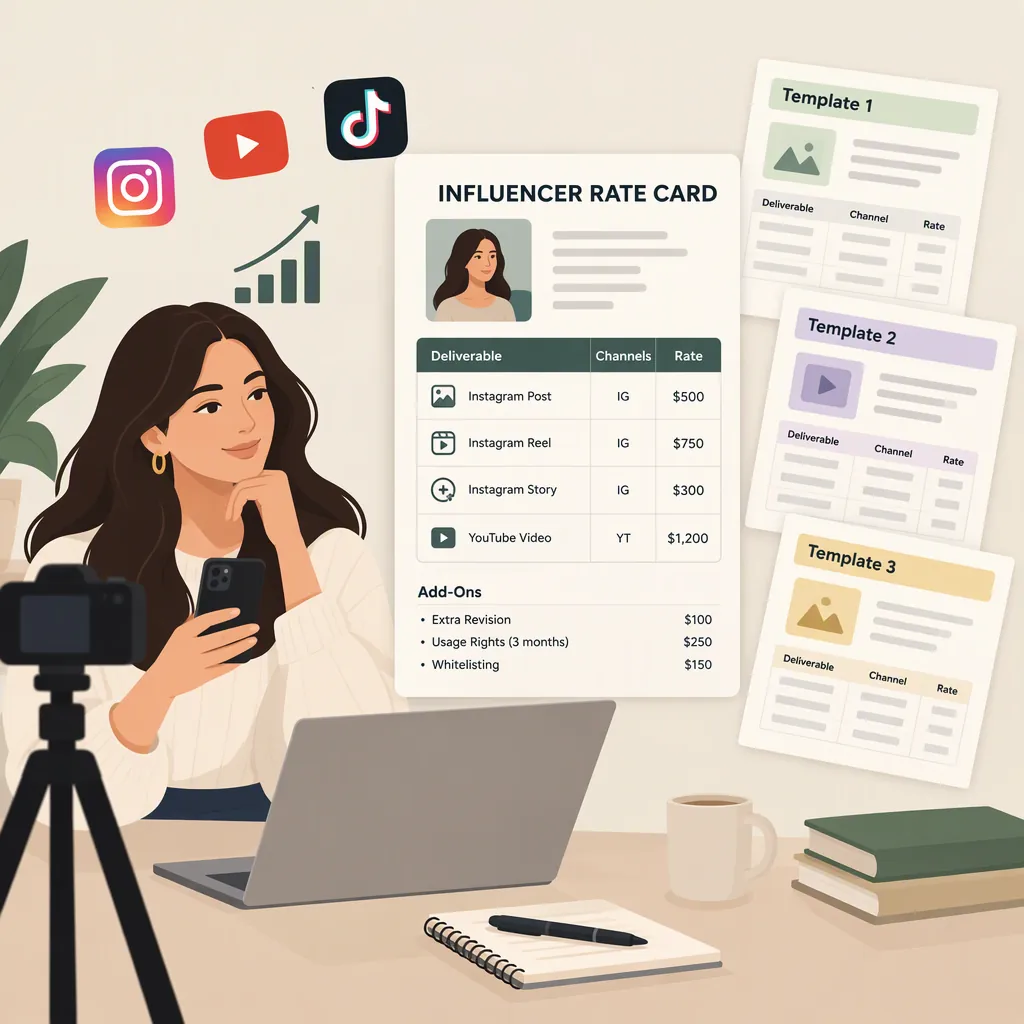
Influencer Rate Card Examples for Posts, Packages, and UGC
An influencer rate card lists collaboration services and baseline prices. Three useful formats are an individual-service menu, a campaign package, and a UGC asset menu. Each should make deliverables, included usage rights, and separately priced terms clear. Treat the card as a starting point for a scope-specific quote, not a substitute for an agreement. The templates below are original educational examples, not actual creator rate cards or market-rate benchmarks. [c1] [c2]
What an Influencer Rate Card Should Explain
A media kit introduces a creator’s work and audience; a rate card focuses on services and pricing. They can overlap, but they answer different questions: “Who is this creator?” versus “What does this collaboration include and cost?” [c2]
For the examples below, use these fields:
- Deliverable: Platform, format, quantity, duration, and who publishes it.
- Baseline price: Amount and currency, with the scope that price covers.
- Production scope: Editing, revisions, delivery timing, and any required travel or materials.
- Usage rights: Permitted channels, purpose, and license duration.
- Separate terms: Paid advertising, exclusivity, rush work, and additional assets.
- Version: Date of issue and quote-validity period.
These are suggested template fields, not a mandatory industry format. The supplied guides describe baseline pricing, production effort, usage rights, and exclusivity as considerations when preparing or negotiating rates. [c1] [c2]
Example 1: An Individual-Service Menu
Use this layout when a collaboration may involve a single post or a small selection of formats. The supplied Pitchbrand guide includes an à la carte example with separate starting prices for posts, videos, and story sets. [c1]
This original template separates each service from its assumptions. A “starting at” price should still explain what the baseline covers; otherwise, the reader cannot meaningfully compare options. All bracketed entries are placeholders, not suggested prices.
Editable Individual-Service Rate Card
Creator: [Creator name]
Issued: [Date]
Currency: [Currency code]

Instagram feed post
Deliverable: 1 image with caption, published on the creator’s account
Starting fee: [Amount]
Included: [Production scope], [revision allowance], [publication period]

Instagram Reel
Deliverable: 1 edited video up to [duration], published on the creator’s account
Starting fee: [Amount]
Included: [Concept scope], [revision allowance], [publication period]

Instagram story set
Deliverable: [Number] frames with [agreed elements]
Starting fee: [Amount]
Included: [Production scope] and [reporting scope]

Rights and exclusions
Brand reposting: [Included or separately priced; channels and duration]
Paid advertising: [Excluded or defined license]
Exclusivity: [Excluded or defined category and duration]
Additional revisions, travel, and rush delivery: [Separate quote terms]
Final fee: Confirmed after the campaign brief and rights are agreed.
Example 2: A Campaign Package
A package groups several deliverables into one defined scope. Both supplied guides discuss service bundles or packages as rate-card options. [c1] [c2]
In this template, the package price belongs to the complete scope, rather than an unspecified collection of posts. A bundle does not need an assumed discount: if a discount is offered, show which individual-service prices form the comparison. Keep licensing and exclusivity explicit instead of hiding them inside the package name.
Editable Campaign Package Rate Card
Package: [Campaign package name]
Currency: [Currency code]
Baseline package fee: [Amount]

Deliverables
- 1 edited short-form video for [platform], up to [duration]
- 1 story set containing [number] frames
- [Number] edited photographs delivered to the brand

Publication and delivery
Creator-published content: [List]
Brand-delivered assets: [List]
Campaign window: [Dates or scheduling assumptions]
Included revisions: [Number and definition of a revision round]
Reporting: [Metrics and reporting date]

Included rights
Brand use: [Channels, purpose, territory, and duration]
Paid advertising: [Excluded or defined scope]
Exclusivity: [Excluded or named category and duration]

Price adjustments
Additional deliverables: [Pricing or separate quote]
Extended licensing: [Pricing or separate quote]
Rush work or reshoots outside the agreed brief: [Terms]
Payment schedule: [Proposed milestones]
Quote valid through: [Date]
Example 3: A UGC Asset Menu
For UGC work, distinguish creating an asset from publishing it to the creator’s audience. Pitchbrand’s UGC example centers on delivered videos, photographs, and usage rights rather than follower count. [c1]
The following template deliberately keeps creator-account posting separate. It also distinguishes an edited deliverable from raw footage and alternative versions. Those choices make the production scope visible without implying that every asset or right is included.
Editable UGC Rate Card
Creator: [Creator name]
Service: UGC production for brand use
Currency: [Currency code]

Edited video
Quantity: [Number]
Length: Up to [duration] per video
Format: [Aspect ratio and file specifications]
Creation fee: [Amount]
Included: [Concept development], [editing scope], [revision allowance]

Edited photographs
Quantity: [Number]
Specifications: [File format and dimensions]
Creation fee: [Amount]

License
Organic brand use: [Channels, territory, and duration]
Paid advertising: [Separate fee and license scope, or excluded]
License start: [Agreed date or trigger]

Separately scoped items
Raw footage: [Included, unavailable, or separately quoted]
Alternative hooks or edits: [Quantity and pricing]
Creator-account publication: [Not included or separately scoped]
Exclusivity: [Not included or separately scoped]
Delivery timeline: [Timing after brief approval and receipt of required materials]
Set Prices Without Treating Examples as Benchmarks
The supplied sources are educational guides, not a representative market-rate dataset. Their example prices and suggested licensing percentages do not establish what a particular creator should charge.
impact.com recommends researching rates relevant to a creator’s niche and treating baseline prices as a negotiation reference. It also identifies rush fees, usage rights, and production costs as reasons a final price may change. [c2]
A practical preparation method is to separate production, creator-account publication, licensing, and exclusivity in your working estimate. You can display a combined fee on the card while retaining that breakdown for scope changes. This is a suggested method, not a universal pricing formula.
Before turning the card into a campaign quote, check:
- Are deliverables and publication responsibilities unambiguous?
- Does each price identify its currency and included scope?
- Are brand reposting and paid advertising addressed separately?
- Are license duration and exclusivity boundaries stated?
- Are revisions, reshoots, and additional versions defined?
- Are payment timing, quote validity, and any applicable taxes addressed?
- Are any audience metrics accurate and dated?
A rate card summarizes an offer. Confirm the final scope and terms in the campaign agreement rather than relying on a short pricing menu to resolve every detail.
FAQ
Is an Influencer Rate Card the Same as a Media Kit?
No. A media kit introduces the creator’s portfolio, audience, and positioning. A rate card focuses on services and baseline prices for collaboration discussions. They can be combined, but their purposes differ. [c2]
Should a Rate Card Show Fixed Prices or Starting Prices?
Either can be used if the included scope is clear. Pitchbrand shows starting-price examples, while impact.com frames baseline rates as a negotiation reference. A fixed price needs a defined scope; a starting price needs clear assumptions and an explanation of what may change the quote. [c1] [c2]
Are Paid Advertising Rights Automatically Included?
Do not assume they are. The supplied examples distinguish organic brand use from paid advertising licenses. State whether paid use is included or separately priced, and define its channels, duration, and other boundaries in the agreed terms. [c1]
Can I Use an Online Example to Determine My Rates?
Use an example to organize your offer, not as proof of a market rate. The provided references do not establish a representative pricing benchmark. impact.com recommends researching your niche and considering scope-dependent factors before settling on baseline prices. [c2]