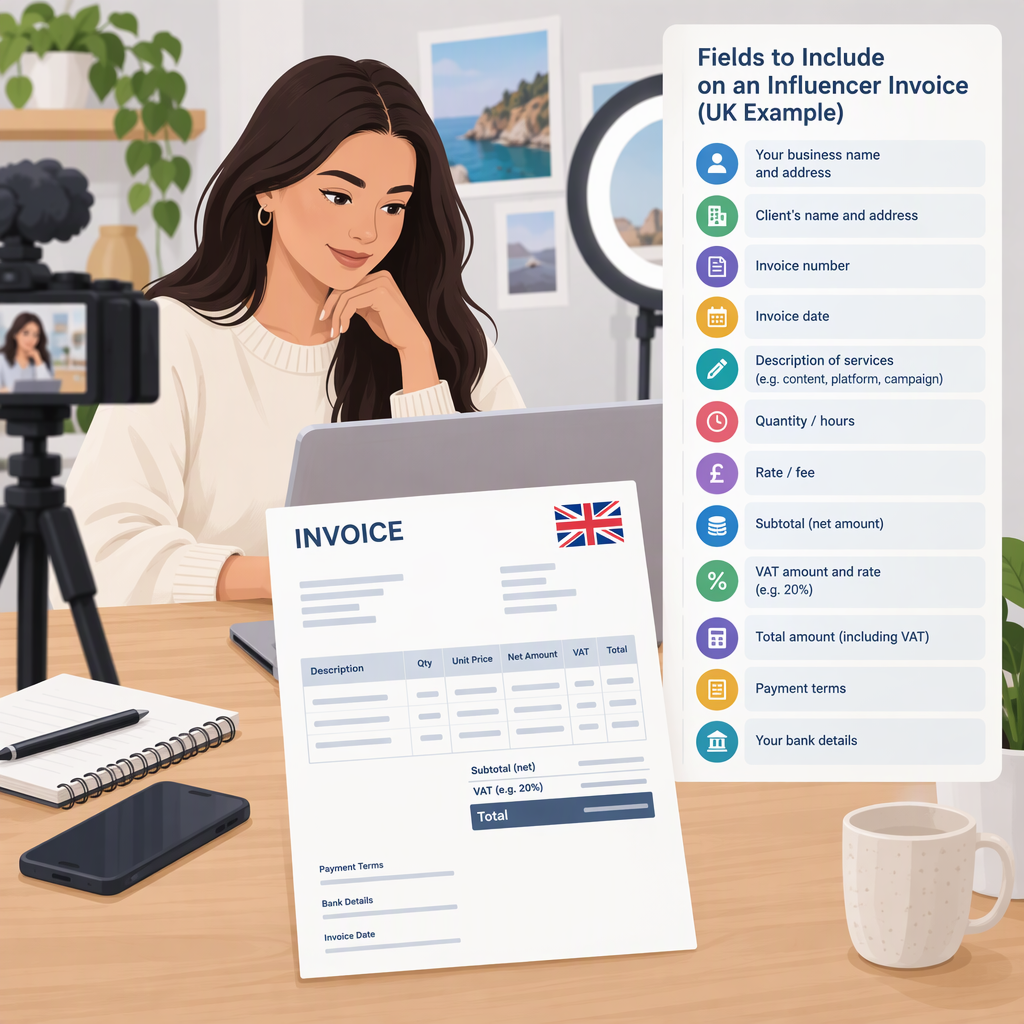
VAT on an Influencer Invoice: Fields to Include (UK Example)
VAT Fields on a Creator Invoice: The Short Answer
There is no single VAT invoice checklist that applies worldwide. The fields and VAT treatment depend on the jurisdiction and the transaction—not simply on whether you are an influencer. The checklist below is a UK example, not a template for creators in every country. The supplied page locale does not establish where you or your client are based.
For a UK full VAT invoice, HMRC lists a unique sequential number; the date of supply and invoice issue date; seller and customer details; a clear service description and extent; item-level values and VAT rates; and the VAT total. Whether to charge UK VAT is a separate question: check your VAT registration position, the service and its place of supply, and any applicable VAT liability rules before filling in the VAT amount. (gov.uk)
UK Full VAT Invoice Field Checklist
For a full UK VAT invoice, check these fields against HMRC guidance:
- A unique sequential invoice number that identifies the document.
- The time of supply (the date the service was supplied) and the invoice issue date. They may be different dates.
- Your name, address and VAT registration number, matching your registration details.
- The customer’s name and address.
- A clear description of the service and its extent—for example, what campaign work was supplied and how much of it. This is an illustrative description, not a required formula.
- For each item: its unit price, the amount before VAT and the applicable VAT rate.
- The total before VAT and the total VAT, with the VAT total expressed in sterling for the UK full-invoice rules described by HMRC.
- The cash-discount rate, if you offer a cash discount.
- A relevant indication or reference if the supply is under a margin scheme or the customer is liable for VAT under a reverse-charge arrangement. Do not add special wording unless that treatment actually applies. (gov.uk)
A payment due date, campaign reference or purchase-order number may help you and your client match the invoice to the work, but the HMRC full-invoice list above does not identify those as VAT particulars. Do not confuse convenient business details with verified VAT requirements.
Decide Whether and How VAT Appears
Use this order of checks for the UK example:
- Check your registration status and obligations. HMRC says someone who is not VAT-registered cannot issue a VAT invoice. That does not, by itself, settle whether you are required to register; check the current registration rules for your circumstances before invoicing. (gov.uk)
- Identify the actual supply and customer. Creator work can involve different services and arrangements. Do not assume a particular VAT result from the job title “influencer.”
- Work out the place of supply. HMRC says service rules depend on factors including the kind of service, the location of the business, and where the business customer belongs. Under the general rule, a service to a business customer is generally treated as supplied where the customer belongs; a service to a non-business customer is generally treated as supplied where the supplier belongs. Special rules can change that result. If the place of supply is outside the UK, UK VAT is not chargeable under the rules in HMRC’s notice, though another country’s rules may need checking. (gov.uk)
- Confirm the VAT liability and any special treatment. If the supply is within UK VAT rules, establish the correct treatment for that service before entering a rate or amount. A reverse-charge note is not a generic way to invoice an overseas brand: use such a reference only when the applicable rule makes the customer liable and the invoice requirements call for it. (gov.uk)
Illustrative arithmetic only: if a confirmed applicable VAT rate is r%, and the agreed fee before VAT is £1,000, the VAT amount would be £1,000 × r ÷ 100, and the total would be £1,000 plus that amount. This calculation does not establish which rate or treatment applies to a creator’s service.
Before You Send the Invoice
- Confirm which country’s VAT rules apply; do not use the UK list as a global template.
- Record what service you supplied, who the contractual customer is, and where the relevant businesses belong.
- Check your VAT registration status and whether registration is required.
- Verify the applicable treatment before showing a VAT rate or amount.
- Check the invoice number, service and invoice dates, seller and customer details, service description, item amounts and totals.
- Add special wording only when the applicable rule requires or supports it. If the service, customer status, place of supply or treatment is uncertain, resolve that uncertainty before issuing the invoice.
For a UK invoice, consult HMRC’s full VAT invoice requirements and place-of-supply guidance for services. Creators outside the UK should use the relevant tax authority’s rules instead.