Free Music Archive Licences: How to Check Whether You Can Use a Track
Free Music Archive (FMA) tracks are not automatically free to reuse just because you can listen to or download them. Before using a track, check the licence shown for that specific song, read the linked licence terms, and compare them with what you plan to do. If the terms do not clearly permit your use, don’t treat uncertainty as permission. FMA says that most tracks are under Creative Commons licences, but that artists select the licences and retain copyright. (freemusicarchive.org)
Check a Specific Track Before Using It
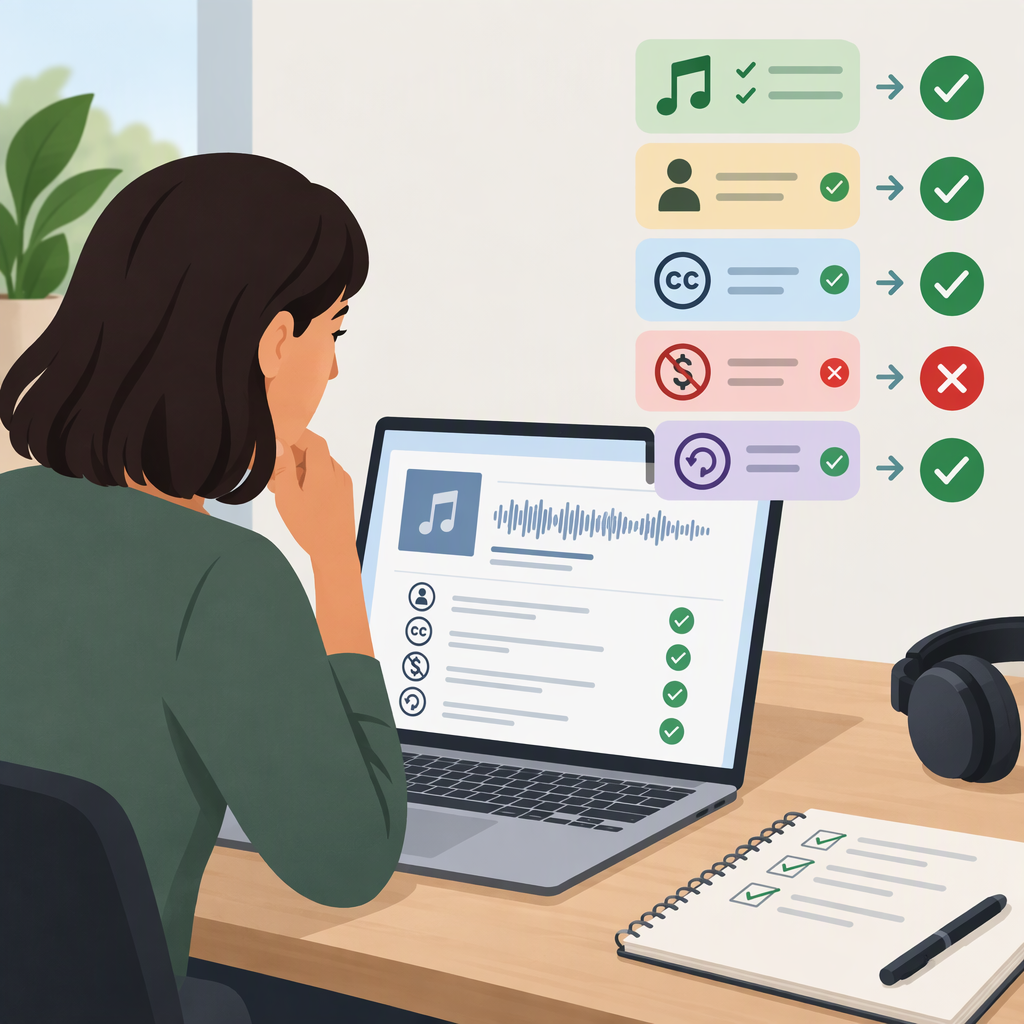
Use this track-by-track process:
- Identify the exact track. Record its title, artist, and FMA track-page details. Don’t rely on an album description or a search-filter result alone: FMA’s own album pages may tell visitors to check individual tracks for their licensing information. (freemusicarchive.org)
- Read the licence shown on the track page. Note the licence name and version, if shown, and follow its link to the licence text. FMA’s License Guide directs users to the specific licence conditions on the song page. (freemusicarchive.org)
- Describe your intended use. For example: Will the track be part of a video, podcast, game, advertisement, or another work? Will you earn money from the project? Will you edit, remix, or otherwise adapt the music? Will you redistribute the track itself?
- Compare each relevant action with the licence. Check whether commercial use, adaptations, and sharing are allowed and what conditions apply. Don’t assume a licence permits every use just because it permits one of them.
- Decide: permitted under the terms you checked, not permitted, or unresolved. If permission is unresolved, pause and seek clarification or choose another track.
FMA says visitors can use its search filters to narrow results by uses such as remixing, video, and commercial use. Treat those filters as a way to find candidates, not a substitute for checking the licence on the individual track you plan to use. (freemusicarchive.org)
What Common Creative Commons Terms Mean
Apply these summaries only if the track page identifies that exact licence and version. The letters flag different conditions; the linked licence text is the authority for the specific permission.
- BY (Attribution): Credit the creator as required by the licence. The CC BY 4.0 deed permits sharing and adaptation, including commercially, subject to its terms. (creativecommons.org)
- NC (NonCommercial): The licence does not grant permission for commercial use. If your project has a commercial purpose, or you’re unsure how the condition applies, seek permission rather than assuming it qualifies as noncommercial. (creativecommons.org)
- ND (NoDerivatives): The licence permits sharing the original, unadapted work under its terms; it does not grant permission to distribute an adaptation. If your project changes the music, get permission or select a track whose licence permits that use. (creativecommons.org)
- SA (ShareAlike): If you distribute an adaptation, the licence requires you to share it under the same terms. Check the legal code for the particular licence and how it applies to your project. (creativecommons.org)
For example, imagine a track is labelled CC BY 4.0. That licence allows commercial use and adaptations if you follow its terms, including attribution. A CC BY-NC licence does not grant commercial-use permission, while CC BY-ND does not grant permission to distribute an adaptation. These are examples of what the named CC conditions mean, not claims about any particular FMA track. If a track shows a different, older, or custom licence, don’t translate it into these examples; read the terms linked from that track instead.
Follow the Conditions That Apply to the Track
For CC BY 4.0, the deed calls for appropriate credit, a link to the licence, and an indication of changes, if any. It also cautions that the deed is a summary: read the actual legal code rather than relying on the summary alone. (creativecommons.org)
A practical record for each track can include:
- Track title, artist, and FMA track-page reference.
- The licence name, version, and link shown for that track.
- The intended use you checked, including whether you will adapt or commercially use the music.
- The applicable credit or other licence conditions, and how you met them in the published work.
Check that the final credit or notice follows the actual licence. Don’t apply a condition from one CC licence to every FMA track, and don’t assume that giving credit makes an otherwise restricted use permissible.
If the Licence or Rights Information Is Unclear
FMA says it cannot change the terms of a licence chosen by the rights holder, and directs users who need different conditions to contact the artist and seek permission. Its video guidance also advises contacting the artist if the CC licence does not allow the intended project. If you request permission, describe the intended use clearly and keep any written response with your records. (freemusicarchive.org)
If the track page and linked terms conflict, the licence version is unclear, or you cannot confirm that your intended use is allowed, don’t rely on the download being available as proof of permission. Recheck the official track information, ask the artist or rights holder if a suitable contact is available, or choose a track with clear permission for your use. FMA’s guidance says the archive does not itself license artists’ original works or change their licence terms. (freemusicarchive.org)
A Creative Commons licence may not address every right relevant to a project; the CC BY 4.0 deed notes, for example, that other rights such as privacy, publicity, or moral rights may affect use. For a high-stakes or uncertain project, consider getting appropriate professional advice rather than treating a licence label as a guarantee of every necessary permission. (creativecommons.org)
Before You Publish
- Have you checked the licence on the specific track, not just an album or search result?
- Does the linked licence permit your commercial use, adaptation, and distribution, as applicable?
- Have you followed the licence’s actual attribution and other conditions?
- If permission is unclear, have you obtained clarification or selected another track?
The key rule is simple: decide from the track’s applicable licence and your actual use—not from the word “free” or the fact that the track can be downloaded.