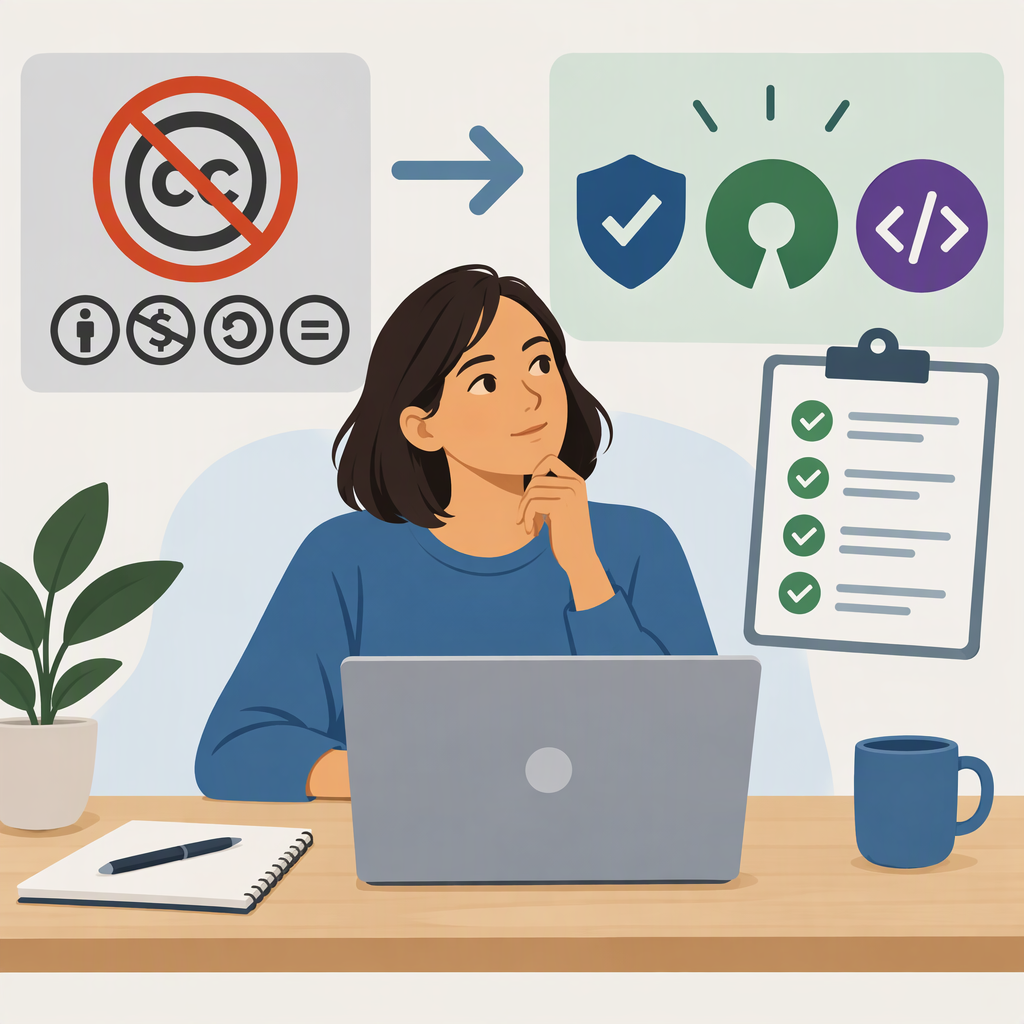
Creative Commons License for Software: What to Use Instead—And What to Check
Short answer: Creative Commons (CC) recommends against using its licenses for computer software or hardware and recommends a standard free software license instead. CC licenses are copyright tools, but they do not address important software-sharing needs such as source-code distribution. That is a recommendation about suitability—not a claim that putting a CC notice on code is automatically impossible or legally meaningless. (chooser-beta.creativecommons.org)
The key distinction is what you are licensing. Software code, a user guide, photographs, illustrations, and other materials distributed together may have different licenses. A CC license on an image or guide does not, by itself, license the software—and a software license does not necessarily cover those separate materials.
Why Cc Is Usually the Wrong Fit for Software
CC says its licenses may be applied to copyrightable works generally, but specifically does not recommend them for computer software or hardware; it points users toward standard free software licenses. One practical reason is that CC licenses do not address source-code distribution, which is an important part of sharing software. (chooser-beta.creativecommons.org)
There is another scope issue: CC licenses operate on copyright and do not cover rights such as patents or trademarks. Software licensing can involve patent permissions as well as copyright permissions, so readers should check what a candidate software license says about each rather than assume one kind of permission covers all rights. (creativecommons.org)
What to do: If you are licensing code, compare established software licenses and read the exact license text. The Open Source Initiative’s directory describes open-source licenses as allowing software to be freely used, modified, and shared, and lists licenses that have gone through its review process. That directory can help you find candidates; it does not decide which one fits your needs. (opensource.org)
Code and Bundled Creative Materials Can Have Separate Licenses
A software package can contain several kinds of work. For example, its code may use a software license, while its manual, screenshots, photographs, icons, or music use a separate license. Identify the rights notice for each component; do not assume the package’s main license automatically covers every file.
CC offers six copyright licenses with different combinations of conditions. For example, all six require attribution; ShareAlike requires adaptations distributed under that license to use the same terms; NonCommercial restricts commercial uses; and NoDerivatives does not permit distributing modified versions without further permission. These conditions concern the CC-licensed material—not automatically the program distributed alongside it. (creativecommons.org)
Hypothetical example: A program’s code is labeled with a software license, and a separately credited illustration in its manual is marked CC BY 4.0. Treat those as two notices for two components. If reusing the illustration, follow its CC BY attribution terms; for the code, consult the software license. The example does not establish that either notice is valid or that the publisher has authority to license the material.
What to Compare When Choosing a Software License
There is no one best license for every project. Before choosing, compare the exact terms against your intended use:
- Use and sharing: What may others do with the software, including copying, modifying, and redistributing it?
- Source code: Does the license address providing source code when software is distributed? CC notes that its licenses do not address this important aspect of software sharing. (creativecommons.org)
- Conditions on redistribution or changes: What notices or other conditions must be preserved, and what terms apply to modified versions? Read the license text rather than infer conditions from a short label.
- Patents and other rights: Does the license contain a patent grant or other relevant terms? Copyright and patent rights are different, and CC licenses do not cover patent rights. (creativecommons.org)
- Compatibility: If you plan to combine the software with other code, check whether the licenses’ terms can be followed together. Do not assume that licenses can be combined just because both allow reuse.
Use a software-license directory, such as the OSI list, to identify possible candidates, then review the full text of the specific license and version. The directory’s inclusion is a useful reference point, not a substitute for checking the terms that apply to your project. (opensource.org)
A Practical License Check Before Reuse or Publication
- List the components. Separate code, documentation, images, audio, fonts, datasets, and other materials where relevant.
- Find the notice for each component. Check the project’s license file and any notices attached to individual assets. A repository label or a file’s presence alone does not establish who owns the work or whether the person posting it had authority to license it.
- Record the exact license and version. Follow the notice to the applicable license text; do not rely only on a shorthand label or search-result snippet.
- Match the terms to your intended action. Check permission and conditions for the use you actually plan—such as modifying, redistributing, or commercially using the work. For CC material, verify the specific license’s conditions, including attribution, ShareAlike, NonCommercial, or NoDerivatives where applicable. (creativecommons.org)
- Check code and assets separately. Also review relevant dependencies and bundled third-party materials under their own notices.
- Pause if rights are unclear. If notices conflict, ownership is uncertain, or you cannot tell which terms cover a component, seek clarification from the rights holder or qualified legal advice before relying on the material.
This is general educational information, not legal advice. License effects can depend on the specific work, license text, and applicable law; if those details matter to a particular decision, get advice suited to that situation.