CreaMem: Scene-Aware Memory for Personalized Agents
CreaSeed Research · Findings of EMNLP 2026
A creator's next opportunity should not start from zero.
CreaMem is research into long-term memory for personalized agents. It explores how an AI business partner can organize experience by context and bring forward what matters when a creator's business changes.
When a new brand reaches out, the right decision is not in the brief alone. It may depend on what has worked before, the creator's audience and creative direction, pricing history, existing commitments, and the goals they are building toward.
That is why an AI business partner needs more than a longer conversation history. It needs memory that understands context.
Abstract
Creator businesses accumulate useful context across partnerships, content, pricing decisions, audience signals, preferences, and goals. CreaMem studies a scene-aware long-term memory architecture that separates this experience by context, represents it through both episodic events and scene-specific traits, and retrieves complementary evidence when a question depends on more than one memory.
The work was evaluated on the LoCoMo and LongMemEval-S long-term memory benchmarks. In the paper's matched evaluation settings, CreaMem achieved the highest overall accuracy among the compared methods. These are controlled research results, not evidence that the architecture is deployed in CreaSeed or that it improves creator income or commercial outcomes.
Key Findings
- Organizing memories by scene can reduce competition between unrelated parts of a user's history.
- Representing experience as both events and traits preserves different kinds of evidence from the same interaction.
- Some questions benefit from retrieving a specific event together with a broader pattern rather than selecting only the most textually similar record.
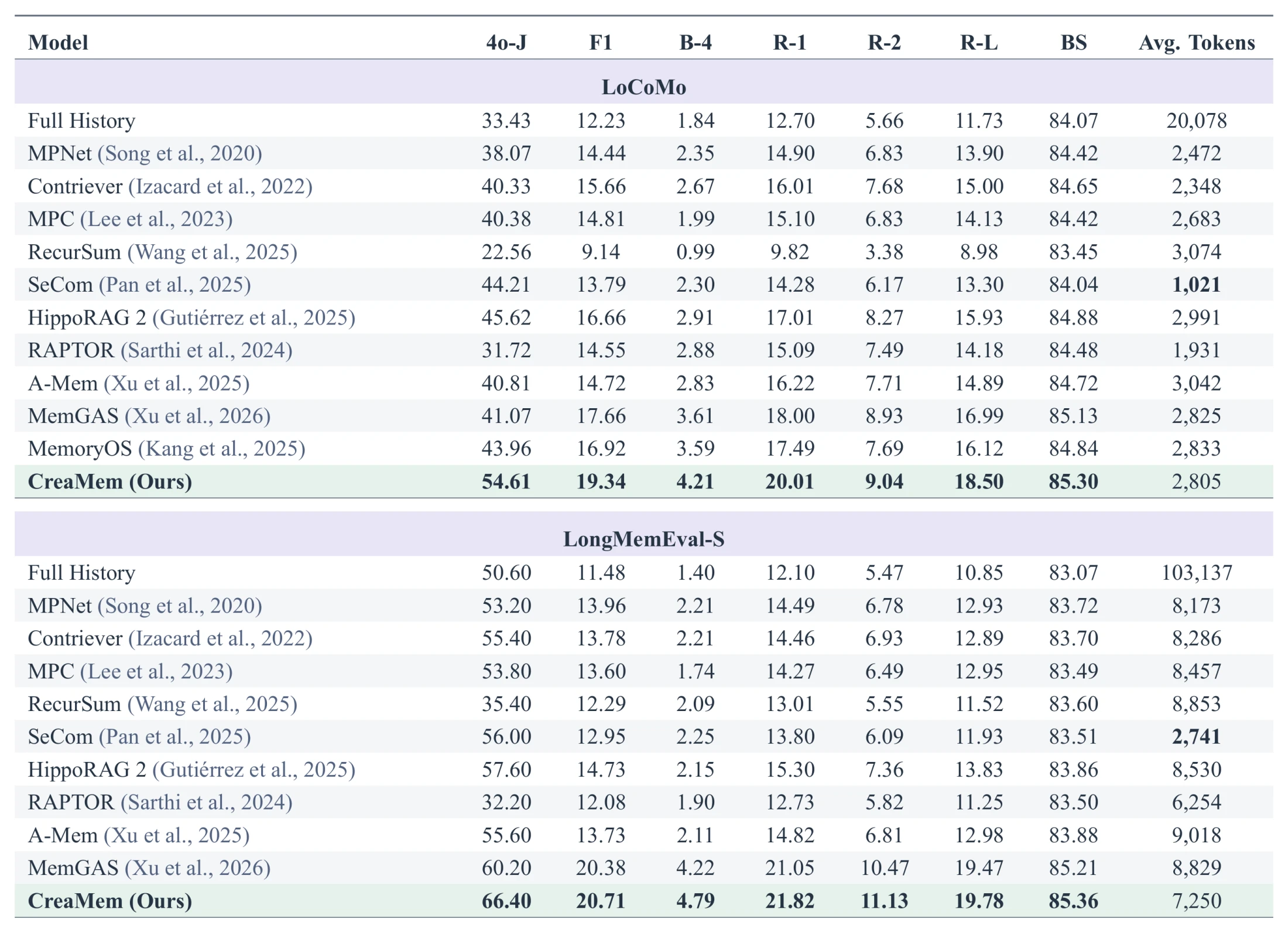
- CreaMem recorded 54.61% overall accuracy on LoCoMo and 66.40% on LongMemEval-S in the paper's matched GPT-4o judge comparison.
Creator Businesses Do Not Fit Inside One Conversation
Every creator business gathers context over time. A past collaboration can reveal more than a deliverable. It can show which formats resonated, which working styles were sustainable, and which types of partnership fit the creator's audience.
Useful support depends on carrying this context forward—without confusing a travel preference with a commercial goal, or treating a past event as the whole story of a person.
A capable assistant understands the task at hand. A true business partner carries context into what comes next.
The Research Question
Many memory systems place everything a user has said into one broad retrieval space. As the memory grows, unrelated experiences compete with one another.
CreaMem asks a different question: Where does this memory belong, what does it reveal, and which other memories are needed to reason about the question at hand?
The research is relevant to personalized agents generally. For CreaSeed, it points toward the long-term continuity a creator needs from a business partner.
Three Ideas Behind CreaMem
Scene-Aware Memory
CreaMem organizes memories into distinct life scenes rather than a single undifferentiated store. This reduces the chance that unrelated parts of a person's experience compete during retrieval.
Dual-Coded Memory
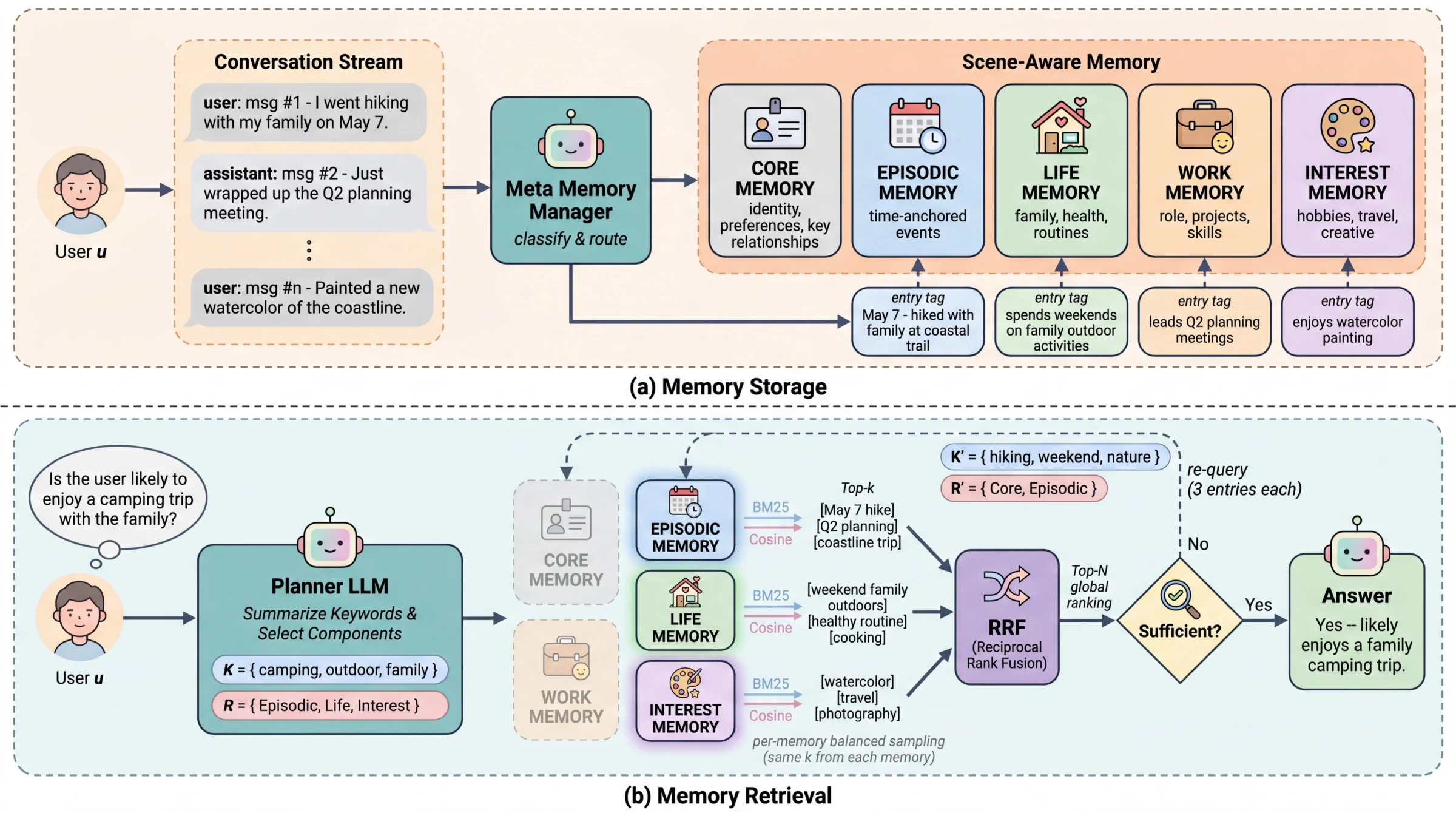
CreaMem represents an experience as an event in Episodic Memory and as a trait in the relevant scene memory. For example, leaving a job to gain autonomy can be stored as a dated event and as evidence of a preference for autonomy at work.
Cross-Memory Synergy
Some questions require both a specific event and a broader pattern. CreaMem retrieves complementary entries from selected memory components so the agent can use both in its answer.
Overall Architecture
CreaMem has two stages: storage and retrieval. A Meta Memory Manager routes information to the relevant components: Core Memory for user profiles, Episodic Memory for time-anchored events, and Life, Work, and Interest memories for scene-specific traits.
For each question, a Planner LLM selects memory components and search keywords. The system balances candidate retrieval across the selected event and trait memories, ranks the combined results, and retrieves additional context if needed before generating an answer.
Methodology
The paper evaluates CreaMem on two established long-term conversational-memory benchmarks: LoCoMo and LongMemEval-S. It compares CreaMem with full-history prompting and a set of retrieval and memory systems under matched benchmark settings, reporting judge accuracy, text-overlap metrics, a broader similarity score, and average token use.
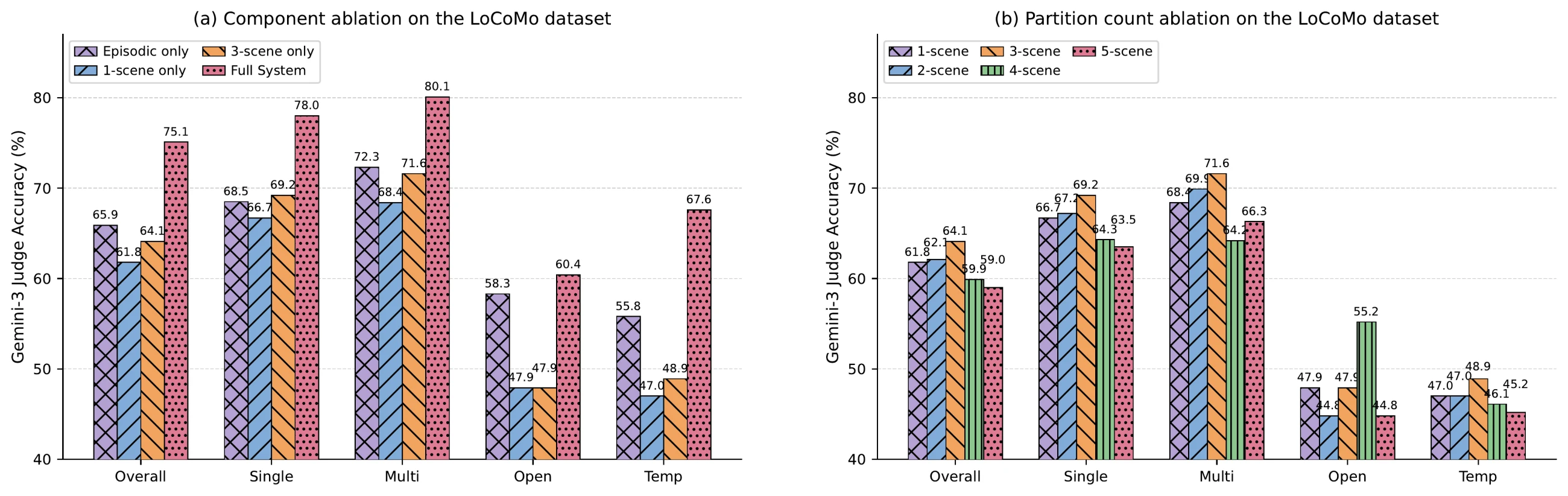
The paper also includes controlled ablations on LoCoMo. These tests isolate the contribution of episodic memory, scene-specific memory, dual encoding, and the number of scene partitions. Some ablations use Gemini-3 as both the question-answering backbone and judge, so their absolute scores should be interpreted separately from the GPT-4o-mini/GPT-4o benchmark comparison.
What the Paper Found
Matched Benchmark Results
In the reported matched evaluation, CreaMem achieved the highest overall judge accuracy among the compared methods on both benchmarks.
| Evaluation | CreaMem | HippoRAG 2 | A-Mem | What It Measures |
|---|---|---|---|---|
| LoCoMo | 54.61% | 45.62% | 40.81% | Long-term conversational-memory question answering |
| LongMemEval-S | 66.40% | 57.60% | 55.60% | Memory question answering across multiple sessions |
Scene and Component Ablations
Under the evaluated scene-partitioning schemes, three scene-specific memories achieved 64.1% overall accuracy, compared with 61.8% for a one-scene partition: a difference of 2.3 percentage points.
The full system combining episodic and scene-based trait memories achieved 75.1% overall accuracy, compared with 65.9% for episodic memory alone: a difference of 9.2 percentage points. This ablation used Gemini-3 as both the question-answering backbone and judge, so it should not be compared directly with the absolute GPT-4o judge results above.
Why This Matters to CreaSeed
CreaSeed is building toward an AI business partner for creators. That partner should become more useful as a creator's business evolves—not restart every time a new brief arrives.
CreaMem is the first public release from CreaSeed Research, published by AgentWoods Inc., the company behind CreaSeed. It reflects a product direction: an AI partner that can carry forward the business context needed for a stronger next decision.
As creators grow, CreaSeed grows alongside them—carrying business context forward so each next opportunity does not start from zero.
Read more: The CreaMem Paper
FAQ
Is CreaMem a CreaSeed Product Feature Today?
No. CreaMem is a research architecture. It informs the direction of CreaSeed's work on long term context, but it is not being announced as a deployed feature.
Will Memory Make Decisions for Creators?
No. Memory can make relevant context available; it does not replace creator judgment. Creators remain responsible for their commercial commitments and final decisions.
Does This Research Guarantee Better Income or More Brand Partnerships?
No. Benchmark performance does not guarantee business outcomes. The value of this research is in exploring a capability that may help an AI partner provide more contextual support over time.