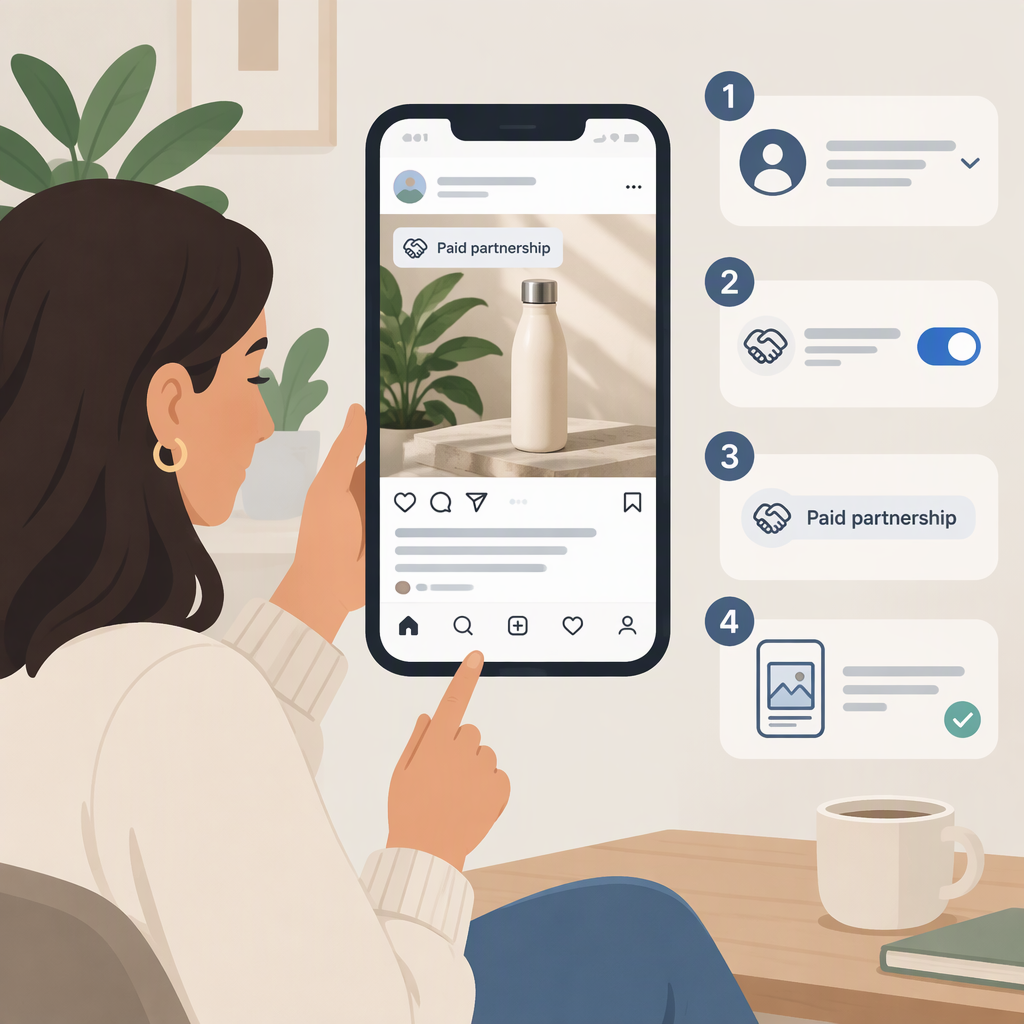
How to Disclose a Sponsored Post on Instagram
The Short Answer
If you endorse a brand on Instagram and have a connection your audience might not expect—such as payment, a free or discounted product, or a personal, family, or employment relationship—make that connection clear in the post itself. Use plain wording such as “Ad,” “Sponsored,” or “Paid partnership with [Brand]”; make it easy to notice without clicking to expand the caption. For Stories and video, put the disclosure in the content itself, not only in the caption. You can also use Instagram’s Paid partnership label, but the FTC cautions that a platform’s built-in tool may not be adequate on its own. (ftc.gov)
This guide summarizes U.S. Federal Trade Commission (FTC) guidance for creators. Other countries may have different requirements, and a post that reaches consumers in more than one country may be subject to more than one jurisdiction’s laws. This is general educational information, not legal advice. (ftc.gov)
When Should You Disclose?
The FTC says to disclose a brand relationship when it is financial, employment-related, personal, or familial. Financial connections are not limited to cash: getting something of value in connection with mentioning a product can count. For example, if a brand gives you a free or discounted product or another perk and you then mention one of its products, FTC guidance says to disclose—even if the brand did not ask you to post. That guidance also says not to assume your followers already know about the relationship, or to skip disclosure just because you believe your opinion is unbiased. (ftc.gov)
A useful distinction: if you bought a product yourself, have no relationship with its brand, and simply want to share your opinion, the FTC’s influencer guide says you do not need to announce that you have no brand relationship. Whether a particular connection needs to be disclosed can depend on the circumstances. (ftc.gov)
What Should You Write?
Choose clear, ordinary words that explain the relationship. The FTC’s influencer guide lists “advertisement,” “ad,” and “sponsored” as understandable options. You can also identify the sponsor—for example, “Ad — [Brand] paid me to try this product” or “Sponsored by [Brand]”—so readers know what the connection is. These are practical examples, not a guarantee that a particular phrase is sufficient in every situation. The disclosure should accurately describe your actual relationship. (ftc.gov)
Avoid vague shorthand such as “sp,” “spon,” or “collab,” and do not rely on a standalone “thanks” or “ambassador” to explain the relationship. If you use a hashtag, make the disclosure itself clear—such as #ad—and do not bury it in a cluster of hashtags or links. (ftc.gov)
Where Should the Disclosure Go?
Put it close to the endorsement, where it is easy to notice and understand. FTC guidance warns against placing disclosures only on your profile, at the end of a post or video, or somewhere viewers must tap “more” to see. (ftc.gov)
- Feed photo or carousel: Put a clear disclosure at the beginning of the caption, before text that could be hidden behind “more.” If the image itself carries the endorsement, a visible disclosure on the image can help connect the notice to what viewers see. Keep it readable and distinct from hashtags.
- Story: Put the disclosure over the image or video, where it can be seen and read for long enough. Do not rely only on a separate caption or another Story viewers might miss. (ftc.gov)
- Reel or other video: Include the disclosure in the video, not just in its caption. Make it noticeable and understandable while the endorsement is being made. In a 2023 warning letter about specific Instagram and TikTok videos, FTC staff said the disclosure should have appeared in the videos themselves; where endorsements were both visual and spoken, the letter called for disclosure in both portions. Treat that letter as a concrete warning about visibility in those videos, not as a ruling on every possible post. (search.ftc.gov)
Example: If you received a free skincare product and recommend it in a Reel, a practical approach is to show a readable “Gifted by [Brand]” or “Ad — [Brand] sent me this product” disclosure in the Reel itself, and put it near the beginning of the caption too. The example applies to the stated free-product scenario; it is not a universal legal safe harbor.
What Does Instagram’s Paid Partnership Label Do?
Meta describes Instagram branded content as content that can carry a Paid partnership label. Use the platform label when it applies to your collaboration, but do not assume it replaces a clear explanation in your content. The FTC says a platform’s built-in disclosure tool might not be adequate by itself; in its warning letter about particular videos, FTC staff said the Paid partnership label was too easy to miss when used alone. Pairing the label with a plain-language disclosure in the post or video is the more cautious approach under that guidance. (about.fb.com)
Before You Publish
- Identify any payment, product, perk, or personal, family, or work relationship with the brand.
- Describe it in plain language—such as “Ad,” “Sponsored by [Brand],” or “[Brand] gifted me this product.”
- Put the disclosure where viewers encounter the endorsement; do not hide it after “more,” in a profile, or at the end.
- For Stories and video, make the disclosure visible in the content itself; use the Paid partnership label as an additional signal where applicable.
The FTC notes that whether a disclosure is needed and whether a specific disclosure is sufficient can depend on context. If your situation is unusual or involves audiences in multiple countries, consult guidance that applies to those circumstances. (consumer.ftc.gov)