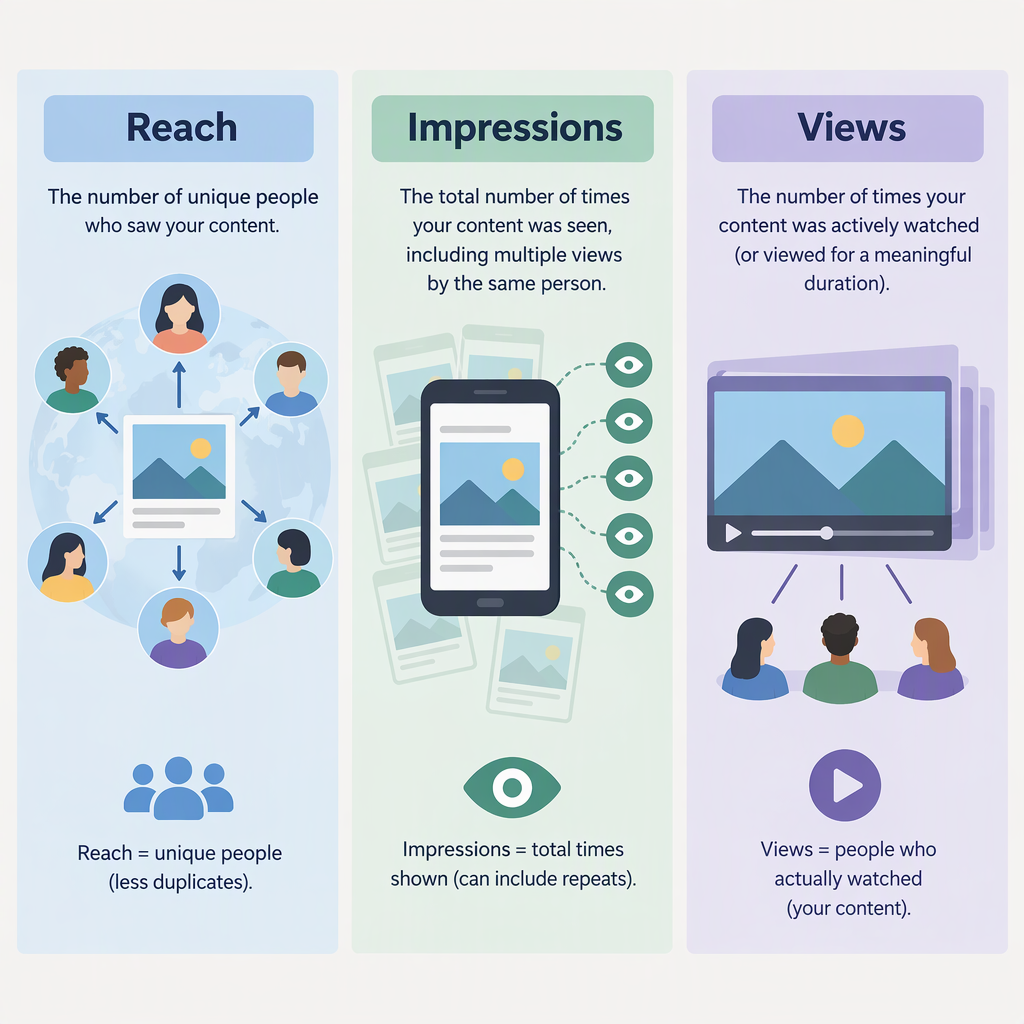
Reach Vs. Impressions Vs. Views: What Each Metric Means
Reach is audience breadth, impressions are exposure volume, and views are qualifying video-play events. That’s a useful general framework, not a universal set of platform definitions: each platform may count these metrics differently, and a “view” can depend on the platform, format, and reporting context.
| Metric | What it helps you understand | What it does not establish by itself |
|---|---|---|
| Reach | How broadly content was seen—typically an estimate of the people or accounts exposed | How many total exposures occurred, or how closely people watched |
| Impressions | How many times content or its representation was displayed under a platform’s rules | How many distinct people saw it, or whether they watched a video |
| Views | How many qualifying video-play events were counted under a platform’s rules | How many unique people watched, how long they watched, or whether they finished |
Why Can the Numbers Differ?
Reach and impressions measure different things. If the same person is exposed to content more than once, that can contribute to multiple impressions while still representing one person in a reach measure—where the platform reports deduplicated reach. So impressions may be higher than reach, but the exact relationship depends on the platform’s definitions and reporting scope.
Views are a separate measure. Platforms set their own rules for what qualifies as a view, and those rules can vary across formats and change over time. For example, YouTube’s published guidance says that, effective August 24, 2026, views count when a video starts playing across Shorts, long-form videos, and live streams. That is a YouTube-specific rule, not a definition to apply to every platform. (support.google.com)
Illustrative example—not platform data: Suppose a post is seen by 100 distinct people, and some of those people see it again, resulting in 140 total displays. Its reach might be 100 and its impressions 140, if the platform measures reach as distinct people and counts each display as an impression. If the post includes a video, the view count would depend on the platform’s separate view criteria; it should not be assumed to equal either number.
Which Metric Should You Use?
Choose the metric that matches the question:
- “How broad was the audience?” → Reach. Useful for audience breadth, but it doesn’t tell you how many total exposures occurred or whether people paid attention.
- “How much exposure did the content receive?” → Impressions. Useful for exposure volume and, with appropriately defined reach, understanding whether people encountered content more than once. Impressions alone don’t reveal how many distinct people saw it.
- “How many video plays qualified?” → Views. Useful for counted play events. Views alone don’t establish unique viewers, watch time, completion, or attention; look for separate audience-retention or watch-time measures when those are the questions.
Compare Like with Like
Before comparing results, match the platform, format, metric definition, reporting period, and scope—for example, whether the report covers one post or an entire account, and whether it combines paid and organic activity. A platform’s own labels and documentation matter: YouTube, for example, defines its thumbnail impressions within particular display contexts and reports views and unique viewers separately. (support.google.com)
Bottom line: Use reach for audience breadth, impressions for exposure volume, and views for qualifying video plays. Treat them as complementary measures, not interchangeable counts, and check the relevant platform’s current rules before interpreting or comparing specific numbers.