How to Build a Content Outreach Strategy for Creator Partnerships
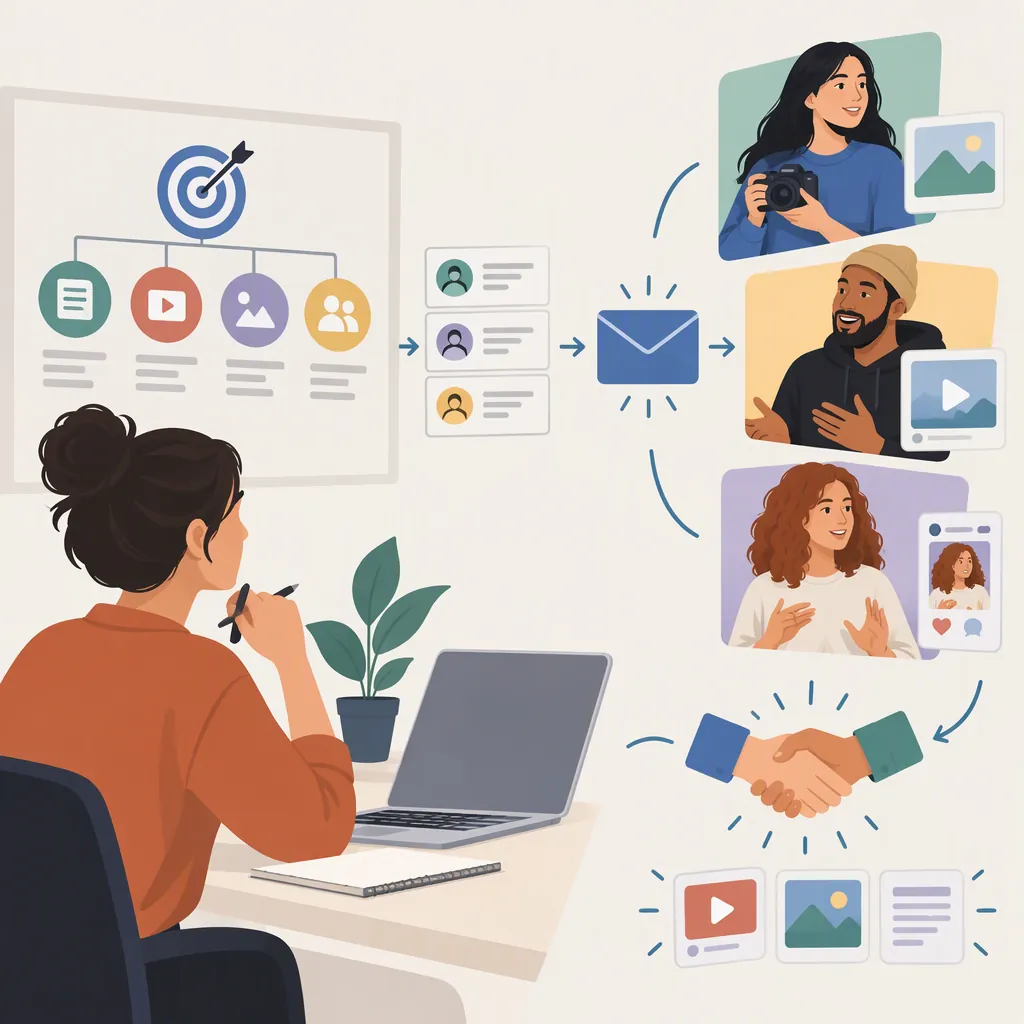
A content outreach strategy is a plan for identifying relevant creators or publishers, offering content that serves their audiences, managing contact and follow-ups, and evaluating outcomes. Start with audience fit and a specific contribution—not a mass contact list. The provided guides support relevant prospecting, concise pitches, and message quality checks; the creator-focused workflow below adapts those principles rather than presenting verified influencer benchmarks. [c2] [c3]
Define the Audience, Contribution, and Outcome
Before choosing creators, write down who the content should help, what useful contribution you can make, and what outcome you will evaluate. Nettl organizes outreach planning around who, why, how, and when. Its guide concerns customer outreach; those questions also provide a practical planning structure for creator partnerships. [c4]
Keep the proposed contribution distinct from the desired outcome. A contribution might be a sourced explainer, an interview, or a demonstration. An outcome might be an agreed collaboration, a published video, or visits to a relevant resource. None is guaranteed simply because a creator replies.
Use one primary objective for the initial outreach round. If the objective is a substantive collaboration, counting sent messages alone will not establish whether the plan worked.
One-Page Outreach Brief
Audience: {Who should benefit from the content?}
Audience question: {What specific question will it answer?}
Contribution: {What can you provide, and what evidence supports it?}
Creator fit: {What publicly observable work makes this creator relevant?}
Primary outcome: {What event will count as success?}
Contact route: {Which publicly listed professional channel will you use?}
Timing: {When is the contribution ready?}
Boundaries: {What compensation, rights, approvals, or deadlines require agreement?}
Measurement: {Which results can you actually observe?}
Research Creator Fit Before Audience Size
Bespoke Digital defines prospecting as finding publications that share the intended audience and assessing their relevance, editorial content, and suitability for contributions. Its guidance is primarily about magazines and blogs, not video-platform analytics. [c2]
For creator outreach, adapt that approach by reviewing publicly available work:
- Topic fit: Does the creator regularly address the question your content answers?
- Format fit: Could the contribution suit their interviews, tutorials, commentary, or other recurring formats?
- Editorial fit: Would the idea add something useful rather than repeat a recent piece?
- Contact fit: Is there a publicly listed professional contact route or submission process?
- Evidence limits: Which audience characteristics are visible, and which remain unknown?
Record specific examples instead of broad praise. A creator covering a topic is evidence of topic relevance; it is not proof of audience demographics, purchasing intent, or willingness to collaborate.
Treat public follower and view counts as context, not a complete selection rule. For this workflow, prioritize a defensible audience-and-content match over an unsupported prediction of reach.
Creator Research Record
Creator or publication: {Name}
Public work reviewed: {Title and source location}
Relevant topic or recurring format: {Observation}
Proposed contribution: {Idea}
Reason it fits: {Specific connection to the reviewed work}
Professional contact route: {Publicly listed route}
Audience information: {Observed facts only}
Unknowns: {Demographics, analytics, availability, or other unverified details}
Decision: {Consider / Hold / Exclude}
Decision reason: {Brief explanation}
Write a Specific, Honest Pitch
Bespoke Digital recommends clear, honest, succinct outreach that explains who the sender is and why the audience would value the contribution. Siege Media emphasizes identifying the appropriate contact, avoiding context errors in templates, and reviewing messages before sending them. [c2] [c3]
Build the pitch around one real observation and one concrete idea. Explain what you can supply and what participation would involve. If compensation, sponsorship, or content reuse is part of the proposal, state that plainly rather than presenting the request as purely editorial.
Do not invent familiarity, praise work you have not reviewed, or promise results you cannot substantiate. A reusable structure is useful; the reason for contacting each creator should still be specific.
The template below is an illustrative drafting aid, not a tested message or a claim about response rates.
Creator Outreach Message Template
Subject: Content idea for your {series or topic}

Hi {creator name},

Your {specific piece} addresses {accurate observation}. I’m {name and relevant role}, and I’m proposing {specific contribution} to help viewers understand {audience question}.

I can provide {materials, expertise, or access that is actually available}. The proposed format is {format}, with {participation requested}. {State any compensation or sponsorship involved.}

Would this fit your editorial plans? If so, I can share a short outline for consideration.

Thanks,
{sender name}
Pre-Send Review Checklist
- Confirm the recipient and professional contact route.
- Check the creator’s name and preferred brand spelling.
- Verify the referenced content and the observation about it.
- Explain the audience benefit in plain language.
- State the contribution and requested participation.
- Remove unsupported results, invented familiarity, and generic flattery.
- Make compensation or commercial involvement explicit when relevant.
- Replace all template placeholders.
- Check any attachments or resource locations.
- Record the message and date before sending.
Set Follow-Up Limits and Manage Replies
Decide on follow-up boundaries before sending. Siege Media recommends providing new value when following up with relevant contacts who have not responded. HeyReach advises respecting declines and stopping after unanswered follow-ups, although its guide focuses on sales and LinkedIn outreach rather than creator collaborations. [c3] [c1]
A conservative starting policy for this workflow is one follow-up after several business days, unless the creator specifies a different process. This is a suggested operating rule, not a proven optimal cadence. Add a useful clarification or a concise outline rather than repeating the original request.
Do not treat silence as permission to contact someone across every available channel. Use the professional route they identify, honor explicit declines, and close inactive threads under the policy you set.
When a creator expresses interest, clarify the scope before assuming agreement: format, responsibilities, compensation, timing, attribution, review expectations, content reuse, and access to performance information. A positive reply is not the same as a confirmed publication.
Reply and Follow-Up Decision Rules
Interested: Clarify scope and unresolved terms; record the next agreed step.
Requests information: Answer the specific question with verified material.
Not now: Follow the recipient’s stated timing; do not invent a restart date.
Declines: Acknowledge briefly and close the thread.
No response: Send at most one useful follow-up under this workflow, then close unless invited to continue.
Delivery failure: Recheck the publicly listed professional contact route before another attempt.
Confirmed collaboration: Record the agreed responsibilities, deadlines, rights, and measurement access.
Separate Outreach Performance from Video Performance
Track the outreach process separately from the performance of any resulting content. HeyReach distinguishes connection acceptance, replies, and conversion between those stages in its LinkedIn reporting guidance. That stage-based approach is useful here, but its sales benchmarks should not be treated as creator-outreach targets. [c1]
For this workflow, use explicit definitions:
| Measure | Suggested Definition | Limitation |
|---|---|---|
| Reply rate | Unique contacted creators who reply divided by unique creators contacted | Include declines; distinguish delivery failures |
| Interested reply rate | Creators who express interest divided by unique creators contacted | Interest does not establish agreement |
| Collaboration agreement rate | Confirmed collaborations divided by unique creators contacted | Define what counts as confirmation |
| Publication completion rate | Published collaborations divided by confirmed collaborations | Pending work needs a consistent cutoff |
| Content outcome | The objective-specific result observed after publication | Availability and attribution may be limited |
For video collaborations, keep publicly visible reach indicators separate from deeper interpretation. Record visible views and the date observed if relevant to the objective. If a creator voluntarily shares analytics, label those figures as creator-provided and record the reporting period and definitions. Do not infer watch time, retention, audience demographics, or conversions from public view counts alone.
These are proposed reporting definitions, not industry standards. The supplied references do not establish video-platform measurement rules or influencer campaign benchmarks.
Outreach and Content Results Ledger
Creator: {Name}
First contact date: {Date}
Delivery status: {Sent / Failed / Unknown}
Reply status: {No reply / Declined / Information requested / Interested}
Agreement status: {Unconfirmed / Confirmed}
Publication status: {Pending / Published / Canceled}
Publication date: {Date or Not published}
Primary outcome: {Defined result}
Observed result: {Value or Not available}
Data source: {Public observation / Creator-provided / Your own measurement}
Reporting period: {Start and end dates}
Limitations: {Missing data, attribution uncertainty, or incomplete reporting}
Review the Process Without Overclaiming
At a consistent review point, inspect each stage before changing the entire strategy. Low interest can prompt a review of recipient fit and the proposed contribution. Replies without agreements can prompt a review of scope or terms. Agreements without publication can prompt a review of readiness and scheduling. Treat these as diagnostic questions, not proven explanations.
Keep a record of what changed between outreach rounds. If you change the creator list, pitch, offer, and timing simultaneously, describe the outcome as a combined change rather than attributing it to one adjustment.
The evidence base has limits. Bespoke Digital and Siege Media primarily discuss editorial outreach and digital PR; HeyReach and Nettl primarily discuss sales or customer outreach. These sources support planning, relevance, personalization, quality checks, and follow-up practices, but they do not validate a particular influencer selection model, video interpretation method, response-rate target, or tool comparison. [c1] [c2] [c3] [c4]
FAQ
What Is a Content Outreach Strategy?
It is a structured plan for finding relevant recipients, proposing useful content, managing communication, and evaluating outcomes. Bespoke Digital distinguishes prospecting—finding suitable publications—from outreach—contacting them with a relevant contribution. For creator partnerships, apply that distinction to creators and their content formats. [c2]
How Much Should a Creator Pitch Be Personalized?
Personalize the reason for contact: reference specific work, explain the audience benefit, and propose a suitable contribution. A template can supply the structure, but check names, context, and accuracy before sending. Siege Media specifically recommends reviewing templates for context breaks and applying editorial quality assurance. [c3]
How Often Should You Follow up with a Creator?
Follow the creator’s stated contact process first. Otherwise, this workflow suggests one useful follow-up after several business days, then closing the thread if there is no response. That is a conservative recommendation, not a verified creator-specific benchmark. Siege Media recommends adding value in follow-ups, while HeyReach advises stopping after declines or unanswered follow-ups. [c3] [c1]
Can Public Video Views Prove an Outreach Campaign Worked?
Not against every objective. Public views can be recorded as an observed content result, but this workflow does not treat them as proof of retention, audience fit, or conversions. Define success before outreach and report unavailable data explicitly. The supplied references do not provide a validated video-influencer attribution method; HeyReach’s metrics concern LinkedIn outreach stages. [c1]