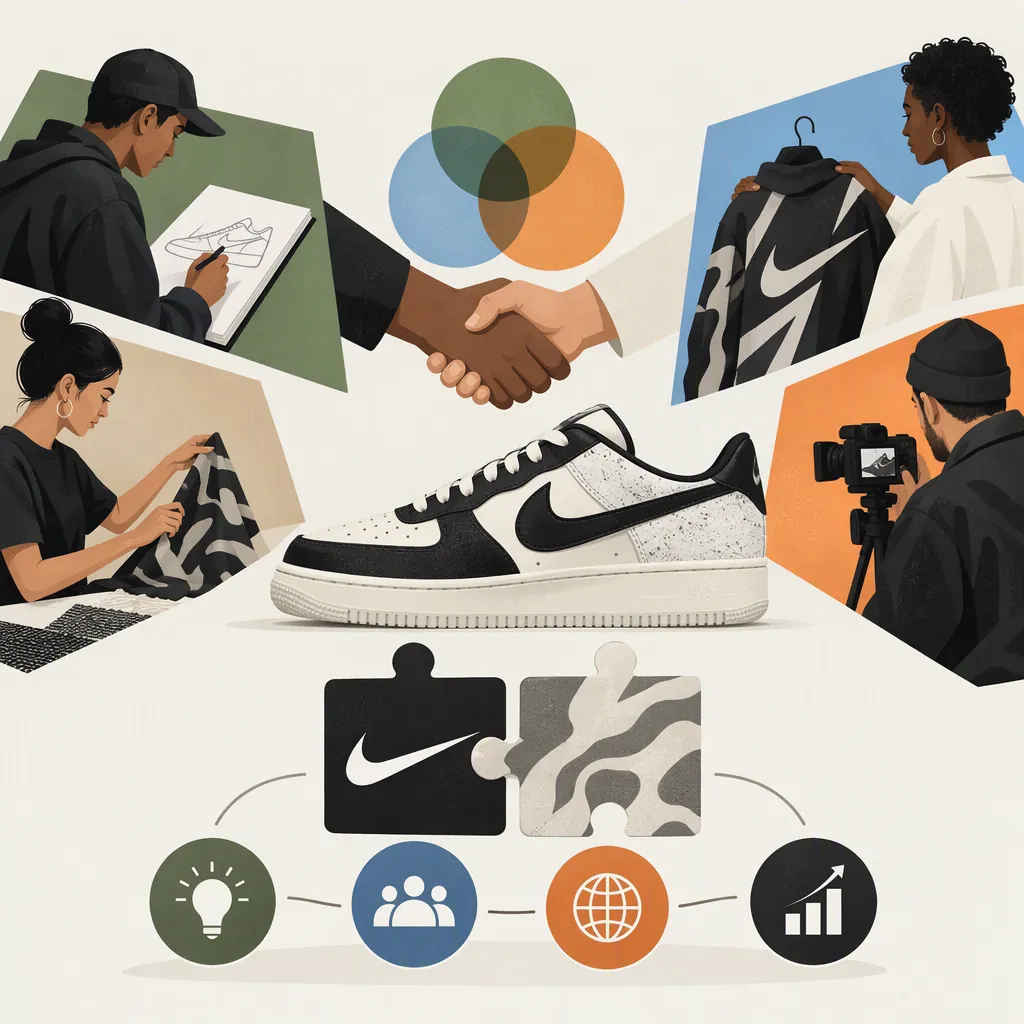
Nike Brand Collaborations: How to Assess Opportunities and Fit
To assess Nike brand collaborations, first distinguish a co-designed product partnership from athlete sponsorship or a paid content campaign. Nike’s public materials document collaborations such as Nike x sacai and Virgil Abloh’s The Ten, but the provided sources do not establish an open application process, current sponsorship openings, compensation, or eligibility rules. Use these examples to research creative fit—not as evidence that a deal is available. [nike_lab] [nike_ten]
Define the Type of Collaboration
“Nike brand collaborations” can describe different arrangements. For research purposes, separate them before evaluating an opportunity:
| Arrangement | What You Are Trying to Establish |
|---|---|
| Product collaboration | Whether the project involves joint design or a co-branded collection. |
| Athlete sponsorship | Whether the arrangement supports an athlete and includes endorsement obligations. |
| Paid content campaign | Whether a creator is contracted to produce defined promotional content. |
| Product gifting | Whether products are supplied and whether any posting obligations exist. |
These are working distinctions, not Nike’s published program categories. An announcement about a collaborative collection does not, by itself, establish a creator recruitment program or sponsorship opening.
For example, NikeLab features Nike x sacai outerwear. That supports the existence of a product collaboration, not a claim that Nike is accepting partnership proposals from readers. [nike_lab]
What Documented Collaborations Can Show
Two official examples provide useful context without revealing a general selection formula:
- Nike x sacai: NikeLab presents this collaboration in an outerwear context, connecting fashion and sport-oriented design. [nike_lab]
- Virgil Abloh’s The Ten: Nike’s retrospective describes a collaborative exploration of ten footwear silhouettes, organized around the design themes “REVEALING” and “GHOSTING.” It also describes Abloh’s design background and the reconstruction process behind the project. [nike_ten]
A practical research question is: What specific creative contribution did the collaborator bring? In these examples, the source material discusses design work rather than simply audience size.
That is a useful lens for evaluating your own concept, but it is not a verified Nike selection criterion. Neither example supplies a minimum follower count, an acceptance rate, or a repeatable route to securing a partnership.
Separate Collaboration News from Open Opportunities
Treat the NikeLab page as evidence of the collaboration it presents and the Abloh article as a historical account. Neither provided source is an opportunity listing with application requirements. The NikeLab source is also a UK page, so it should not be treated as proof of a US-specific program or product availability. [nike_lab] [nike_ten]
When evaluating a possible opportunity, record:
- The source: Is the information an official announcement, a retailer’s description, or an unverified message?
- The offer: Does it identify a specific project and the type of participation sought?
- The status: Is it historical, announced, accepting applications, closed, or unclear?
- The scope: Are geography, dates, eligibility, and deliverables stated?
- The verification gap: What still needs confirmation before the opportunity can be treated as actionable?
Keep “documented collaboration” and “confirmed opening” as separate labels. If a source does not state that applications are open, mark that status as unknown rather than inferring it from a recent announcement.
Opportunity Evidence Log
Copy this template for each item:

- Project name:
- Source URL:
- Publication date, if stated:
- Date reviewed:
- Arrangement type:
- What the source explicitly confirms:
- Application status: open / closed / not stated
- Geographic scope:
- Eligibility requirements:
- Compensation: stated / not stated
- Verified contact or application route:
- Unresolved questions:
- Working label: documented collaboration / confirmed opening / unverified lead
Assess Fit Without Inventing Nike Requirements
Use a self-assessment rather than claiming to know Nike’s internal criteria. A useful fit review asks:
- Relevant contribution: What can you contribute through design, sport, storytelling, production, or community work?
- Evidence: Which existing work samples demonstrate that contribution?
- Audience relevance: Can you describe your audience using information you actually have, without assuming every follower is a prospective buyer?
- Distinctive concept: What makes the proposed work more specific than attaching two names or logos?
- Execution capacity: Can you explain the scope, resources, and timeline needed?
- Potential conflicts: Are there existing commitments or rights issues that would need review?
These questions are a planning framework, not eligibility rules. A strong portfolio or a coherent concept cannot establish that Nike wants the project, has budget for it, or will respond.
Collaboration Fit Worksheet
Complete each field using evidence rather than predictions:

- Proposed arrangement:
- One-sentence concept:
- Specific contribution I can make:
- Relevant work samples:
- Audience information I can substantiate:
- Public Nike example used for context:
- How my concept differs from that example:
- Resources required:
- Existing commitments or rights questions:
- Information still needed from a verified opportunity brief:
- Assessment: supported fit / partial fit / insufficient evidence
Clarify Terms Before Treating a Lead as a Deal
If a verified discussion develops, use written terms to distinguish the actual arrangement from the initial idea. Questions worth resolving include deliverables, payment or product-only compensation, content usage, exclusivity, approval responsibilities, cancellation terms, and applicable disclosure obligations.
Do not fill these gaps with assumptions drawn from famous collaborations. The provided sources do not disclose general Nike sponsorship rates, standard creator contracts, guaranteed response times, or a verified sponsorship email contact. [nike_lab] [nike_ten]
The practical conclusion is narrow: these sources can support research into documented Nike collaborations. They cannot determine whether a particular person or brand is eligible, whether a current opportunity exists, or what terms a future agreement would contain.
FAQ
Does Nike Have an Open Collaboration Application?
The provided sources do not establish one. NikeLab presents collaboration content, while the Virgil Abloh article documents a historical project. Neither should be treated as an open application listing. [nike_lab] [nike_ten]
How Many Followers Do You Need for a Nike Collaboration?
No minimum follower count is stated in the provided sources. The documented examples do not support a numerical eligibility rule, and follower count alone cannot confirm access to an opportunity. [nike_lab] [nike_ten]
Can Nike X Sacai or the Ten Show Whether My Brand Qualifies?
They can inform research into collaborative design, but they do not establish your eligibility. NikeLab features Nike x sacai outerwear, and Nike’s retrospective explains The Ten’s design process; neither publishes a general qualification framework. [nike_lab] [nike_ten]
Sources
-
[nike_lab] NikeLab. Nike UK
-
[nike_ten] The History of Nike x Virgil Abloh's “The Ten” — NIKE, Inc.