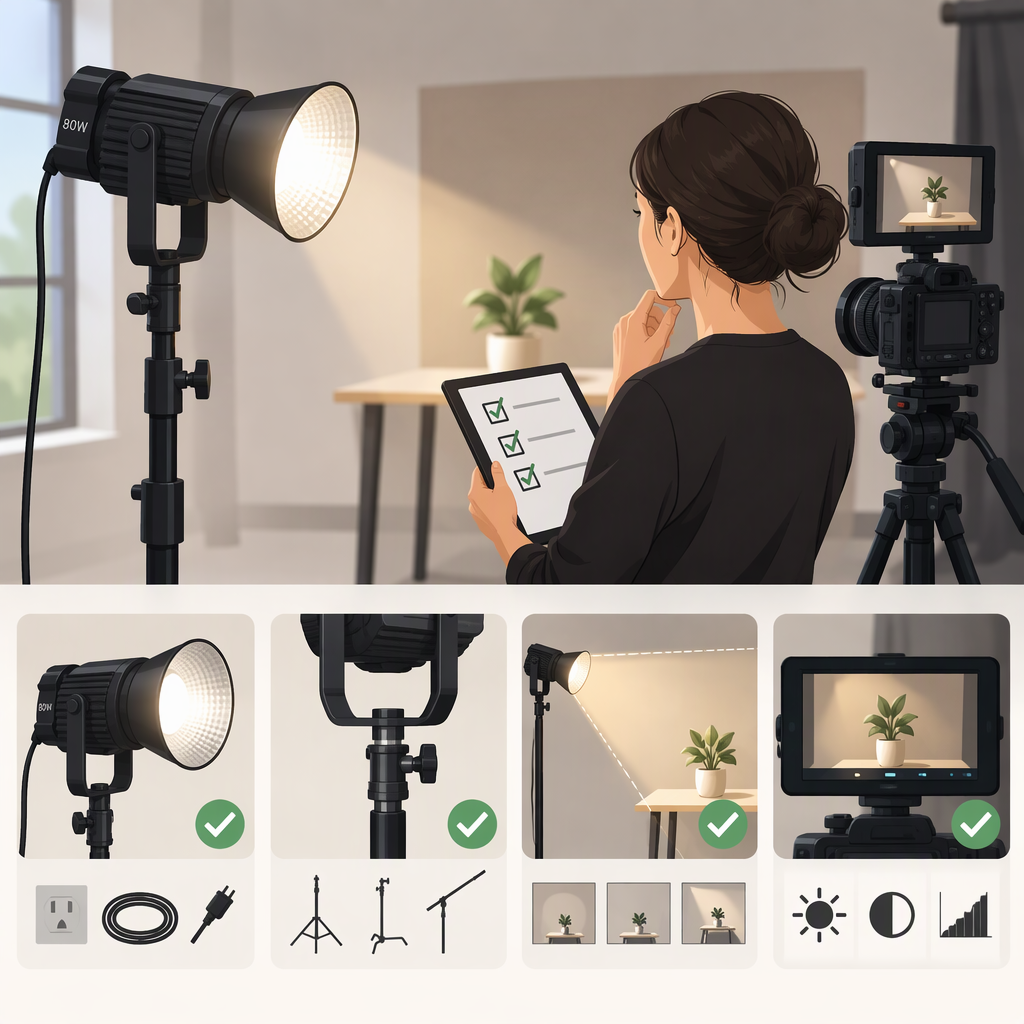
Wellmaking 80W Light: How to Check Whether It Fits Your Filming Setup
Short Answer
The Wellmaking product page identifies its 80W light as the HL-800C. It lists illuminance figures of 8,160 lux at 1 m and 32,090 lux at 0.5 m, along with a 5600K color temperature and adjustable beam angle. Those are manufacturer-published specifications, not an independent test; the page does not state the setup or accessories used for the illuminance measurements. So the figures can help with an initial comparison, but they are not enough by themselves to confirm that the light will suit your shoot. (wellmaking.cn)
Treat “80W” as the product’s stated power rating, not as a direct measure of brightness on your subject. To decide whether it fits, confirm the exact model, compare documented output under relevant conditions, and account for distance, coverage, ambient light, and modifiers. If comparable output evidence is unavailable, the honest conclusion is not enough information to confirm fit.
Verify the Exact Light and What “80W” Means
The manufacturer’s 80W product page names model HL-800C and lists Power: 80W. It also describes the maximum output as 80W. The page does not explain the measurement method or clarify whether “maximum output” means electrical input or another rating. Confirm that the label or manual for the light you are considering says HL-800C; “Wellmaking 80W” alone may not identify the precise product or version. (wellmaking.cn)
The manufacturer lists the following for the HL-800C:
- Illuminance: 8,160 lux at 1 m and 32,090 lux at 0.5 m.
- Color temperature: 5600K; CRI: at least 95; TLCI: at least 96.
- Dimming: listed as stepless from 5% to 100%.
- Beam adjustment: listed as 15–40 degrees.
- Mount: Bowens mount.
- Power: AC adapter or DC battery options are described; the page specifies a 110–240V, 14.8V, 8A adapter and a 14.8V battery option.
- Noise: the page describes the cooling fan as “noiseless,” but gives no measured sound level.
These are manufacturer claims, not independent measurements. The same page also lists “Beam angle ≥ 120°” as a specification alongside the adjustable 15–40-degree angle. Because it does not explain how those two entries relate, ask the seller or manufacturer which applies to the bare light and which to a focusing attachment, if any, before relying on either for coverage. (wellmaking.cn)
Match the Reported Output to Your Filming Setup
Use an illuminance figure only when its distance and lighting configuration are relevant to your use. The HL-800C page gives two distances, but does not specify the reflector, lens, modifier, or other conditions used for those readings. Don’t assume the values will hold with a softbox or other accessory attached.
Before deciding, write down:
- Subject distance: How far will the light be from the subject in your usual setup?
- Coverage: Do you need to light a small product, one person, or a wider scene evenly?
- Ambient light: Will the light work in a controlled room or alongside daylight and other room lighting?
- Modifiers: Will you use a diffuser, softbox, or another accessory that changes the light reaching the subject?
- Required consistency: Will you need to repeat the same look across different distances or locations?
Then compare the manufacturer’s measurements with a measurement or test for the setup you actually plan to use. Comparisons are more useful when distance and accessories match. If those conditions are unknown, regard the published lux numbers as a reference point—not a guarantee of the brightness or coverage you will get.
Example: A creator lighting a small tabletop subject from close range has a different coverage problem from someone lighting a person from farther away or illuminating a wider background. The HL-800C’s two published lux readings may be worth checking against the close-range setup, but they do not establish how evenly a wider scene will be lit. Without a comparable measurement for that arrangement, neither setup can be given a definitive brightness verdict from the 80W label.
Check the Other Specifications That Affect the Result
- Color: The manufacturer lists 5600K, CRI ≥95, and TLCI ≥96. These specifications may matter when matching daylight-oriented lighting or trying to keep filmed colors consistent. Check whether a fixed listed color temperature suits your other lights and workflow; the page does not list a variable color-temperature range. (wellmaking.cn)
- Dimming: The page lists stepless dimming from 5–100%. That may help adjust intensity without moving the light, but the page does not describe dimming behavior or provide test results at different levels. (wellmaking.cn)
- Beam and modifiers: The page lists a Bowens mount and adjustable 15–40-degree beam angle, but its separate ≥120-degree beam-angle entry is unexplained. Confirm the angle and accessory setup relevant to your intended coverage before choosing modifiers. (wellmaking.cn)
- Power and runtime: The page describes AC and DC operation and says its specified 14.8V, 3000mAh battery runs for about 40 minutes at maximum power. Treat that runtime as a manufacturer estimate for the stated battery and condition, not a guarantee for every battery or shoot. Check which power accessories come with the exact listing you are reviewing. (wellmaking.cn)
- Noise: The manufacturer calls the fan noiseless, but supplies no sound-level measurement. If the light will be near a microphone, seek a test or return option that lets you assess fan noise in your own recording conditions. (wellmaking.cn)
- Mounting: Confirm that your stand, tilt bracket, and intended Bowens accessories are compatible with the specific unit and included hardware. The product page’s mention of a Bowens mount does not establish that every accessory or support is included. (wellmaking.cn)
A Practical Decision Checklist
- Match the model: Confirm the product is the HL-800C, rather than relying on “Wellmaking 80W” in a title.
- Read the rating carefully: The manufacturer lists 80W power, but does not define a separate measurement method for “maximum output.” Don’t use wattage as a substitute for subject-level brightness evidence.
- Define your setup: Note subject distance, required coverage, ambient light, and planned modifiers.
- Look for comparable output evidence: Check measurement distance and configuration; if they are missing or unlike your setup, mark brightness fit as unconfirmed.
- Check relevant practical details: Verify color, dimming, beam or coverage, mounting, power accessories, and noise for your use.
- Make a conditional conclusion: It is a plausible fit only if the documented output suits your setup and the verified features meet your requirements. It is a no-fit if a confirmed requirement—such as compatible mounting or adequate measured output—is not met. If the evidence does not answer those questions, the defensible result is insufficient information, not a verdict based on “80W.”