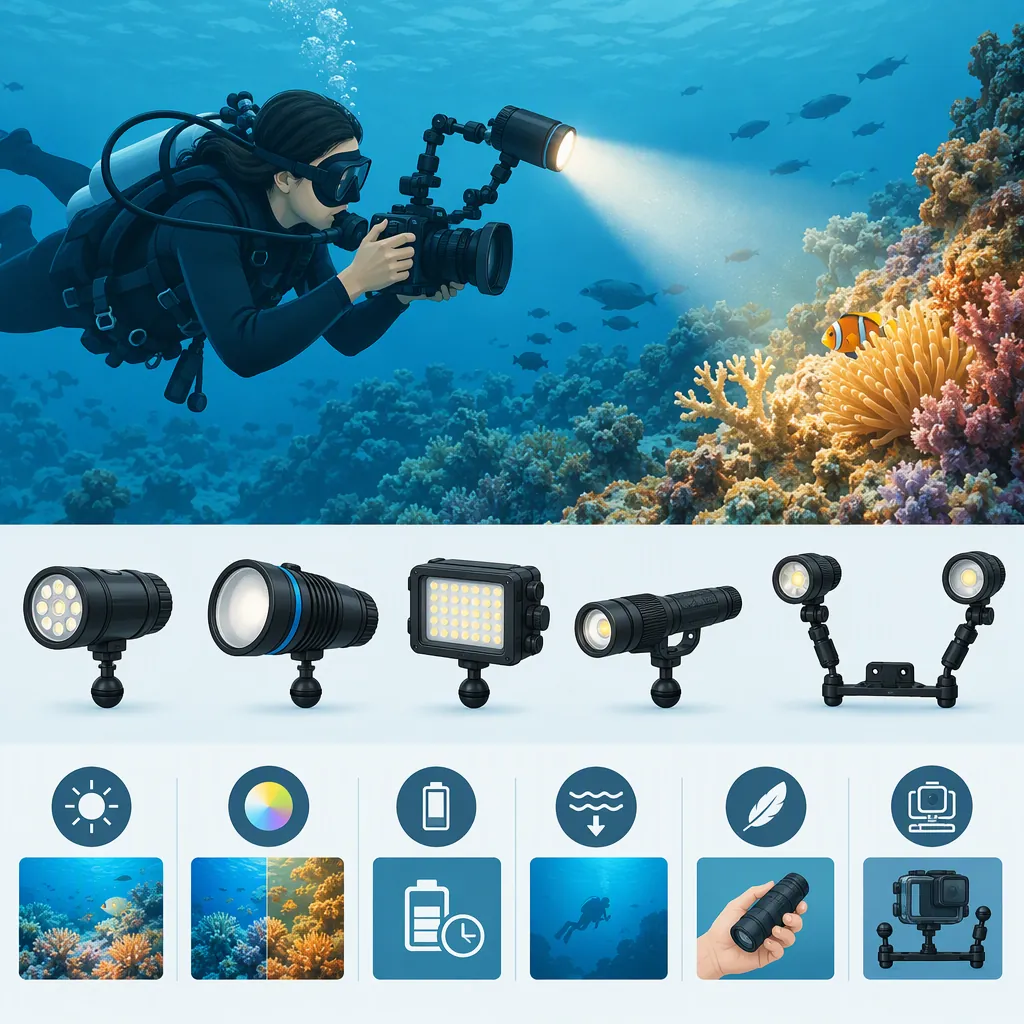
How to Choose the Best Underwater Video Light for Your Filming
The best underwater video light is the one that meets your filming needs for beam coverage, sustained brightness, runtime, depth rating, and handling. Start with a wide-beam option for general video, then check output over time rather than choosing by peak lumens alone. The supplied sources support this selection framework, but not a verified model winner or a universal lumen requirement. [c1] [c2]
Define the Shot Before Comparing Lights
Write down your camera and housing, intended framing, approximate subject distance, planned depth, and recording duration. Use these as comparison requirements rather than beginning with a brand ranking.
DIVEIN identifies intended use, beam shape, light output, batteries, and dimensions as selection factors. It distinguishes broad illumination from a narrow, focused beam. A light suited to navigation or signaling is therefore not automatically the right starting point for filming. [c1]
For a small subject, make controlled coverage and adjustable brightness priorities in your evaluation. For a broad scene, prioritize checking coverage across the actual camera frame. These are suggested comparison priorities, not verified performance claims about any particular light.
Compare Beam Coverage Before Peak Lumens
DIVEIN describes wide beams of 60–120 degrees as suitable for underwater photography and video because they provide even illumination. Treat that range as a starting point from a general dive-light guide—not proof that every light within it will cover your camera's view evenly. [c1]
Evaluate a candidate at the framing and distance you intend to use. Look for a bright center, dark corners, or an abrupt beam edge. A useful comparison should show the whole frame, not just an illuminated subject in the middle.
Do not turn a general dive-light lumen recommendation into a universal video requirement. The supplied references do not establish a single output threshold for every camera, scene, and recording setup.
Separate Sustained Output from Runtime
Ask two different questions: how long does the light operate, and how much brightness does it maintain during that period?
The supplied ScubaBoard discussion raises concerns about output dropping during use. Those posts are user reports and opinions, not controlled comparative measurements; they justify investigating sustained output, but do not establish a brand-wide reliability judgment. DIVEIN also identifies consistent output as a useful selection factor. [c2] [c1]
For each candidate, request an output-versus-time record for the brightness mode you expect to use. Record the test conditions and whether the stated runtime describes steady brightness or merely continued operation. If that information is unavailable, mark sustained performance as unknown rather than assuming the advertised output lasts for the entire runtime.
For a footage comparison, keep camera exposure and white balance fixed and compare clips recorded near the beginning and end of the planned recording period. Follow the light's operating instructions; do not improvise extended dry-running tests.
Light Comparison Worksheet
| Criterion | Candidate A | Candidate B |
|---|---|---|
| Intended framing and subject distance | Record requirement | Record requirement |
| Stated beam angle | Record specification | Record specification |
| Full-frame illumination evidence | Record evidence or unknown | Record evidence or unknown |
| Output at intended brightness mode | Record specification | Record specification |
| Output-versus-time evidence | Record conditions or unknown | Record conditions or unknown |
| Runtime at intended mode | Record specification or unknown | Record specification or unknown |
| Depth rating | Verify for exact model | Verify for exact model |
| Battery replacement and charging | Record procedure | Record procedure |
| Mount and control compatibility | Verify fit | Verify fit |
| Unresolved limitations | List unknowns | List unknowns |
Verify Depth, Batteries, and Rig Fit
Check the exact model's depth rating against your planned use. DIVEIN distinguishes purpose-built dive lights from ordinary flashlights and advises checking the manufacturer's depth rating. Do not substitute a marketplace category label for that verification. [c1]
Make battery access and charging part of the comparison. The ScubaBoard discussion includes concerns about battery replacement in a factory-sealed design, but does not establish current service policies or replacement costs. Treat those as model-specific questions requiring confirmation. [c2]
Before selecting a light, verify:
- The included adapter fits your housing, tray, or arm system.
- Controls are accessible with the gloves you intend to wear.
- The assembled rig remains manageable for you.
- Charging, battery access, seal care, and storage procedures are documented.
Follow the exact model's maintenance instructions. This article is a filming-equipment framework, not a dive-safety lighting plan.
Read Rankings with Their Limitations
The supplied sources serve different purposes:
- General guide: DIVEIN discusses dive-light selection broadly; it is not a matched comparison of video lights for your camera. [c1]
- Community discussion: ScubaBoard offers individual reports and preferences, which should remain attributed rather than treated as test results. [c2]
- Sales ranking: Amazon labels its best-seller list as sales-based and frequently updated. The supplied list mixes lights with mounting accessories and other lighting categories, so its order is not a video-performance ranking. [c3]
- Review archive: Underwater Photography Guide lists individual light reviews, specifications, and comparisons. The supplied archive excerpt does not contain enough full-review evidence to establish a winner. [c4]
A defensible selection meets your documented requirements and makes its unknowns explicit. None of these references, alone or together, verifies one light as best for every underwater video setup.
FAQ
How Many Lumens Do I Need for Underwater Video?
The supplied evidence does not establish a universal number. DIVEIN offers general dive-light output guidance, but your selection should also account for beam coverage, sustained output, and runtime. Treat any lumen figure as one specification, not a complete measure of filming suitability. [c1]
Can a Dive Torch Serve as a Video Light?
Evaluate its beam rather than relying on the dive-torch label. DIVEIN distinguishes narrow beams used for signaling and visibility from wide beams suited to photography and video. Check the candidate's coverage in your actual camera frame before treating it as suitable. [c1]
Does a Best-Seller Ranking Identify the Best Video Light?
No. Amazon describes its ranking as based on sales, not a controlled underwater video test. The supplied list also includes mounting accessories and other lighting categories. Use it as a product-discovery list, not evidence of superior beam quality or sustained brightness. [c3]