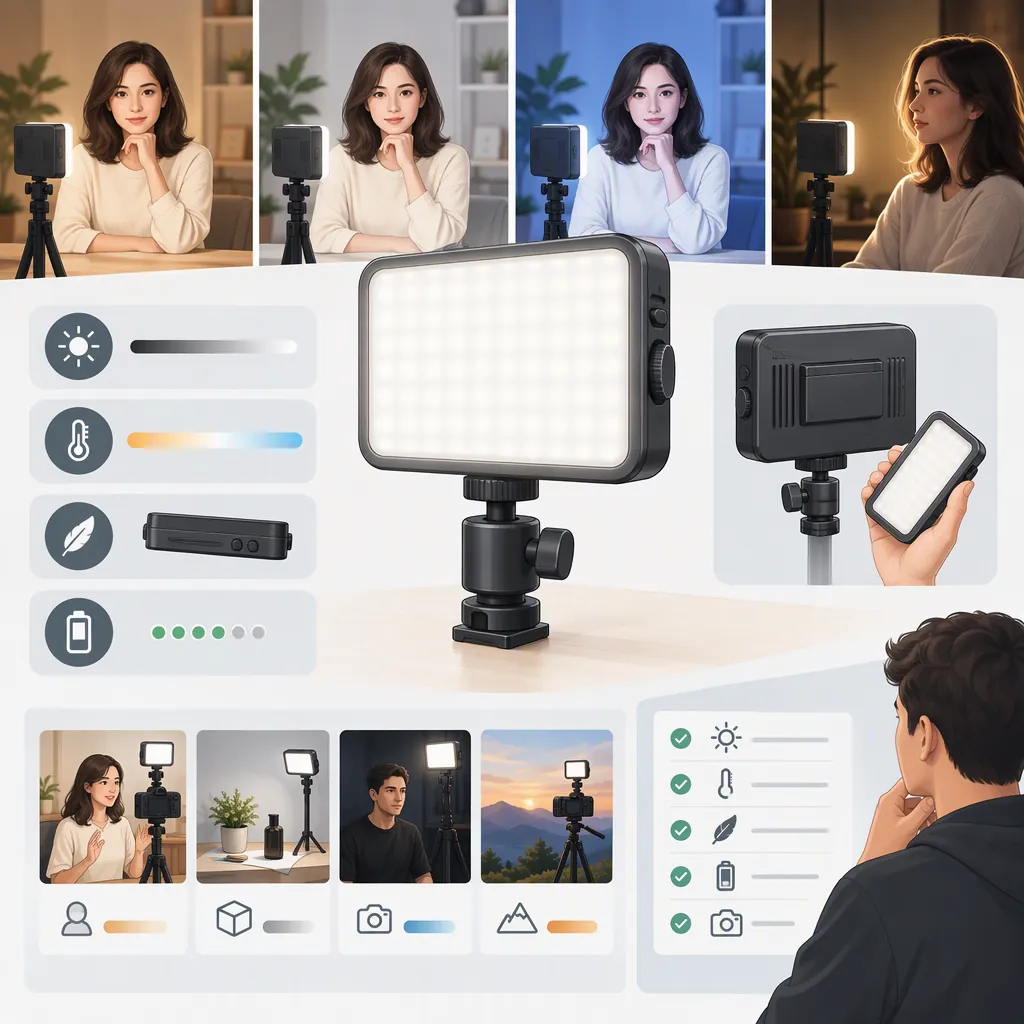
Ulanzi Vijim R316: Choosing a Light for Your Filming Setup
When researching “ulanzi vijim r316,” start with the lighting job: illuminating a face, filling shadows, lighting an object, or adding background color. Define what the shot requires, then assess the exact candidate against those requirements. A light should remain unverified for that role if a necessary condition cannot be checked.
The public reference used here is pepe’s blog’s “Ulanzi RGB LEDビデオライト Model R316,” published December 12, 2020. It is a third-party article, not a current manufacturer specification sheet or a controlled comparison with other lights. It cannot establish suitability for your particular shoot. [r316-source]
Clarify the Model and Evidence
The blog article names Ulanzi Model R316 in its title and includes VIJIM in its embedded shopping text. This naming context does not establish that every listing using Ulanzi, VIJIM, or R316 describes an identical unit or package. [r316-source]
Use this guide as a selection framework, not a product review. The reference does not establish current availability, warranty terms, or the condition of a particular unit. Historical listing details should not be treated as verified present-day facts. [r316-source]
Model Verification Worksheet
Before evaluating a candidate, record:
- Exact model printed on the unit:
- Model shown in its manual:
- Included mounting hardware:
- Included power accessories:
- Documentation date:
- Differences between the unit and its listing:
- Unresolved identity or package questions:
Mark unresolved items as unknown rather than assuming a match.
Define the Lighting Job Before Comparing Lights
Write down acceptance criteria before reviewing test footage. Separate necessary conditions from preferences: an essential recording duration is not the same kind of requirement as a preferred shadow style that you are willing to adjust.
| Lighting job | What to evaluate | What to define beforehand |
|---|---|---|
| Main light for a face | Exposure, skin appearance, shadow shape, and eye comfort | Required face exposure, unacceptable color shifts, intended shadow style |
| Shadow fill | Shadow detail and the balance between light and dark areas | Which details must remain visible and how much contrast to retain |
| Object or tabletop lighting | Reflections, label readability, and coverage | Which surfaces and text must be readable; which reflections are unacceptable |
| Background color or accent | Recorded color and unwanted light reaching the subject | Intended background appearance and acceptable spill onto the subject |
Apply these criteria to an R316 candidate just as you would to another light. No R316 performance result is established by this worksheet.
Shot Requirements Worksheet
Complete one record per planned shot:
- Shot and framing:
- Lighting role:
- Subject-to-light distance and available placement space:
- Existing room lighting:
- Camera frame rate, shutter setting, aperture, and ISO:
- White-balance setting:
- Desired exposure, color, and shadow appearance:
- Required uninterrupted recording duration:
- Necessary conditions:
- Acceptable tradeoffs:
- Reasons to reject the setup:
Hypothetical Example: A Seated Talking-Head Shot
This is a planning example, not an R316 test result.
- Role: Main light for a seated speaker.
- Necessary conditions: The face reaches the exposure target selected before testing; important skin areas show no unacceptable color shift; the mount is secure in the intended position; recording continues for the planned session.
- Preferred appearance: A defined shadow on one side of the face, with both eyes remaining visible.
- Acceptable tradeoff: A different light angle is acceptable if it stays outside the frame and preserves the intended appearance.
- Reject for this role: Required exposure is achievable only by exceeding the chosen camera-setting limits.
- Leave unverified: Continuous operating time has not been tested or adequately documented.
Use your own targets rather than adopting a universal brightness, color, or runtime threshold.
Compare Lights with a Repeatable Test
If candidate lights are available, keep the subject, framing, room lighting, and neutral reference object consistent. Record each light’s distance, angle, operating mode, output setting, and any diffusion or other light-shaping accessory.
Separate two kinds of test:
- Fixed-setting comparison: Lock exposure and white balance so automatic adjustments do not change the comparison between candidates. Keep the same camera settings and reference object in each recording.
- Practical setup test: After the fixed comparison, allow adjustments within your predetermined limits to see whether each candidate can produce an acceptable shot. Record every change and keep these results separate from the fixed-setting comparison.
A fixed comparison shows the results under shared conditions; a practical test checks whether an adjusted setup meets the shot’s requirements. Do not treat them as interchangeable.
Five Checks to Record
-
Exposure: Place the candidate at the intended working distance. Compare the recorded face or object against your preset exposure target. In the practical test, note whether reaching that target requires camera or light changes outside your acceptable range.
-
Color: Include the same neutral reference object alongside skin or important scene colors. Under fixed white balance, note any differences visible in the recordings. In the practical test, record any white-balance adjustment and check whether all important colors remain acceptable. A displayed color-temperature setting alone is not a pass result.
-
Flicker or banding: Record at every planned frame rate and shutter setting, using the intended light mode and output settings. Inspect recorded playback rather than relying only on the live preview. Limit the conclusion to the settings actually tested.
-
Placement and mounting: Check whether the proposed position fits the framing and available space. Follow the relevant hardware instructions, and do not improvise an unsecured overhead installation. Mark mounting compatibility or safety as unresolved if the documentation is insufficient.
-
Power and duration: Rehearse the planned continuous recording period using the intended power arrangement. Record interruptions and operating restrictions. Follow the unit’s documentation rather than assuming it can operate while charging.
These are proposed checks, not reported R316 measurements.
Comparison Record
Complete a separate record for each candidate and test type:
- Candidate and exact model:
- Test date:
- Test type: Fixed-setting comparison / practical setup test
- Camera settings, including white balance:
- Light distance and angle:
- Light mode and output settings:
- Diffusion or other accessories:
- Neutral reference object:
- Power arrangement:
- Exposure result: Pass / fail / unverified
- Color result: Pass / fail / unverified
- Flicker or banding result: Pass / fail / unverified
- Mounting result: Pass / fail / unverified
- Recording-duration result: Pass / fail / unverified
- Footage filename:
- Adjustments made during the practical test:
- Unresolved limitations:
- Decision for this shot and reason:
Turn the Results into a Selection Decision
Use the necessary conditions from your shot worksheet as the first filter.
| Result | Decision for the planned role |
|---|---|
| A necessary condition fails | Do not select that setup for the role. If you revise the setup, test it again. |
| A necessary condition is unverified | Keep suitability unresolved; do not count it as a pass. |
| Necessary conditions pass, but a preference does not | Decide whether the documented tradeoff is acceptable. |
| Necessary conditions and required appearance pass | Treat the candidate as suitable for the tested setup, not for every possible shoot. |
| Several candidates pass | Compare their documented tradeoffs against the same shot requirements rather than declaring a universal winner. |
For example, acceptable color does not compensate for failing a required continuous recording duration. Likewise, passing at one distance or shutter setting does not establish a pass at another.
If You Cannot Test a Candidate
Use documentation and comparable test material to narrow uncertainty, not to convert missing evidence into a recommendation.
| Question to resolve | What to request or check | What may remain unresolved |
|---|---|---|
| Is this the exact model and package? | Unit-label photos, matching manual, and itemized included accessories | Undocumented differences between listings or units |
| Will it fit the intended mounting setup? | Mount details and relevant hardware compatibility instructions | Practical clearance and stability in your actual setup |
| Does the intended power arrangement support the session? | Documented operating restrictions and runtime conditions | Actual duration for the particular unit and chosen settings |
| Is there useful exposure evidence? | Test distance, light mode, output setting, accessories, and camera settings | Exposure in your room and framing |
| Is there useful color or flicker evidence? | Recorded tests with disclosed white balance, frame rate, shutter, and light settings | Results at settings or conditions not tested |
A seller’s answer can clarify the offered package or documentation, but it is not a substitute for a controlled performance test. Footage without disclosed settings may illustrate an appearance without resolving your requirements.
If a critical condition remains unknown, the defensible conclusion is “not yet established for this shot.” You can defer the decision or evaluate another candidate with better-matched evidence; neither choice establishes that the R316 itself passes or fails.
FAQ
Can the Ulanzi Vijim R316 Serve as My Main Filming Light?
Pepe’s blog’s R316 article does not establish that for your setup. [r316-source] Evaluate the exact candidate at your intended distance, framing, room-light level, and camera settings. Require your preset exposure, color, shadow, mounting, and recording-duration conditions to pass before assigning it that role.
Do Ulanzi and Vijim in the Search Term Confirm the Same Product?
Not by themselves. Pepe’s blog uses Ulanzi Model R316 in its title and VIJIM in embedded shopping text, but that does not verify equivalence across all listings. Compare the exact unit label, manual, and package contents. [r316-source]
Does the Available Article Show That the R316 Is Better than Another Light?
No. Pepe’s blog’s R316 article is not a controlled comparison between candidate lights. A ranking would require comparable evidence under conditions relevant to the intended shoot. [r316-source]
What Should I Do If I Cannot Test the R316 Before Choosing?
Verify model identity, mounting compatibility, and power restrictions through matching documentation. Look for recorded tests that disclose conditions comparable to your shot. Keep any necessary condition without adequate evidence marked unverified rather than assuming suitability.
Should I Use Automatic Exposure or Automatic White Balance When Comparing Lights?
For the fixed-setting comparison, lock exposure and white balance. Then run a separate practical setup test in which adjustments are allowed within your preset limits. Record those adjustments so an acceptable final image is not confused with performance under identical settings.
Sources
- [r316-source] Ulanzi RGB LEDビデオライト Model R316 - pepe’s blog