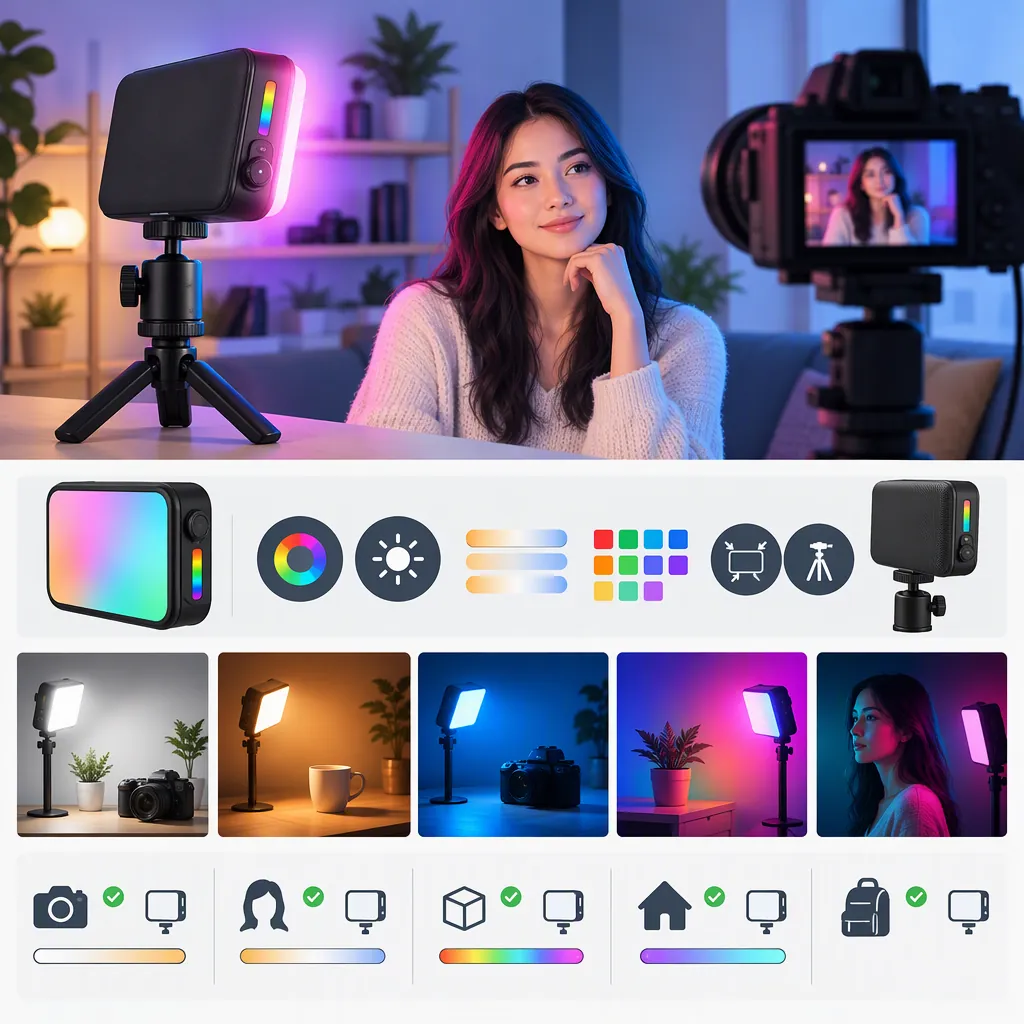
Ulanzi L2 RGB Video Light: A Filming Light Selection Guide
If you are searching for “ulanzi l2 rgb cob video light,” verify the exact model before comparing specifications. The Ulanzi lighting collection excerpt cited here does not identify an L2 RGB model or confirm its COB construction, output, power requirements, or mounting interface. It provides general lighting-selection guidance, not an L2 RGB manual. [ulanzi-lighting]
To make a selection, define your shot’s non-negotiable requirements, check model-specific documentation, and test any unresolved practical conditions. Classify the candidate as suitable for the planned setup, unsuitable, or insufficient evidence according to whether those requirements are met—not according to the search wording.
Verify the Exact Model
Treat “L2,” “RGB,” and “COB” as details to confirm rather than established specifications. Look for a product label and documentation that consistently identify the same model, then record:
- Available light and color modes
- Output measurements and their stated test conditions
- Power requirements and any documented runtime conditions
- Mounting interface
- Compatible diffusion or modifiers
- Dimensions and weight
The cited collection excerpt lists the Ulanzi C60 60W RGB Video Light and Ulanzi C01 100W COB Light L099. These are separate listings; neither establishes the specifications of the Ulanzi L2 RGB named in your search. [ulanzi-lighting]
If the model identity cannot be resolved, stop the model-specific comparison and mark the candidate insufficient evidence. Do not fill gaps with specifications from a similarly named light.
Define the Light’s Job in Your Shot
Ulanzi’s collection guidance identifies key, fill, backlight, and accent roles. It also recommends considering brightness, light quality, power options, portability, RGB adjustment, diffusion, stands, mounts, and modifiers. These are category-level selection factors. [ulanzi-lighting]
Turn those factors into requirements you can evaluate for your own shot:
| Planned role | Prioritize checking | Conditional selection rule |
|---|---|---|
| Main subject light | Exposure and the appearance of the subject at the intended distance, camera settings, and modifier arrangement | Consider the candidate suitable only if the planned setup produces your required exposure and appearance. If a required condition fails, classify it as unsuitable for that setup. |
| Fill light | Adjustment range and the resulting balance with the main light | Require a setting that achieves your intended fill level. If the light cannot achieve that balance in the planned position, it does not meet the requirement. |
| Colored background or accent | Documented color controls, appearance on camera, and coverage of the intended area | If selectable color is essential, confirm that control first, then test the desired look. Missing confirmation means insufficient evidence—not assumed RGB capability. |
| Mobile filming | Total carried size and weight, usable mounting, available power, and session duration | Require the complete setup to fit your carrying, mounting, and power constraints. A confirmed failure on any non-negotiable constraint makes it unsuitable for that session. |
Set your acceptance criteria before evaluating a candidate. For example, specify the recording duration you need, the subject-to-light distance you can accommodate, and whether a particular modifier is essential. These are your setup requirements, not claims about L2 RGB performance.
Build an Evidence-Based Comparison
Separate what you need from what is confirmed. The collection page supports using brightness, power options, portability, and modifiers as selection factors, but its general accessory guidance does not confirm L2 RGB compatibility. [ulanzi-lighting]
For each candidate, record the evidence beside the requirement. When comparing output measurements, retain the stated distance, mode, and modifier; do not treat measurements taken under different conditions as directly equivalent.
Filming Light Comparison Worksheet
Planned setup
- Planned shot: ____
- Lighting role: ____
- Subject-to-light distance: ____
- Camera settings to use in the test: ____
- Required color controls: ____
- Planned recording duration: ____
- Required modifier or diffusion: ____
- Carrying and mounting constraints: ____
Candidate identification
- Exact model: ____
- Model label or model-specific documentation: ____
- Unresolved identity questions: ____
Requirement checks
| Non-negotiable requirement | Documentation or test conditions | Result |
|---|---|---|
| Exposure and subject appearance | ____ | Meets / does not meet / unverified |
| Required color controls and appearance | ____ | Meets / does not meet / unverified |
| Power for the planned session | ____ | Meets / does not meet / unverified |
| Mounting arrangement | ____ | Meets / does not meet / unverified |
| Modifier compatibility | ____ | Meets / does not meet / unverified |
| Size and weight limits | ____ | Meets / does not meet / unverified |
| Acceptable recorded sound and image behavior | ____ | Meets / does not meet / unverified |
Omit requirements that do not apply to the shot, and add any essential constraints specific to your setup.
Translate the Results into a Decision
Use the following rules in order:
- Unsuitable for the planned setup: At least one non-negotiable requirement is confirmed not to be met. Record the failed requirement rather than making a broad judgment about the light.
- Insufficient evidence: No requirement is confirmed to fail, but the model identity or at least one essential condition remains unresolved.
- Suitable for the planned setup: The exact model is established and every non-negotiable requirement is supported by relevant documentation or a test under the planned conditions.
Keep optional preferences separate. A preference can help distinguish candidates that already meet the essential requirements, but it should not conceal an unresolved requirement.
Use a Shot Test to Resolve Practical Questions
When the exact model is established and a sample is available, test the setup you intend to use. The cited collection page provides general guidance rather than identified L2 RGB test results. [ulanzi-lighting]
- Recreate the shot. Use the planned subject placement, light distance, background, and modifier.
- Record the settings. Note camera settings, light mode, brightness setting, power source, and any other relevant controls.
- Review the image. Check exposure, shadows, color appearance, coverage, and visible banding against your acceptance criteria.
- Review the sound. Record with the intended microphone and listen for unwanted operating noise.
- Check the complete arrangement. Confirm that the mount and power setup work for the planned session. A short clip alone does not resolve a full-session power requirement.
- Update the worksheet. Mark only the conditions actually established by the test. Leave other essential questions unresolved.
A successful test supports a decision for that unit and setup; it is not a universal performance verdict. This guide reports no firsthand L2 RGB testing, measured output, or verified runtime.
FAQ
Is the Ulanzi L2 RGB a Cob Video Light?
The cited Ulanzi collection excerpt does not establish whether the Ulanzi L2 RGB is a COB video light. It names other RGB and COB products, but their construction and specifications cannot be transferred to L2 RGB. Confirm the exact model through model-specific documentation. [ulanzi-lighting]
Can the Ulanzi L2 RGB Serve as the Main Light for Filming?
The cited collection page cannot confirm whether the Ulanzi L2 RGB is suitable as a main light. It recommends considering brightness and lighting role, but provides no identified L2 RGB performance evidence. [ulanzi-lighting]
For your setup, require acceptable exposure and subject appearance at the intended working distance, camera settings, and modifier arrangement. If those essential conditions are untested or undocumented, classify the decision as insufficient evidence.
Can I Assume the Ulanzi L2 RGB Supports a Bowens Softbox?
No. The collection’s general modifier and mount guidance is not model-specific confirmation that the Ulanzi L2 RGB supports a Bowens softbox. Verify the exact light’s interface and the intended modifier’s compatibility before treating them as a usable combination. [ulanzi-lighting]
What Should I Do If Important L2 RGB Specifications Are Missing?
Leave the missing fields marked unverified. The cited collection excerpt does not identify the L2 RGB model, so it cannot resolve model-specific gaps. [ulanzi-lighting]
If a missing detail affects a non-negotiable requirement—such as power for the planned session or a required mounting interface—the decision remains insufficient evidence until relevant documentation or testing resolves it.
Sources
- [ulanzi-lighting] Photography Lights | Illuminate Your Creative Vision