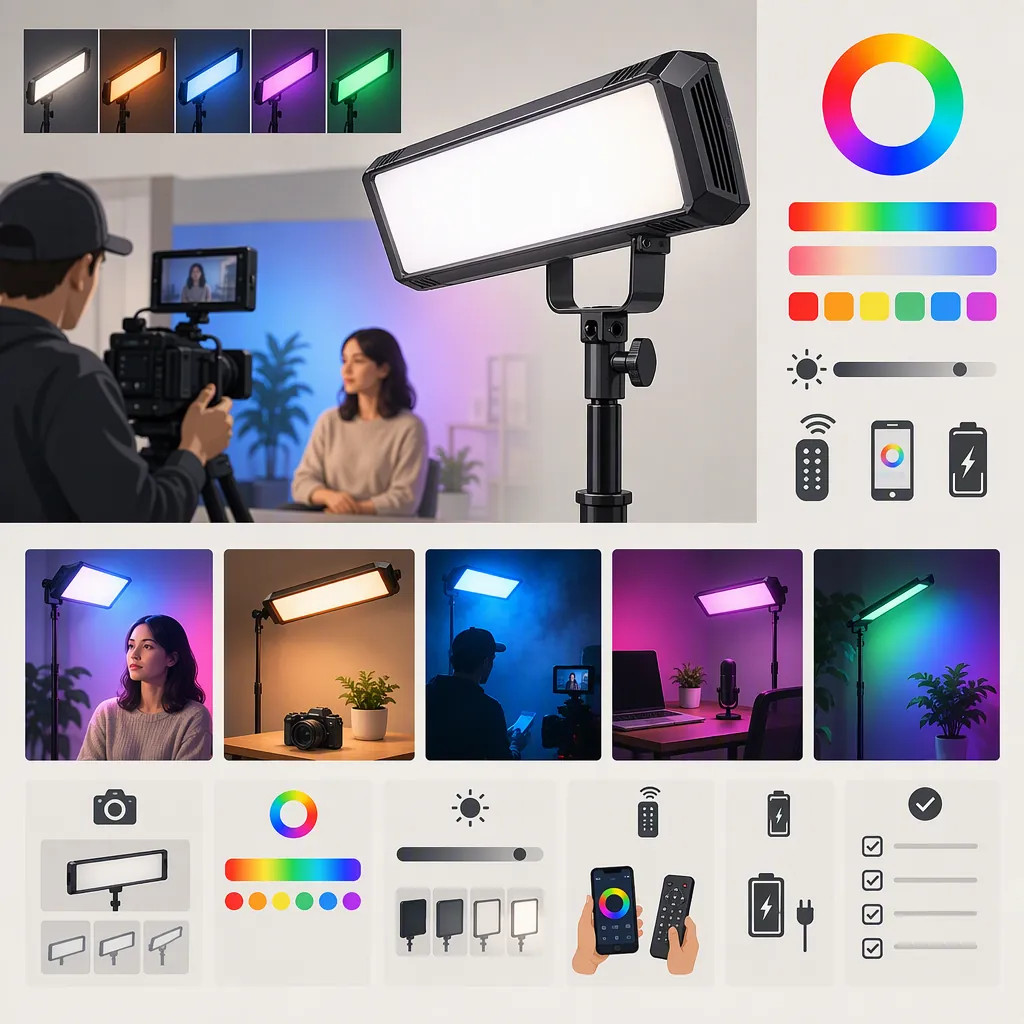
Switti S45 RGB: How to Evaluate It for Filming
Evaluate the Switti S45 RGB by confirming the exact model, checking the included accessories, and testing it with your camera in the intended setup. The supplied sources describe an S45 RGB light and separate S45c bi-color kits; they do not establish that these are interchangeable or provide enough evidence for a definitive performance recommendation. [source_1] [source_2] [source_3]
Confirm the Model Before Comparing Kits
The name is the first selection checkpoint. Medienzentrum des Landkreises Harburg describes a dimmable RGB video light called the S45 from Switti, equipped with a softbox. The two RecycledPhoto references instead identify S45c bi-color kits. These descriptions should not be treated as proof that all three listings refer to the same model or capabilities. [source_1] [source_2] [source_3]
For an item labeled “Switti S45 RGB” or “S45RGB,” check the model label on the actual unit against its documentation. If colored lighting is essential to your shoot, verify the available color controls rather than inferring them from a similar model name. Keep RGB requirements separate from requirements for adjustable white light.
Model Verification Checklist
- Record the exact model name from the fixture label.
- Match that name to the available manual or documentation.
- Identify whether the controls provide adjustable white light, RGB color, or both.
- Record the power-input requirements shown on the unit.
- Mark any unresolved model or accessory mismatch before evaluating performance.
Separate Listed Specifications from Verified Results
The Harburg page, dated December 16, 2022, lists specifications for its S45, including 0–100% brightness adjustment and a 2600–10000 K color-temperature range. These are figures reported by that source, not measurements verified for this article. [source_1]
Its output entry uses the heading “Lumen” but gives values in lux at specified distances. Preserve that distinction: do not convert the entry into a total-lumen claim or use it as a clean comparison with differently documented lights. The supplied text also does not specify whether those readings were taken with the softbox attached. [source_1]
The available references do not establish camera-specific flicker performance, fan noise, battery runtime, long-term reliability, or current availability. Treat these as unresolved selection questions. There is also no supplied comparative test supporting a claim that this light outperforms an alternative.
Compare the Actual Accessory Package
Accessory descriptions differ across the references. Harburg describes two lights with stands in its lending inventory. One RecycledPhoto S45c listing describes a case, softbox, diffusion panel, and AC adapter; the other additionally names a wireless remote. These are descriptions of particular inventories or listings, not evidence of a universal package. [source_1] [source_2] [source_3]
Build a checklist around the actual filming setup: support, modifier, power supply, transport protection, and any required remote control. Confirm each item separately. Do not assume that an accessory shown or named for an S45c kit is included with, or compatible with, an S45 RGB unit.
For an existing or used fixture, inspect the mounting hardware, cables, modifier attachment, and controls before deciding whether the package is complete for your intended work. Follow the unit's documented power and mounting requirements.
Use a Repeatable Filming Test
Use a practical test to resolve the questions the references cannot answer. Define the intended role first: face lighting, tabletop work, a background accent, or another specific setup. Then evaluate the actual unit at the required subject distance, with the intended modifier and camera settings.
For a fair comparison, keep the camera position, exposure settings, white balance, subject, and framing consistent. Record what changes between fixtures. Assess the footage against your needs rather than treating a listed specification as a guarantee.
A reasonable decision rule is to keep the light under consideration only if the exact unit meets your exposure, color, sound, control, and mounting requirements. If any essential requirement remains untested, leave the conclusion provisional.
Filming Test Worksheet
1. Record the fixture model, modifier, power source, and light-to-subject distance.
2. Record the camera, lens, frame rate, shutter setting, ISO, aperture, and white balance.
3. Capture the intended subject at several useful brightness settings; inspect playback for banding or brightness changes.
4. If adjustable white light is needed, record samples at the settings relevant to the scene.
5. If RGB is needed, record the intended colors and inspect the subject and background separately.
6. Record room sound with the production microphone in its intended position.
7. Check mounting stability and access to controls using the documented setup requirements.
8. Mark each requirement as met, not met, or unresolved. Preserve the clips and notes for comparison.
FAQ
Is the Switti S45 RGB the Same as the S45c?
The supplied references do not establish equivalence. Harburg describes an S45 RGB light, while RecycledPhoto describes S45c bi-color kits. Confirm the label and documentation for the actual fixture rather than combining their specifications. [source_1] [source_2] [source_3]
Does Every Kit Include a Softbox and Remote?
A softbox appears in all three supplied descriptions, but a wireless remote is explicitly listed in only one RecycledPhoto kit. That does not establish the contents of every S45 or S45c package. Verify the contents of the specific kit. [source_1] [source_2] [source_3]
Do the Sources Prove It Is Suitable for Interviews?
No. Harburg describes the S45 as suitable for studio video, photo, and portrait work, but that is a source assessment rather than a verified interview test. The supplied material does not establish flicker or sound performance for your camera and microphone setup. [source_1]