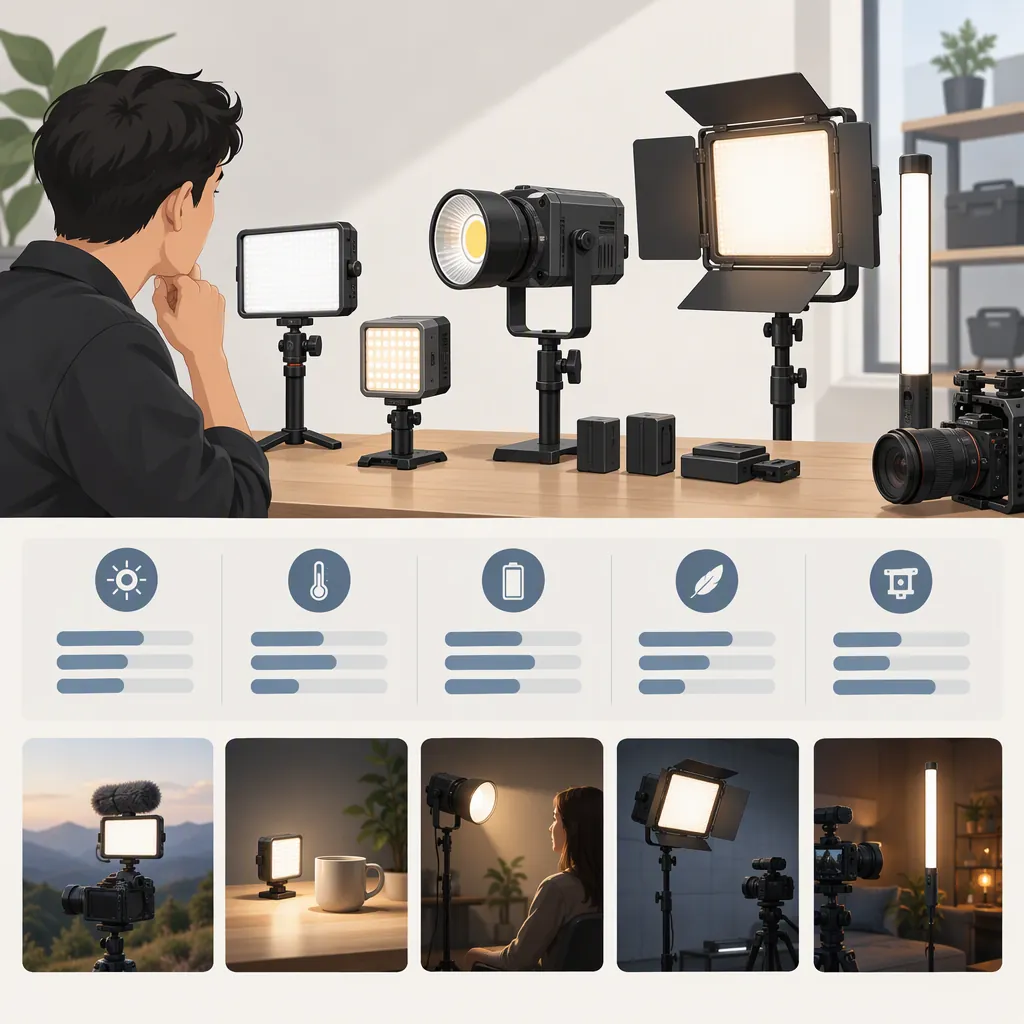
How to Choose a Smallrig Video Light for Filming
Choose a SmallRig video light by defining its job first: camera-mounted fill, a separately positioned subject light, or a background accent. Then compare the exact model and kit for mounting, power, color controls, and modifier compatibility. The supplied sources identify on-camera, LED, and COB lighting categories, but do not provide enough comparable evidence to name a best model or guarantee filming performance. [c1] [c3]
Start with the Shot, Not the Model Name
Write down what the light must accomplish before comparing listings. For a moving camera, prioritize a mounting arrangement and power plan that you can verify for the complete rig. For an interview or desk recording, plan where the light will sit relative to the subject and camera. For a background accent, specify whether you need white light, colored light, or an effect.
The supplied Amazon.com storefront separates on-camera lights, creative lighting, COB video lights, stands, and modifiers. Treat these as navigation categories—not proof that a particular light will suit your shot. [c1]
Use three questions to narrow the search:
- Must the light move with the camera, or can it remain on a support?
- What subject area and working distance must it cover?
- What exposure, color, and shadow appearance will count as acceptable in the finished footage?
Compare the Complete Lighting Setup
The reseller listing includes LED lights, COB lights, softboxes, light stands, and accessories. It also distinguishes some products by regional plug, edition, or kit configuration. Record the exact model identifier rather than comparing only a family name. [c3]
| Selection Area | What to Record or Verify |
|---|---|
| Placement | Camera-mounted or separate support; planned position and subject distance. |
| Light control | Required white-light adjustment, color controls, and dimming behavior. |
| Output | Comparable measurements with distance, modifier, and settings stated. Mark missing data as unknown. |
| Power | Supported supply, connectors, included adapter, and runtime evidence for the intended settings. |
| Mounting | Exact attachment interface and support requirements for the complete assembly. |
| Modifiers | Explicit compatibility with the selected model, not just the brand. |
| Audio | A recording check for operating noise at the intended microphone position. |
| Kit contents | Light, adapter, battery, support, modifier, and cables included or separately required. |
Do not assume that an accessory appearing in the same catalog fits every light. Treat compatibility as unresolved until documentation for the exact combination confirms it.
Keep Listing Claims and Evidence Separate
These references are storefront and catalog material, not a controlled comparison. They support identifying categories and listing variants; they do not establish a performance ranking.
The supplied Amazon.ca P96L listing illustrates why specifications need careful reading: its headline gives a 2500–8000K range, while the item description gives 2500–9000K. It also uses differing model suffixes in the headline and description. Those inconsistencies remain unresolved in the supplied evidence. [c2]
For any candidate, keep the following boundaries visible:
- Do not treat an advertised specification as an independently verified result.
- Do not transfer specifications between similarly named models or editions.
- Leave brightness, runtime, charging compatibility, and recording behavior unconfirmed when the relevant documentation or test conditions are absent.
- Do not use listed price or availability as a lasting comparison point.
This guide therefore offers a selection process, not a product recommendation or a claim about real-world SmallRig performance.
Use a Repeatable Verification Plan
If evaluation equipment is available, compare candidates under the same filming conditions. Set the camera exposure and white balance manually, retain the same framing and subject position, and document each light's placement, settings, and modifier.
Record a short clip at the intended frame rate and shutter setting. Inspect it for exposure, unwanted color shifts, visible banding, and the shadow appearance you need. Record audio with the microphone in its working position. Check power continuity for the planned take length using only power equipment confirmed as compatible.
Without access to a test or sufficiently detailed documentation, label the result unverified rather than converting a listing into a pass.
Lighting Selection Worksheet
Copy one worksheet per candidate.

- Filming task:
- Exact model identifier and edition:
- Required placement and subject distance:
- Required color controls:
- Planned modifier and confirmed compatibility:
- Mount and support requirements:
- Confirmed power supply and kit contents:
- Camera frame rate, shutter, exposure, and white balance:
- Exposure and shadow check: pass / fail / unverified
- Color and banding check: pass / fail / unverified
- Microphone noise check: pass / fail / unverified
- Planned take-length power check: pass / fail / unverified
- Missing evidence:
- Decision and reason:
FAQ
Which Smallrig Video Light Is Best for Filming?
The supplied sources do not establish a best model. Start with the shot's placement, exposure, color, and power requirements, then compare exact models against those requirements. The storefront and catalog identify categories rather than controlled performance results. [c1] [c3]
Should I Choose an On-Camera Light or a Separate Light?
Use camera movement and planned light placement as the first decision points. If the light must travel with the rig, evaluate a camera-mounted setup. If you need independent placement, evaluate a separately supported setup. The supplied storefront lists on-camera lights and separate stand and modifier categories, but it does not verify suitability for a specific shot. [c1]
Can I Rely on the Supplied P96l Specifications?
Treat them as listing information that needs confirmation. The supplied Amazon.ca headline and description disagree on the upper color-temperature limit and use differing model suffixes. Do not resolve those differences by assumption or apply the specifications to another edition. [c2]