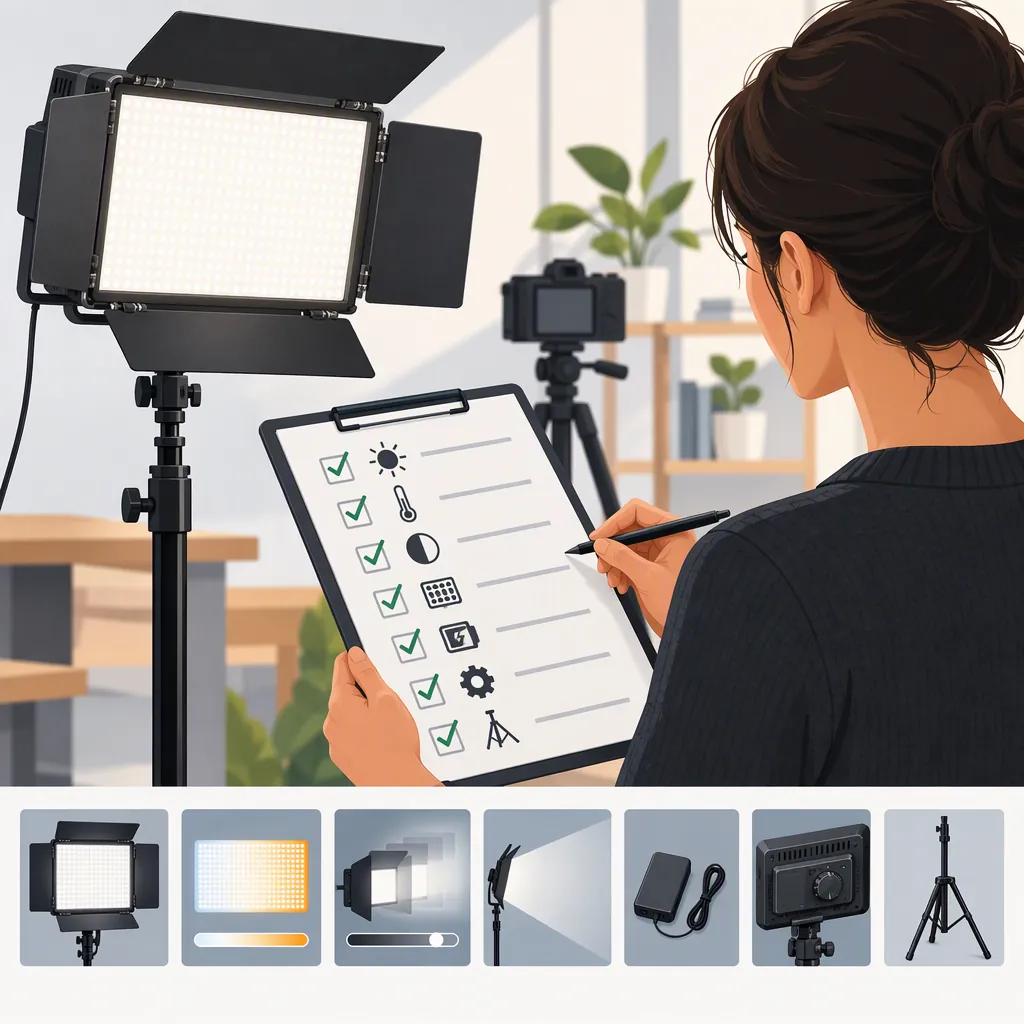
Raleno 116: How to Choose a Light for Filming
To evaluate a light labeled RALENO 116, verify its exact identity, check the documented power and mounting requirements, and test the proposed configuration against your filming needs. Before you have access to the light, you can resolve documentation questions—but its visual suitability remains unverified until you test it in the intended scene.
Evidence limit: The cited Amazon Live page is titled “Watch RALENO PS100 Photography Lighting Kit on Amazon Live.” Its available text provides no RALENO 116 specifications or test results. It therefore does not establish RALENO 116 performance or compatibility. This guide is a selection process, not a product review or recommendation. [source_1]
Verify the Model Before Comparing Specifications
Treat “RALENO 116” as an identifier to investigate, not a complete specification. Before selecting a configuration:
- Record the full identifier. Read the model label on the light, or obtain a clear image of it if you do not have the equipment. Record any model suffix rather than shortening the name to “116.”
- Separate the kit name from the light’s model. Record the package or kit name separately from the identifier on each light. Do not assume a kit title identifies every included component.
- Match the documentation. Check whether the manual or specification sheet explicitly names the same model. If the identifiers differ, leave the affected details unconfirmed.
- Obtain power instructions. Look for the documented power requirements, supported power arrangements, and any instructions for the relevant adapter or battery. Do not infer compatibility from connector appearance alone.
- Obtain mounting instructions. Check the documented mounting interface, supported arrangement, and applicable restrictions. Identify any required accessories and whether their compatibility is confirmed.
If the label or documentation is unavailable, record the missing item as a specific evidence gap. “Full model identifier not confirmed” is more useful than an unexplained “pending.”
Keep the evidence categories distinct:
| Evidence category | What belongs here |
|---|---|
| Documented | Instructions or specifications explicitly tied to the exact model |
| Observed | Results from a test with recorded conditions |
| Unknown | Information neither documented nor tested |
Documentation can help establish how the equipment is intended to be powered and mounted. A camera test can assess whether that documented configuration meets the shot’s visual requirements. Neither substitutes for the other, and the PS100 reference should not be used to fill RALENO 116 information gaps. [source_1]
Define the Shot and Its Acceptance Criteria
Start with the filming job, not an unspecified brightness claim. Identify the light’s intended role—main light, fill, background, or another use—and separate must-haves from preferences.
A must-have determines whether the configuration can serve the shoot. A preference helps compare configurations that already meet the essential requirements.
| Filming situation | Include in the evaluation |
|---|---|
| Seated presenter | Actual framing, seating position, face, glasses, and background |
| Tabletop filming | Intended objects, surface, camera angle, reflections, and access to the work area |
| Mobile filming | Carrying requirements, available mounting space, planned power arrangement, and setup time |
Make the criteria repeatable by stating what you will inspect and what would make the result unusable.
Example acceptance conditions—not RALENO 116 performance standards:
- Exposure: At the planned camera settings, important detail in a predefined area, such as the presenter’s face or a product label, must not be lost to highlight clipping. Identify that area before testing and use the same camera monitoring tools and review method for each comparison.
- Recording artifacts: At every required frame rate and shutter setting, the recorded footage must show no visible bands or pulsing that would make the intended delivery unacceptable. State the review size and viewing conditions, and apply them consistently.
You can also define limits for reflections, shadow placement, setup time, carrying burden, and uninterrupted recording duration. Mark a result uncertain when the test conditions or review method do not allow a reliable judgment.
Visual Screening Is Not Measurement Verification
A camera test can answer a practical question: “Does this configuration produce usable footage for this shot?” It does not, by itself, verify numerical light output, color accuracy, or other specifications.
Likewise, “no visible bands in this recording” is a condition-specific observation, not proof of flicker-free performance at every setting. If a numerical specification is essential to your selection, require evidence tied to the exact model and an appropriate measurement method.
Use One Selection Record
Keep requirements, test conditions, results, and unresolved questions in a single record. This avoids filling out separate worksheets with the same information.
Record header
- Full light model identifier: ______
- Separate kit or package name, if applicable: ______
- Documentation matched to the model: ______
- Intended role, subject, and framing: ______
- Configuration identifier and evaluation date: ______
| Requirement | Planned or tested conditions | Acceptance criterion | Evidence and result | Remaining gap |
|---|---|---|---|---|
| Exposure and coverage | Camera settings, light distance, placement, and controls | Define important subject areas and acceptable detail | Documented / observed; pass / fail / uncertain | ______ |
| Shadows and reflections | Subject, glasses or objects, surface, and background | Identify what must remain visible or unobstructed | Observed; pass / fail / uncertain | ______ |
| Recording artifacts | Required frame rates, shutter settings, and review method | Define unacceptable bands, pulsing, or color changes | Observed; pass / fail / uncertain | ______ |
| Recording duration | Required duration and planned power arrangement | Define unacceptable interruption or change | Observed; pass / fail / uncertain | ______ |
| Power compatibility | Exact power components and model-specific instructions | Confirm the intended arrangement is documented | Documented; confirmed / unknown | ______ |
| Mounting compatibility | Mount, accessories, placement, and instructions | Confirm the intended arrangement is documented | Documented; confirmed / unknown | ______ |
| Practical preferences | Setup time, carrying requirements, and available space | State your preferred limits | Observed or documented; met / unmet / uncertain | ______ |
For visual tests, also record exposure and white balance, whether they were fixed or automatic, camera position, ambient lighting, and anything you could not hold constant. Give each changed configuration its own identifier so results remain traceable.
Test the Proposed Filming Configuration
If the exact light is available, evaluate it in the scene you intend to film. A demonstration of another model is not a substitute.
- Check the documented setup first. Follow the model-specific power and mounting instructions. If a critical compatibility question is unresolved, do not improvise and count it as confirmed.
- Establish a repeatable baseline. Set the intended framing, light-to-subject distance, and camera settings. For controlled comparisons, keep exposure, white balance, camera position, and ambient lighting fixed where possible. Record unavoidable changes.
- Check exposure and coverage. Record the intended scene and inspect the predefined subject areas. Apply the acceptance criteria from your selection record.
- Inspect shadows and reflections. Review relevant faces, glasses, shiny objects, surfaces, and background areas. If you reposition the light or change controls, record a new configuration.
- Review recorded artifacts. Inspect footage for visible bands, pulsing, or unexpected color changes. Repeat at every frame rate and shutter setting required for the shoot.
- Test the full session. Record for the intended duration with the planned power arrangement. Note interruptions or changes rather than inferring endurance from a short clip.
- Evaluate practical handling. Record setup time, carrying requirements, and whether the documented mounting arrangement fits the available space.
If the actual shoot requires automatic exposure or white balance, run a separate test in those modes. Keep it distinct from the fixed-setting comparison so camera adjustments are not mistaken for changes in the light.
Report only what the test establishes: the specific configuration, scene, settings, duration, and observed result.
Make the Selection Decision
Evaluate the configuration, not just the model name. It includes placement, accessories, mounting, power, camera settings, and scene.
| Finding | Decision for this configuration |
|---|---|
| All must-haves pass, and critical power and mounting details are confirmed | Eligible for the shortlist |
| A visual must-have fails | Adjust placement or documented controls and retest; exclude the configuration if it still fails |
| The required recording duration is not met | Evaluate a documented alternative power arrangement, if available, and repeat the duration test |
| Critical power or mounting information is missing | Keep the decision pending until that specific gap is resolved |
| A required camera setting or scene condition is untested | Suitability remains uncertain for that condition |
| Must-haves pass but a preference is unmet | Keep it eligible and record the trade-off |
A failed configuration does not establish that the model fails in every use. A passing configuration does not establish suitability for untested scenes.
If You Cannot Test Before Selecting
Use the documentation stage to narrow the options:
- Confirm the full model identifier and matching instructions.
- Check whether a documented power and mounting arrangement fits your planned setup.
- List the visual and duration requirements that still need testing.
- Separate options with confirmed documentation from options with unresolved critical details.
This can produce a provisional shortlist, not a verified performance conclusion. If a must-have depends on footage or session testing, leave that requirement unverified rather than treating missing evidence as a pass or failure.
Compare Alternatives Using the Same Record
Create one selection record for each alternative. Use the same shot, acceptance criteria, camera settings, and review method wherever possible. Document differences in placement, accessories, or ambient lighting rather than presenting unequal setups as identical.
Compare in this order:
- Identity and documentation: Is the exact model confirmed, with relevant power and mounting instructions?
- Must-have results: Which requirements pass, fail, or remain uncertain?
- Configuration differences: What accessories, placement, or power arrangements does each result depend on?
- Preferences: Among configurations that meet the must-haves, which trade-offs matter for your shoot?
Do not let a convenient setup or a favorable short clip override an unresolved critical requirement.
A defensible conclusion is specific: “This configuration met the recorded requirements at these camera settings for this duration.” Without exact-model documentation and the necessary tests, RALENO 116 suitability remains unverified; the supplied PS100 page does not resolve that gap. [source_1]
FAQ
Is Raleno 116 Suitable for Filming, and What Specifications Are Verified Here?
The supplied evidence does not establish suitability or specifications for RALENO 116. The cited page identifies PS100 instead and provides no basis for assigning RALENO 116 output, color accuracy, battery endurance, mounting compatibility, or flicker performance. Verify the exact model and assess the intended configuration. [source_1]
What Can I Decide Before I Have Access to the Light?
You can check model identity, whether documentation matches, and whether a documented power and mounting arrangement fits your plan. You can also prepare acceptance criteria and identify required accessories. Visual performance and uninterrupted operation for your session remain unverified until tested.
Can Acceptable-Looking Footage Establish Color Accuracy?
No. It can support a practical judgment about that recording under the stated conditions, but it does not establish a numerical color-accuracy specification. Keep visual screening results separate from measurement claims.
What If the Footage Passes but Power or Mounting Information Is Missing?
Keep the configuration pending. A good-looking clip does not resolve compatibility or replace model-specific instructions. Record the missing detail and obtain documentation before treating that requirement as confirmed.