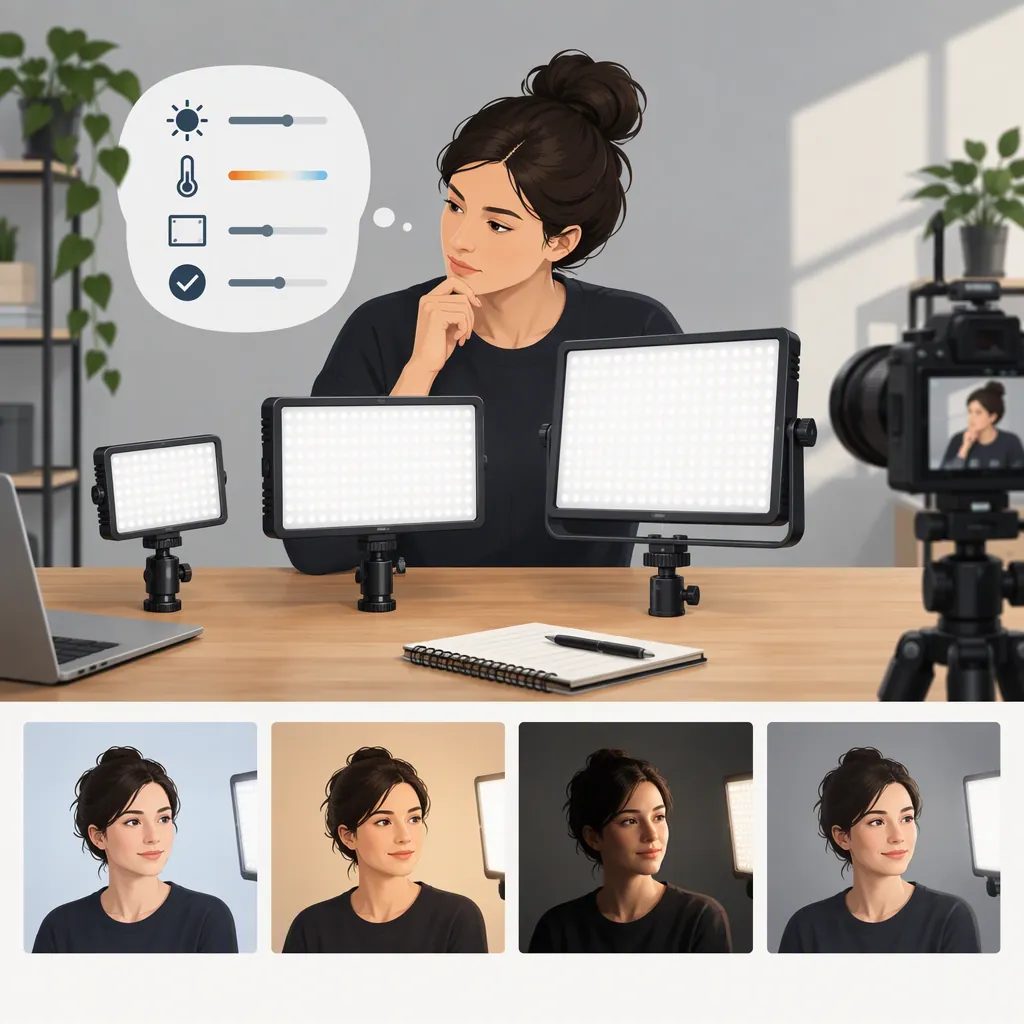
How to Evaluate a Raleno Led Panel for Filming
To select a RALENO LED panel for filming, identify the exact model, define your nonnegotiable requirements, and check whether documentation and camera tests support those requirements. If an essential condition fails, the panel is unsuitable for your current setup. If an essential condition remains unknown, the decision is more evidence needed, not a pass.
The supplied reference identifies a RALENO LED panel lighting video on Amazon Live, but its text does not establish model specifications or measured performance. This guide provides a selection framework, not a verified product recommendation. [ref_1]
What the Available Source Establishes
The reference is titled “Watch RALENO LED Light Panel Video Camera Lighting on Amazon Live.” Its supplied text consists largely of site navigation, without usable model specifications, measurements, or test results. It therefore does not verify brightness, color accuracy, battery runtime, flicker performance, mounting compatibility, or included accessories. [ref_1]
The checks below are proposed evaluation steps. They are not findings from product testing performed for this article.
Define Your Filming Requirements First
Before comparing panels, separate must-have conditions from adjustable preferences.
A must-have is something your setup cannot accommodate changing—for example, your required recording duration or intended mounting arrangement. A preference is something you could adjust, such as placement, if the resulting setup remains acceptable.
Record these conditions:
- Scene and framing: Are you recording a seated presenter, a tabletop subject, or a moving subject? How much of the scene needs illumination?
- Placement: What light-to-subject distance and space outside the frame are available?
- Camera settings: What resolution, frame rate, shutter setting, aperture, and ISO do you intend to use?
- Existing light: Will windows, ceiling fixtures, or other lamps remain in the scene?
- Session length: What is the longest uninterrupted recording you need?
- Support and power: Which stand or mounting point will you use? Will power come from an outlet or a battery?
- Acceptable adjustments: Could you change placement, camera settings, or the power arrangement? Which changes are unacceptable?
The selection question is: Can this exact model meet my must-have conditions, with only adjustments I am willing to make?
Filming Requirements Worksheet
| Requirement | Your planned setup | Must-have or preference? |
|---|---|---|
| Exact model identifier | ______ | — |
| Scene and framing | ______ | ______ |
| Light-to-subject distance | ______ | ______ |
| Available placement space | ______ | ______ |
| Camera and lens | ______ | ______ |
| Resolution / frame rate / shutter setting | ______ | ______ |
| Aperture / ISO | ______ | ______ |
| Other lights remaining in the scene | ______ | ______ |
| Longest uninterrupted recording | ______ | ______ |
| Power arrangement | ______ | ______ |
| Stand or mounting point | ______ | ______ |
Acceptable adjustments: ______
Unacceptable compromises: ______
Check the Exact Model, Not Just the Brand
Seek documentation for the specific panel and kit under consideration. Mark missing information as unknown rather than borrowing specifications from another model.
| Item | What to verify in model-specific documentation | What still needs evaluation in your setup |
|---|---|---|
| Output | Available output measurements, including measurement distance and panel settings | Whether the panel illuminates your actual scene adequately |
| Color controls | Stated adjustment range and any documented color-quality measurements | Whether its appearance is acceptable alongside your other lights |
| Dimming | Available controls and any documented limitations | Whether intended settings produce acceptable footage |
| Power | Supported power sources, charging requirements, and runtime test conditions | Whether the intended arrangement lasts through your session |
| Mounting | Mount interface, dimensions, weight, and support requirements | Whether your support meets the documented requirements |
| Accessories | Exact contents of the model or kit | Whether all required stands, adapters, or other accessories are accounted for |
Documentation and scene tests answer different questions. A documented mounting interface can help you check compatibility; an output measurement alone does not demonstrate that your particular framing and camera settings will work.
If You Cannot Test the Panel
Look for the exact model’s public manual or specification sheet, plus test material that states its conditions. For each relevant result, record the model identifier, panel settings, distance, power source, and camera settings where applicable.
Keep these limits explicit:
- Do not transfer findings from a different model or kit.
- Do not treat footage with undisclosed settings as a controlled comparison.
- Do not assume a stated runtime applies to an unspecified brightness or power arrangement.
- If a must-have condition remains unresolved, retain more evidence needed as the decision.
The supplied Amazon Live reference does not resolve the model-specific checks above. [ref_1]
Use a Repeatable Camera Test
If you have access to the exact panel, test it in the intended setup. Separate a controlled comparison from an actual-use test so the results remain interpretable.
- Set up the real scene. Use the planned camera position, framing, and light-to-subject distance. Follow the equipment’s mounting and power instructions.
- Establish controlled settings. For comparisons, keep the scene unchanged and fix exposure settings and white balance across clips. Record aperture, ISO, shutter setting, frame rate, white balance, panel settings, and power source. Note any deliberate change.
- Evaluate usable output. Record with your intended camera settings. Decide whether the result meets your requirements without an unwanted change to aperture, ISO, shutter setting, or placement.
- Inspect subject and background appearance. Review a face or representative subject, including bright areas, shadows, reflections, and the background. Judge the result against your written requirements.
- Check recording artifacts. Test each intended frame rate, shutter setting, and dimming level. Look for bands, pulsing, or other unwanted changes. “Not observed in this test” is not proof of universal flicker-free performance.
- Test the full session. Use the intended power arrangement for your planned recording duration. Note interruptions and changes in the image.
- Check audio and handling. Listen to a quiet recording. Assess whether placement, controls, and cable routing are workable.
- Run a separate actual-use test if needed. If you normally use automatic exposure or automatic white balance, test that workflow separately and label the automatic settings. Do not treat those clips as equivalent to a fixed-setting comparison.
Compare candidates under the same controlled conditions where possible. A result applies to the tested setup, not every camera setting, placement, or power condition.
Panel Test Record
| Field | Record |
|---|---|
| Model tested | ______ |
| Date and scene | ______ |
| Distance and placement | ______ |
| Test type | Controlled comparison / Actual-use test |
| Camera settings and white balance | ______ |
| Automatic settings, if any | ______ |
| Panel settings and power source | ______ |
| Recording duration | ______ |
| Exposure meets requirement | Pass / Fail / Unknown |
| Subject and background appearance meet requirements | Pass / Fail / Unknown |
| Bands or pulsing | Observed / Not observed in this test / Not tested |
| Planned session completed without interruption | Yes / No / Not tested |
| Audio and handling meet requirements | Pass / Fail / Unknown |
| Mounting and required accessories confirmed | Yes / No / Unknown |
| Untested conditions | ______ |
| Adjustments required | ______ |
Turn the Results into a Selection Decision
Apply the same rules to each candidate:
| Finding | Selection conclusion |
|---|---|
| A must-have condition fails | Unsuitable for the current setup. Reconsider only if you can accept changing that requirement and evaluate the revised setup. |
| A must-have condition is unknown | More evidence needed. Identify the missing documentation or test; do not count the condition as passed. |
| Must-haves pass, but a preference is unmet | Potentially suitable with adjustments. Record the changes and confirm they are acceptable. |
| Must-haves pass and preferences are acceptable | Suitable for the documented setup. Preserve the settings and limits of the evaluation. |
Do not use a simple total of passed checks to override a failed essential requirement. Passing several preferences does not compensate for an unresolved mounting requirement or a failed session-duration test.
Finish with a short decision record:
- Decision: Suitable for this setup / Suitable with adjustments / Unsuitable for this setup / More evidence needed
- Evidence supporting the decision: ______
- Required adjustments: ______
- Remaining unknowns: ______
- Conditions this decision covers: ______
FAQ
Which Raleno Led Panel Is Best for Filming?
There is not enough evidence here to rank models or recommend a particular panel. The supplied reference lacks the specifications and comparative results needed for that conclusion. [ref_1] Evaluate the exact model against your must-have filming conditions, then record whether it is suitable, unsuitable, or still needs evidence.
Does the Provided Reference Confirm Flicker-Free Recording?
No. Its supplied text does not establish flicker performance. [ref_1] If testing is possible, record at your intended frame rates, shutter settings, and dimming levels. Report the result as specific to those conditions rather than as a universal guarantee.
How Should I Decide Whether One Panel Is Enough?
Test the scene rather than making a brand-level assumption. Use your intended framing and assess exposure, shadows, reflections, and background appearance. If the result falls short, identify which requirement failed and whether an acceptable placement or setting change resolves it before considering additional equipment.
Can I Rely on a Stated Battery Runtime for a Full Recording Session?
Treat stated runtime as conditional: check its test conditions against your intended brightness and power arrangement, then test your planned duration if possible. No battery runtime is verified by the supplied reference. [ref_1] If uninterrupted recording is essential and supporting evidence is missing, mark the requirement as unknown.
What Should I Do If I Cannot Test the Exact Panel?
Use exact-model public documentation and test material with disclosed conditions. Separate documented specifications from unresolved scene performance. If an essential requirement still lacks support, keep the decision at more evidence needed rather than assuming the panel will work.
Should I Use Automatic Camera Settings When Comparing Panels?
For a controlled comparison, fix exposure and white balance and record the panel settings. If automatic modes are part of your normal workflow, run a separate actual-use test and label them. Keep the conclusions separate rather than treating both tests as equivalent comparisons.