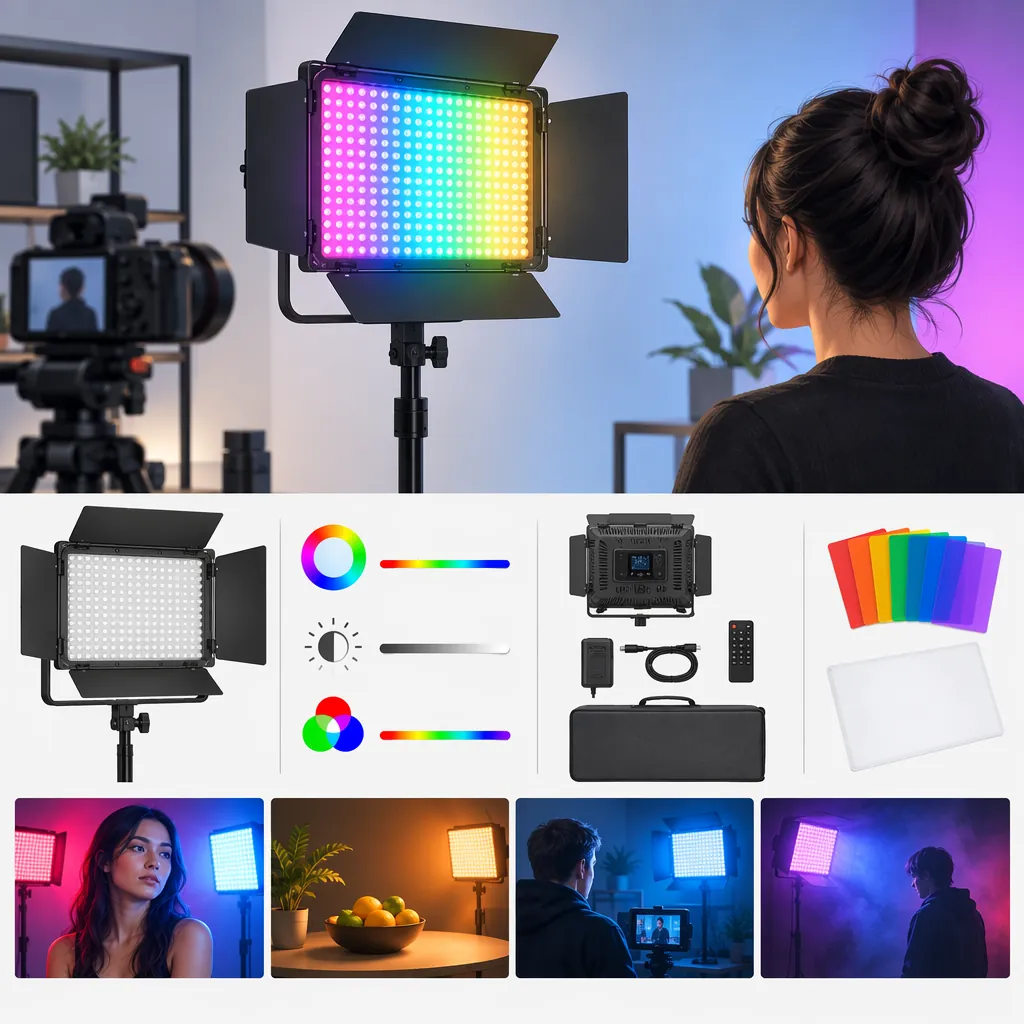
How to Evaluate a Neewer RGB 480 for Filming
For a “neewer rgb 480” search, verify the exact model first, then judge it against your intended shot. The NEEWER NL480 collection page lists a “NEEWER NL480 Bi-Color LED Panel Light”; it does not establish specifications for an RGB 480 model. [c1]
The process below helps you assess model identity, footage, power, and mounting without assuming that similarly named lights share features. It is a selection guide, not a model-specific performance review.
Verify Model Identity and Evidence Limits
The cited collection page supports a narrow identification: its visible listing names the NEEWER NL480 Bi-Color LED Panel Light. It does not establish that NL480 and RGB 480 are the same product or confirm RGB controls for the searched model. [c1]
That page also does not establish RGB 480 output, flicker behavior, dimming performance, battery compatibility, or package contents. Leave those details unverified until you have documentation or test evidence tied to the exact unit.
Model Identity Checklist
- Record the complete product name and model code.
- Compare the listing title with the model label shown in photographs.
- Locate documentation that explicitly names that model.
- Check whether the documented color controls are RGB, bi-color, or another configuration.
- Record the exact kit or package variant.
- Mark mismatched names, labels, or specifications as unresolved.
Decision rule: If the listing, model label, and documentation do not agree, keep the candidate’s identity unresolved. Do not transfer specifications from a similarly named light.
Define the Light’s Job in Your Scene
Start with the intended shot rather than the model name. Identify whether the candidate will illuminate a face, a tabletop subject, or part of the background. Specify the framing, planned placement, and desired appearance.
If you need colored illumination, require exact-model documentation of the relevant color controls. If you need adjustable white illumination, identify the documented adjustment options instead. Treat brightness, coverage, shadows, and color as separate requirements.
Filming Requirements Worksheet
| Requirement | What to record |
|---|---|
| Scene or subject | What will appear in the shot |
| Lighting role | Face, tabletop subject, background, or another stated role |
| Framing and placement | Camera-to-subject and light-to-subject distances |
| Color needs | Required white or colored illumination |
| Exposure target | Planned shutter speed, aperture, and ISO |
| Appearance | Desired coverage, shadows, and reflections |
| Physical constraints | Available space for the light, support, and cables |
| Power arrangement | Available power and any portability requirement |
| Essential features | Requirements that must be verified before selection |
Distinguish essential requirements from preferences. A candidate remains pending when an essential requirement lacks evidence, even if other aspects look promising.
Use a Repeatable Filming Test
If a demonstration unit or representative footage is available, evaluate it against your written shot plan. These are suggested checks, not verified performance claims about a NEEWER RGB 480.
Check Whether Sample Footage Is Comparable
For a meaningful comparison, footage should disclose at least:
- The exact light model.
- Light-to-subject distance and placement.
- Camera exposure settings and white balance.
- Light brightness and color settings.
- Any modifiers or other lighting used.
If key details are missing, use the footage only for limited observations about the shown scene—not a direct comparison of output or color performance.
Run the Test
- Establish the setup. Record the exact model, placement, camera settings, light settings, and accessories.
- Check the intended exposure. Use your planned shutter speed, aperture, and ISO. Note whether the subject reaches the exposure you need at the intended light position.
- Inspect the image. Examine faces or relevant subject colors, coverage, shadows, background spill, and visible reflections.
- Test adjustments. Record at the brightness and color settings you expect to use. During adjustment, inspect for visible brightness jumps, color shifts, or banding.
- Listen to the recording. With the microphone in its intended position, check for unwanted sound during operation and adjustment.
For comparisons, keep the scene, camera settings, and white balance consistent. When a variable must change, document it rather than treating the results as directly equivalent.
Not finding an artifact in one test does not establish suitability for every recording setup. Keep any conclusion limited to the settings and conditions tested.
Footage Evaluation Log
| Item | Record |
|---|---|
| Exact model | Name and model code |
| Recording setup | Camera, exposure, white balance, and recording settings |
| Light placement | Position and distance from the subject |
| Light settings | Brightness and color settings tested |
| Accessories | Modifiers and other lights used |
| Exposure result | Whether the planned exposure was achieved |
| Image observations | Subject color, coverage, shadows, spill, and reflections |
| Adjustment behavior | Visible brightness jumps, color shifts, or banding |
| Sound observations | Unwanted sound captured in the intended microphone setup |
| Limitations | Missing information and untested conditions |
Check Power, Mounting, and Package Contents
Verify power and accessories for the exact model and selected package. Do not infer compatibility or included items from the collection page alone.
Record:
- The documented power input and supported power options.
- Whether the package includes the necessary power supply, cables, batteries, or charger.
- The mounting interface and required support equipment.
- Any documented compatibility with modifiers you intend to use.
- The space needed for the light, support, and cable routing.
- Whether the proposed arrangement meets your stated filming requirements.
Keep output, runtime, color performance, and recording suitability unverified wherever exact-model documentation or relevant testing is missing.
Turn the Checks into a Selection Decision
Use the following rules to connect your requirements with the evidence. These are decision criteria, not conclusions about this model’s capabilities.
| Requirement or check | Result | Selection consequence |
|---|---|---|
| Exact model identity | Listing, label, or documentation conflicts | Keep the candidate unresolved; do not apply another model’s specifications |
| Colored illumination | No explicit exact-model documentation of the required controls | Do not confirm that the candidate meets the color requirement |
| Planned exposure and coverage | The tested setup does not produce the required image | Reassess placement or modifiers, then retest; if the requirement remains unmet, consider another candidate |
| Adjustment behavior | Visible jumps, color shifts, or banding affect the intended shot | Test the settings you would actually use; do not treat the affected configuration as suitable |
| Recording sound | Unwanted sound is captured in the intended microphone setup | Reassess placement or configuration and retest before accepting that setup |
| Essential power or mounting compatibility | Required compatibility is undocumented or unclear | Mark selection as pending |
| Sample-footage quality | Key setup information is missing | Limit observations to the shown footage; avoid direct performance comparisons |
| Essential requirements | Documentation and relevant tests satisfy the stated needs | Treat the candidate as meeting those needs within the verified conditions |
Finish with a short decision record:
- Meets stated needs: Essential requirements have supporting documentation or relevant test results.
- Pending verification: One or more essential requirements remain unknown.
- Does not meet the tested requirement: A documented limitation or test result conflicts with a stated need.
Record why you chose the status and what remains untested. Avoid converting “unknown” into either a favorable score or a claim of poor performance.
FAQ
Is Neewer RGB 480 the Same as Neewer Nl480?
The cited collection page does not establish that they are the same. It lists a “NEEWER NL480 Bi-Color LED Panel Light,” which is not confirmation of RGB functionality for an RGB 480 model. Match the complete model code and documentation before treating the names as interchangeable. [c1]
What If Sample Footage Looks Good but Omits the Settings?
Use it only for limited observations about the image shown. Without the model, light distance, camera exposure and white balance, light settings, and accessories, you cannot make a controlled performance comparison. Keep any essential requirement that depends on those details pending.
What Should I Do If Power or Mounting Details Are Missing?
Leave the selection pending if those details are essential to your setup. Verify the exact model’s requirements and the selected package’s contents separately; do not assume that a compatible accessory is included.
Can This Guide Confirm That a Neewer RGB 480 Is Suitable for Filming?
No model-specific suitability conclusion follows from the cited collection page. Its visible listing identifies an NL480 bi-color light, not verified RGB 480 filming performance. [c1] Use exact-model documentation and relevant tests to decide whether the candidate meets your shot requirements, and limit your conclusion to the conditions you have verified.