Neewer Rgb150: How to Decide Whether It Fits Your Filming Setup
Short Answer
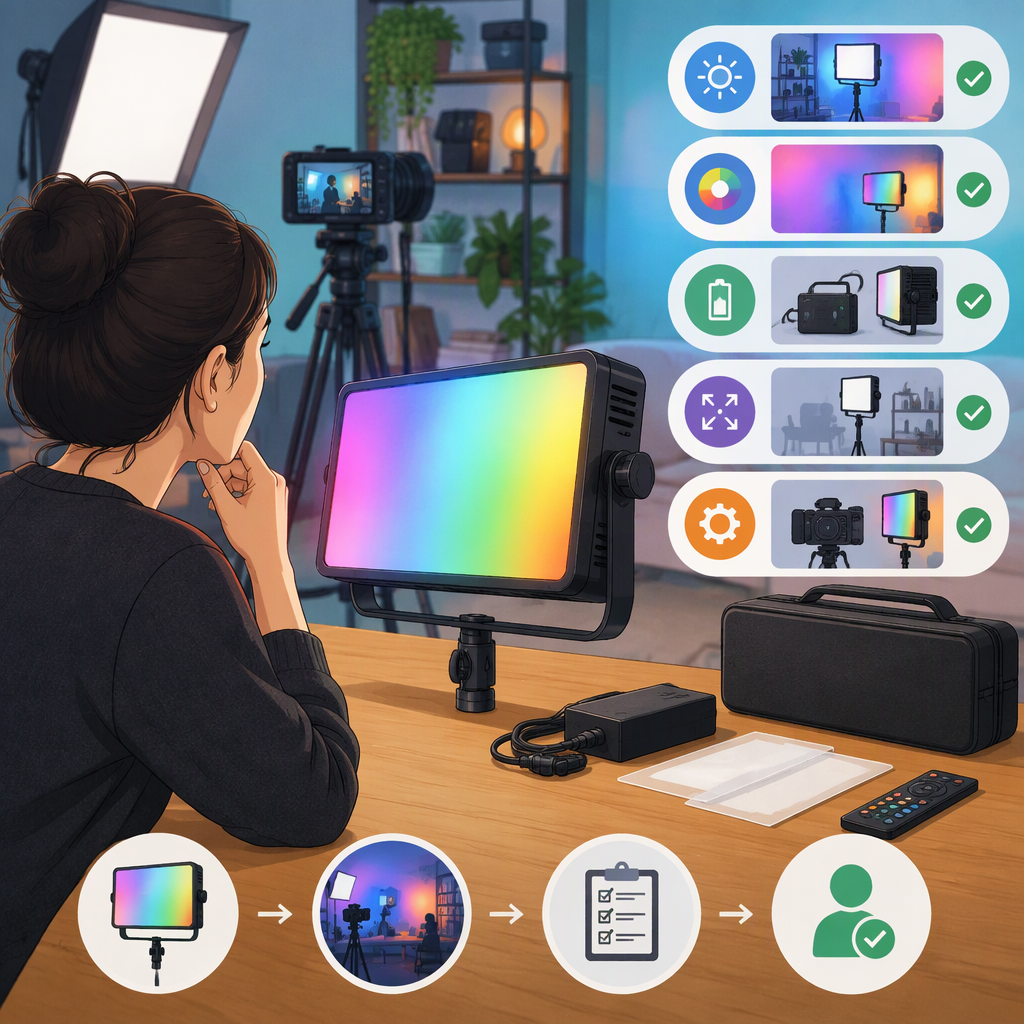
You can decide whether a Neewer RGB150 suits your filming setup only after confirming the exact unit and comparing its applicable documentation with your scene. Start with the light you need at your subject, the colors you need, how you’ll power it, and where you’ll place it. The name alone does not establish the unit’s specifications or whether it will meet those needs.
1. Identify the Exact Light
Match the name on the product listing, label, or manual to the item you plan to use. Look for a model number or other identifier, and check that the documentation names that same model. If a seller’s listing and the manual differ, or the model cannot be confirmed, treat the product identity as unresolved rather than borrowing specifications from a similar-sounding light.
NEEWER’s support FAQ refers to an “RGB150 LED Light” and lists questions about charging and illumination distance. That establishes that the support page uses the name, but the retrieved page text does not answer those questions or establish a model number or specifications. (support.neewer.com) Do not substitute details from another NEEWER model: for example, the company has separate product pages for lights named AP150C and MS150C. A similar number or the word “RGB” is not proof that a specification applies to the RGB150 you’re considering. (neewer.com)
Before comparing specifications, write down the exact model identifier and the source that matches it. If you can’t do that, your next step is to get documentation for the exact item—not to guess from a neighboring model name.
2. Match Documented Details to Your Setup
Use specifications as checks against your actual filming conditions, not as a verdict on their own. The following are questions to verify for the exact unit; they are not claims about what the RGB150 includes or can do.
| Your filming need | What to verify for the exact unit | How to judge the match |
|---|---|---|
| Lighting a subject at your working distance | A documented output or beam measurement, including the distance and setup used for that measurement | Compare the measurement with the distance, framing, and ambient light in your scene. A result at one distance does not by itself establish what you’ll get farther away. |
| White light or colored effects | Documented color modes, ranges, and any relevant color-rendering information | Check that the stated controls cover the colors you need. If natural-looking skin or product color matters, look for relevant color-rendering data or results—not just a color-mode label. |
| Shooting location and duration | Documented power requirements or options and any stated operating limits | Confirm that the documented power setup works where and for as long as you plan to shoot. Don’t assume a battery or runtime unless the matching documentation says so. |
| A specific stand, rig, or confined space | Documented dimensions and mounting details | Compare the measurements and mount with your stand or rig. If compatibility is unclear, treat it as an open question. |
Example (hypothetical): A creator filming a close-up at a desk may care most about color control and how the light looks in the intended frame. Someone lighting a subject across a room may need distance-relevant output information first. These different priorities do not show that the RGB150 is suitable or unsuitable; they show why the same specification checklist can lead to different decisions.
3. Resolve What the Documentation Doesn’t Answer
Check that any review, demonstration, or measurement is actually about the same model. For an output result, note the measurement distance and setup; for a visual demonstration, consider the camera exposure, framing, ambient light, and whether the footage shows the relevant color or brightness setting. Treat observations as evidence from those conditions, not a guarantee for every filming environment.
If you can access the light, assess it with your intended camera, distance, framing, and ambient light. That would be your test, not a test performed for this guide. Record the setup and result so you can distinguish what the documentation states from what you observed.
4. Make a Conditional Decision
A useful conclusion can be specific without pretending certainty:
- Likely fit for my stated setup: The exact model is identified, and the documented or personally observed details meet my important distance, color, power, and placement requirements.
- Mismatch: A confirmed requirement is not met—for example, the mounting arrangement is incompatible with the rig you plan to use.
- Still unresolved: The model identity or a decision-critical detail, such as performance at your working distance or a required power arrangement, has not been established.
With the information available here, no RGB150 performance specifications or test results are established. So a yes-or-no suitability verdict would be unsupported. Identify the exact unit, fill in the checks that matter to your scene, and make a conditional choice—or name the missing fact that is still blocking it.