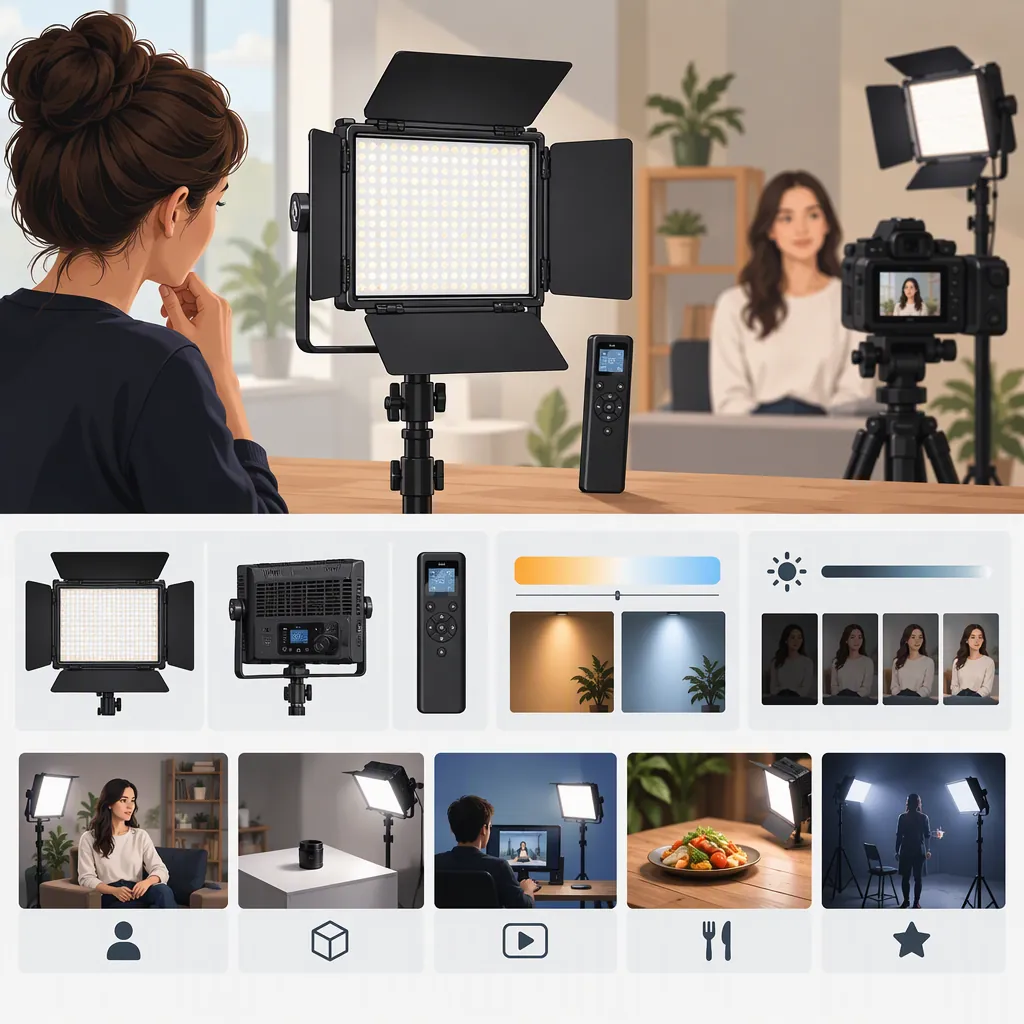
Neewer Nl288a Rc: How to Evaluate It for Filming
For a search such as “neewer nl 288a rc,” start by checking the exact kit: NEEWER’s NL288A single-panel listing identifies the panel model as NL-288ARC, while its two-panel listing also uses NL-288ARC. Compare package contents and power requirements before judging suitability for your filming setup. These manufacturer listings establish advertised specifications, not independently verified image quality, runtime, or flicker performance. [src1] [src2]
Identify the Model and Kit Contents
The naming is not identical across the two provided pages. The single-panel page is titled NL288A but lists NL-288ARC in its specifications. The two-panel kit lists the same model designation. Treat the search wording as a starting point, not a complete description of what is included. [src1] [src2]
The single-panel package lists one panel, a bracket mount, a remote, a power adapter, a manual, and a carrying bag. It does not list a light stand. The two-panel package lists two panels, two stands, two adapters, two power cables, a carrying bag for the lights, a remote, and a manual. [src1] [src2]
For selection purposes, separate the lighting requirement from the accessory requirement: how many independently positioned lights does your shot need, and which supports and power accessories are already available?
Read Specifications as Test Inputs
NEEWER lists a 3200K–5600K color-temperature range, 1%–100% brightness adjustment, and 45W rated or maximum power. Both pages report CRI of at least 97. These are manufacturer-reported specifications, not results from an independent evaluation. [src1] [src2]
For illuminance, both pages list 1400 lux at 1 meter and 4800 lux at 0.5 meter. The two-panel page specifies 4400K for those figures and includes a ±200 lux notation. Do not treat them as proof that every color-temperature setting or filming arrangement will deliver the same measured output. [src1] [src2]
Use the figures to define a test at your intended subject distance, framing, and camera settings. The supplied references do not establish exposure performance for your particular room, daylight conditions, or modifiers. Likewise, the listed CRI does not establish how every fabric, skin tone, or product color will appear on your camera.
Check Power and Remote Requirements
Both listings describe adapter and Sony NP-F battery operation, with panel batteries excluded. However, their wording differs: the single-panel specifications say “1 or 2” NP-F batteries, while the two-panel description says two. Confirm the battery requirement for the exact unit rather than assuming either description applies universally. Neither provided listing supplies a measured runtime. [src1] [src2]
The single-panel page states that the remote uses two AAA alkaline batteries, also excluded. Both pages describe 2.4GHz remote control with 40 channels and four groups. The single-panel page instructs users to press CH/GR once before using the brightness or color-temperature button. [src1] [src2]
A practical setup check should include the intended power source, the panel’s response to remote adjustments, and whether grouped control behaves as needed. The references do not establish remote range or reliability in your location.
Use a Repeatable Filming Test
The two-panel page describes the lighting as flicker-free, but the supplied material contains no independent camera test or measurement method supporting that description. Treat it as a manufacturer claim rather than a guarantee for all recording settings. [src2]
Use this proposed evaluation procedure before making a suitability judgment:
- Re-create the intended framing and light-to-subject distance.
- Fix exposure and white balance so automatic adjustments do not obscure comparisons.
- Record at the frame rates and shutter settings planned for the project, including the dimming levels you expect to use.
- Inspect the footage for banding, brightness variation, unwanted reflections, shadow appearance, and color rendering.
- Repeat with the intended power source and any planned modifiers.
- Record settings and observations so alternative lighting setups can be compared under the same conditions.
These steps are an evaluation plan, not reported test results. Without such footage, the references support a comparison of listed features and package contents—not a conclusion that this light is the best choice for a particular production.
FAQ
Are Nl288a and Nl-288arc Different Models?
The provided NL288A single-panel page lists its model as NL-288ARC, and the two-panel page uses NL-288ARC too. This supports a naming connection in these listings, but does not establish that every similarly named listing has identical contents or hardware. [src1] [src2]
Are Stands and Batteries Included?
The single-panel package does not list a stand; the two-panel package lists two. Both pages say panel batteries are not included. The single-panel page also says the remote’s two AAA batteries are not included. [src1] [src2]
Do the Listed Specifications Prove It Will Suit My Filming Setup?
No. The pages provide manufacturer specifications, including color-temperature and dimming ranges, but do not establish performance with your camera, subject distance, ambient light, or recording settings. Use a repeatable camera test rather than treating those specifications as a production-specific guarantee. [src1] [src2]