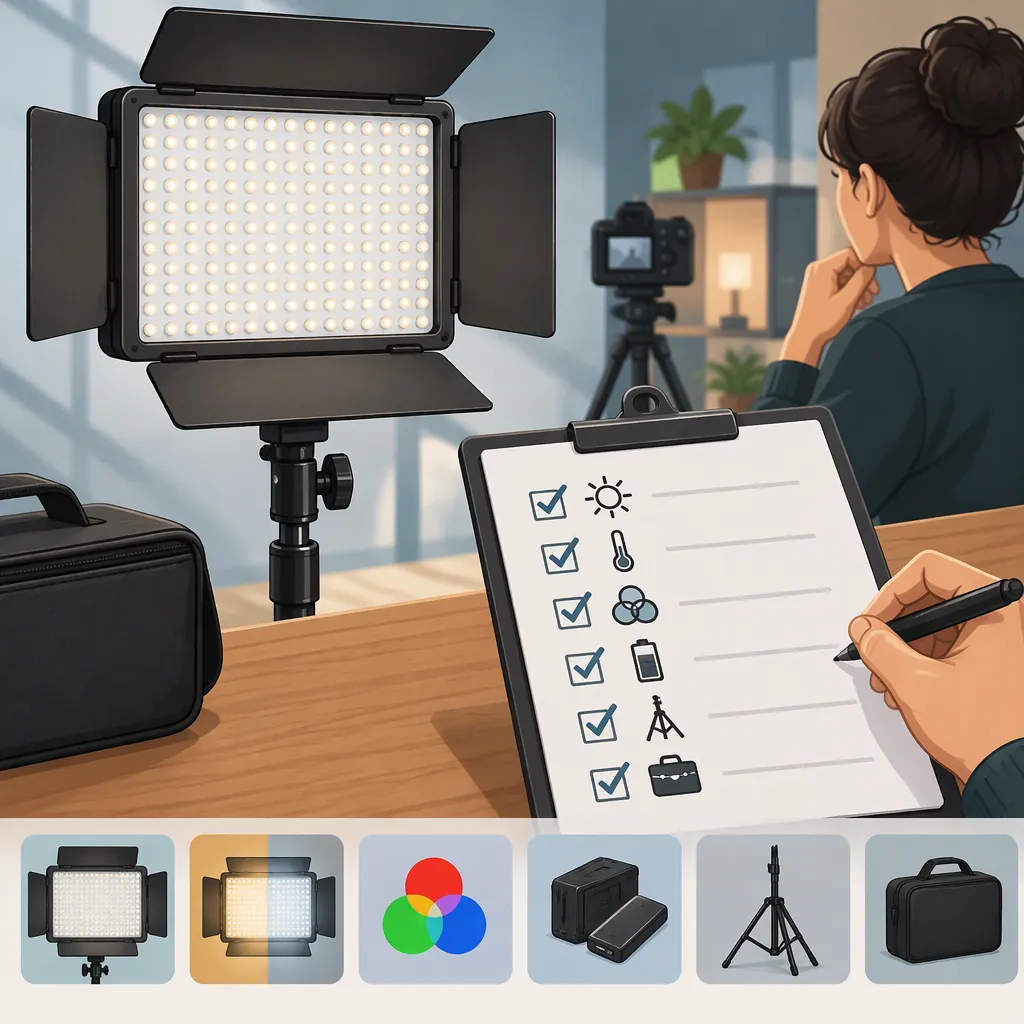
Choosing a Neewer Cn216 for Filming: A Practical Checklist
To decide whether a NEEWER CN216 fits your filming setup, define your non-negotiable requirements, verify documentation for the exact model, and—if a unit is available—test it under your intended recording conditions. Continue considering the configuration only when its critical requirements are supported; pause when evidence is missing, and rule out or retest a configuration that fails a critical requirement.
What the Available Source Establishes
The Click magazine article cited on this page discusses the Neewer CN-160, not the CN216. It is a photographer’s account of another model, not a CN216 specification sheet or controlled video test. Its descriptions of batteries, mounting, accessories and dimming should not be transferred to the CN216. [ref-1]
This page therefore does not verify CN216 output, color accuracy, flicker behavior, battery compatibility, runtime or current price. The steps below are a selection framework, not a product review or endorsement.
Define Your Filming Requirements First
Start with the shot you need, then separate must-have conditions from acceptable compromises. A secondary advantage should not offset a failed critical requirement.
| Requirement | Question to answer before evaluating the light |
|---|---|
| Role | Will it serve as the main light, fill light or background accent? |
| Distance and coverage | Where can it sit, and which parts of the subject must be illuminated? |
| Exposure | What exposure must you achieve at your planned aperture, shutter setting and ISO? |
| Appearance | Which shadows and reflections are acceptable on faces, glasses or products? |
| Color | What recorded appearance is acceptable alongside the other lights in the scene? |
| Power and duration | What documented power arrangement and recording duration do you need? |
| Mounting | What support will you use, and what mounting compatibility must be confirmed? |
These questions define your criteria; they do not establish that the CN216 meets them.
Filming Requirements Worksheet
Complete this before reviewing documentation or testing a unit:
- Light’s role:
- Subject and framing:
- Intended light-to-subject distance and angle:
- Camera frame rate and shutter setting:
- Target aperture and ISO:
- Other lights in the scene:
- Required recording duration:
- Available support and mounting requirements:
- Non-negotiable conditions:
- Acceptable compromises:
- How each condition will be checked:
- Unresolved model specifications:
Define a practical pass standard for each critical condition. For example, specify which areas of the subject need acceptable exposure and whether visible banding in the intended recording is unacceptable.
Verify the Exact Model Before Testing
If you cannot access a unit before choosing, use a documentation-first path:
- Compare model identifiers. Check whether the product page, available photographs of the unit’s label, and the manual identify the same model. Record any variant identifiers rather than assuming similarly named units are equivalent.
- Record the evidence. Note the document title, source, model designation and version or date where available. Keep relevant page numbers or excerpts with your worksheet.
- Check your critical requirements. Look for explicit information about the intended power arrangement, mounting interface and any documented operating limits relevant to your planned use.
- Separate specifications from demonstrated results. Record what the documentation actually states. Do not treat a listing photograph or general description as proof that your exposure, coverage or recording requirements will be met.
- Leave gaps unresolved. Information about the CN-160 does not fill a CN216 documentation gap. [ref-1]
If key evidence remains unavailable, pause the decision. Missing information means “unknown,” not “failed.” Documentation may resolve compatibility questions while leaving recording performance untested.
Test the Exact Unit in Your Intended Setup
If a unit is available for evaluation, make the test repeatable. Fix camera exposure and white balance when comparing clips, and record any setting you intentionally change.
- Set the intended position. Place the light at your planned distance and angle, using a documented, compatible support arrangement.
- Use a representative subject. Record the actual subject or a stand-in that lets you evaluate the important areas, shadows and reflections.
- Check exposure and coverage consistently. Compare the same subject areas and frame edges in each clip. Judge them against the pass standards in your worksheet.
- Check appearance and color. Keep the subject and other scene lights consistent. Include the same neutral object in each comparison and use fixed white balance to inspect visible color differences.
- Check each planned recording setting. Test the frame-rate and shutter combinations—and brightness settings—you expect to use. Review for visible bands or pulsing under consistent playback and display conditions.
- Test recording duration separately. Use only a documented, compatible power arrangement. Run the planned session duration and record whether the required result is maintained.
These visual checks can help assess footage for your intended delivery, but they do not replace instrument measurements or prove color accuracy. Likewise, seeing no bands or pulsing in one test does not establish flicker-free behavior at every setting.
Recording Test Log
Use one entry per configuration:
- Exact model and unit identifier:
- Documentation checked, including version:
- Power arrangement:
- Mount and support arrangement:
- Light position and distance:
- Brightness setting:
- Camera frame rate, exposure and white balance:
- Other scene lights:
- Clip or session duration:
- Playback and display conditions:
- Exposure and coverage observations:
- Shadow and reflection observations:
- Color, banding or pulsing observations:
- Critical requirement: met, not met or unresolved:
- Acceptable compromises observed:
- Limits of this result:
- Next action:
Turn the Evidence into a Selection Decision
Apply the decision to the tested or documented configuration, not to every possible use of the model.
| Result | Next action |
|---|---|
| All critical requirements are supported by relevant documentation or testing | Continue considering that configuration, then assess its remaining compromises. |
| A critical requirement fails in testing | Rule out that configuration, or change a permissible condition and retest. |
| A critical specification is missing or contradictory | Pause until the uncertainty is resolved; do not classify missing evidence as poor performance. |
| Documentation is adequate, but a critical recording result remains untested | Keep suitability unresolved rather than treating specifications as proof of the finished image. |
| Only a non-critical preference is unmet | Decide whether it falls within your predeclared acceptable compromises. |
A successful test supports only the conditions recorded in the log. If you change distance, framing, camera settings, brightness or power conditions, reassess the affected requirements.
FAQ
Can a Cn-160 Review Confirm Cn216 Features?
No. The cited Click article covers the CN-160 and cannot establish CN216 specifications, accessories or filming performance. [ref-1]
Is the Cn216 Suitable as a Main Filming Light?
That remains unverified here. Treat main-light suitability as a critical requirement: check whether the exact unit provides acceptable exposure, coverage and appearance at your intended distance and camera settings. If you cannot obtain relevant evidence, leave the decision unresolved.
Which Batteries and Mounting Accessories Should I Use?
Use documentation for the exact model and variant to confirm compatibility. The batteries and mounting features described in the CN-160 article are not confirmation of CN216 compatibility. [ref-1] Do not test an undocumented power or mounting arrangement merely to see whether it works.
What If I Cannot Test a Unit Before Choosing?
Complete the documentation checks and identify which requirements remain unknown. If an unresolved requirement is non-negotiable, pause the decision. Neither a favorable account of another model nor a lack of documentation establishes how the CN216 will perform in your setup. [ref-1]