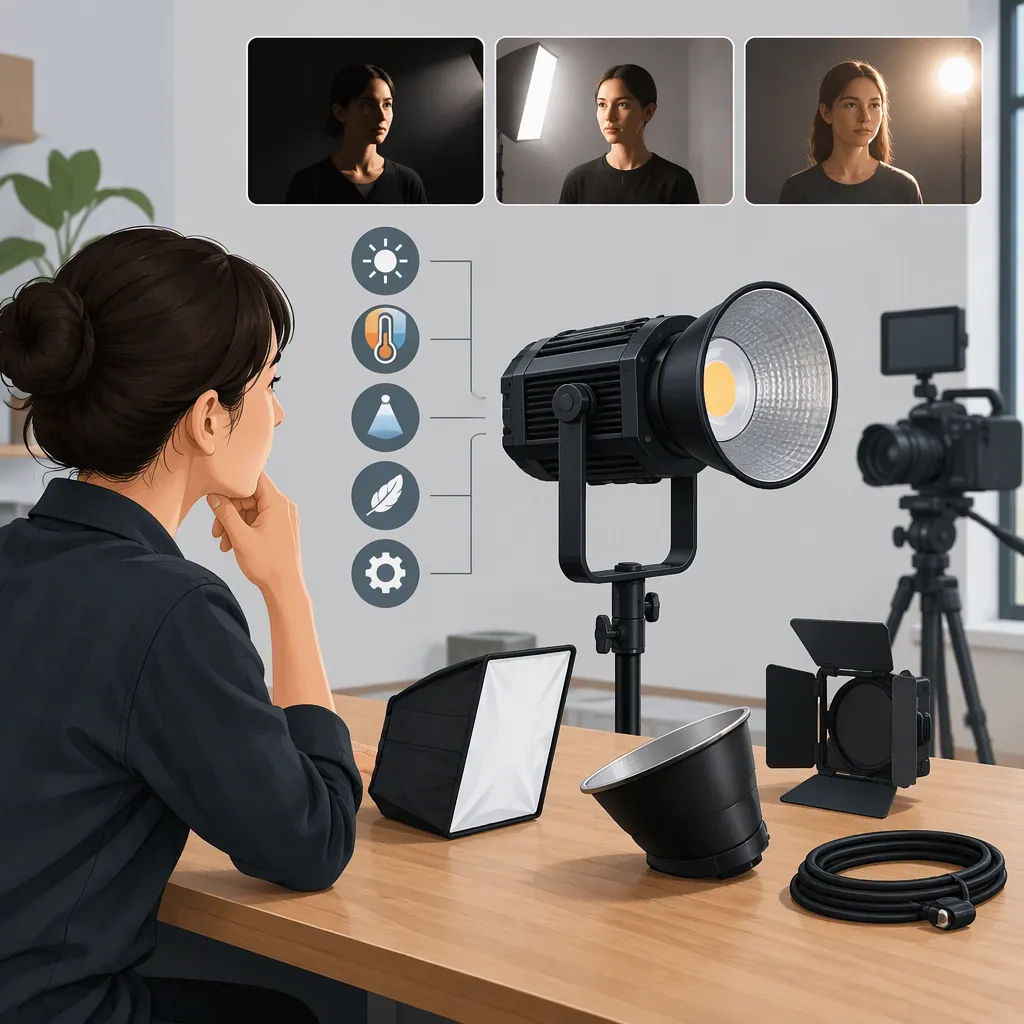
Choosing a Neewer 150W Light for Your Filming Setup
Start with the exact model, not the phrase “NEEWER 150W.” The provided sources identify an AP150B bi-color panel listing and an AP150C RGB panel kit listing; they should not be treated as interchangeable. For filming, assess the intended shot, working distance, diffusion, power arrangement, and sound requirements. These sources establish listing details, not independently verified performance or a best choice for your setup. [c1] [c2]
Identify the Exact Model and Kit
A wattage-based search leaves important details unresolved. NEEWER’s supplied collection page names the AP150C as a “150W RGB LED Panel Video Light Kit.” The supplied Amazon Australia page identifies its selected listing as the AP150B, a “150W Bi Color LED Panel Video Light Kit.” Those descriptions establish two distinct listing identities, not a performance comparison. [c1] [c2]
Before comparing options, record the full model code and selected bundle. Keep these questions separate:
- Which light is being described?
- Which accessories belong to the selected kit?
- Which specifications apply to that model rather than a related variant?
The Amazon page includes several selectable models and reviews labeled for different variants. Do not assign every review, accessory reference, or comparison-table entry on that page to the AP150B. [c2]
Evaluate the Shot Before the Wattage
Use the intended frame as the starting point: a seated interview, a tabletop demonstration, and a wider moving-subject shot need different evaluation plans. Specify where the light can stand, where the subject will be, and which camera settings must remain fixed.
The AP150B listing reports illuminance at both 0.5 m and 1 m, with a stated color-temperature condition of 6500K. Those are listing claims, not measurements independently verified here. Do not treat either number as proof of exposure in your own scene. [c2]
For a useful comparison, request or conduct a demonstration with the actual working distance and intended diffusion. Evaluate the whole frame rather than only the brightest spot: subject exposure, background balance, shadow appearance, reflections, and unwanted spill. Keep distance, camera settings, and modifier configuration consistent between candidates.
For interviews, prioritize a test of the face and background together. For reflective products, include the actual object and inspect reflections. For a wider shot, check each planned subject position. These are evaluation steps, not claims that either listed model will meet the requirement.
Check Recording Behavior and Power Requirements
The AP150B listing describes onboard, app, 2.4G, and DMX control, along with AC and V-mount battery power arrangements. It says the battery and D-tap cable are sold separately. Confirm the selected package contents rather than assuming a “kit” supplies every item needed for location work. [c2]
The same listing describes cooling modes and a frequency-adjustment feature intended to address flicker. That wording does not establish inaudible operation or flicker-free footage at every recording setting. [c2]
Build the evaluation around the production:
- Dialogue: Record room tone with the microphone in its intended position and the light at the planned output and cooling setting.
- Motion or slow motion: Inspect footage at every required frame rate and shutter setting.
- Remote adjustment: Check the exact control method you intend to use, including access to essential settings without an app.
- Location power: Verify the documented battery, cable, voltage, and connector requirements for the exact model.
- Mounting: Verify the complete mounted load, stand rating, attachment method, and cable routing.
The supplied sources do not establish battery runtime, measured fan noise, or suitable support hardware for your assembled setup.
Use a Repeatable Comparison Worksheet
Separate documented details from observed results and unresolved questions. A candidate should remain unconfirmed wherever a requirement lacks model-specific documentation or a relevant demonstration.
The source set consists of a manufacturer collection page and retailer pages, not a controlled side-by-side test. It does not support declaring an overall winner. In particular, detailed AP150B listing information should not be transferred to the AP150C merely because both listings use “150W.” [c1] [c2]
Filming Light Evaluation Sheet
Complete one sheet per exact model and bundle.

Model and bundle: __________
Shot type and subject area: __________
Light-to-subject distance: __________
Camera, frame rate, shutter, aperture, ISO, and white balance: __________
Modifier and attachment compatibility: __________
Exposure and frame coverage observed: __________
Shadows, reflections, and spill observed: __________
Microphone position and cooling setting tested: __________
Noise or flicker observed: __________
Required control method checked: __________
Power supply, battery, and cables documented: __________
Mounted load and support rating verified: __________
Missing evidence or unresolved requirements: __________
Decision: suitable for the tested setup / unsuitable / not yet established.
FAQ
Does “Neewer 150W” Identify One Specific Light?
No. The supplied sources name an AP150B bi-color panel listing and an AP150C RGB panel kit listing. Confirm the model code and selected bundle before using specifications or accessory information. [c1] [c2]
Is a Neewer 150W Light Enough for Interviews?
The supplied evidence cannot establish that for your setup. Evaluate the exact model at the intended distance, with the planned modifier, camera settings, background, and microphone placement. The AP150B’s published illuminance figures are listing claims under stated conditions, not an interview exposure guarantee. [c2]
Does the Ap150b Listing Include Everything for Battery Operation?
The supplied AP150B listing says its V-mount battery and D-tap cable are sold separately. Verify the selected bundle and documented power requirements; the listing does not establish runtime for your recording session. [c2]