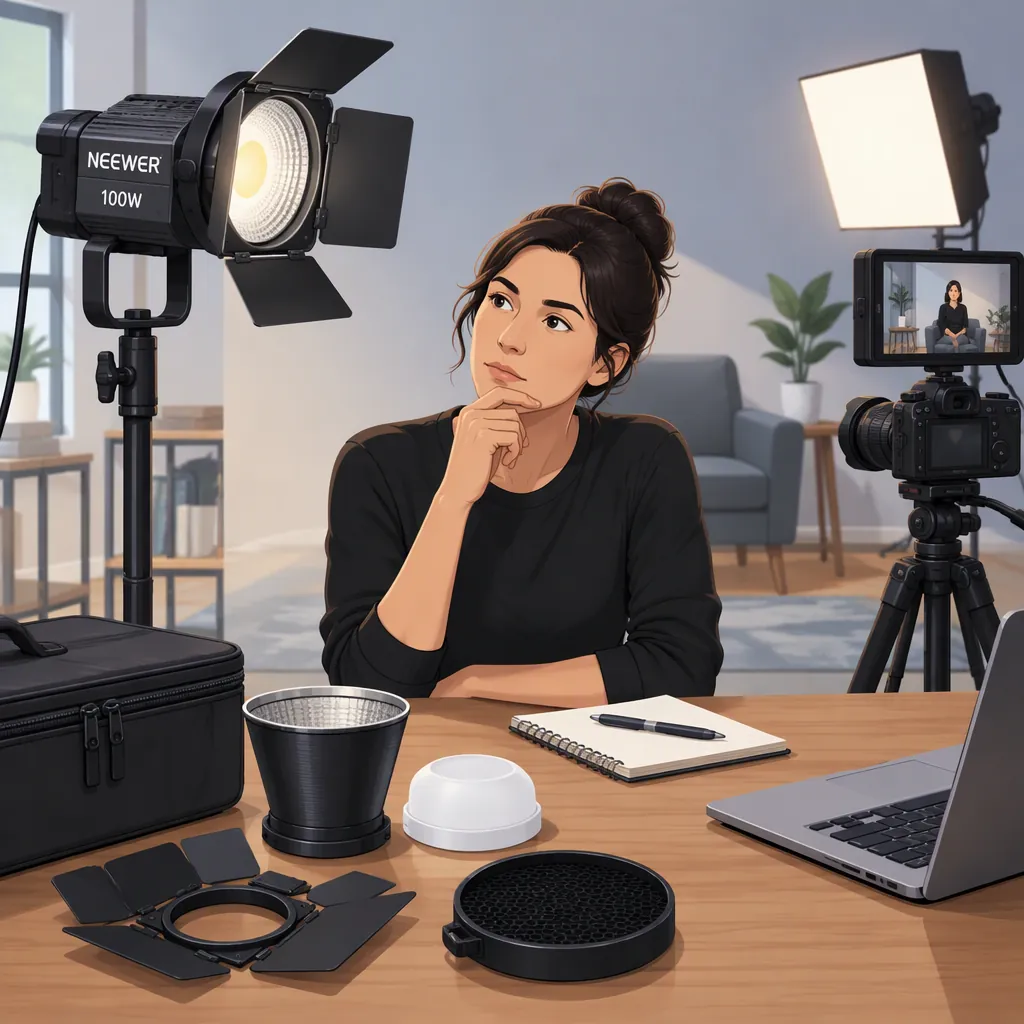
Neewer 100W: How to Choose a Light for Filming
For a “neewer 100w” search, confirm the exact model before comparing lights. A candidate meets your filming needs only if it delivers your planned image at the intended distance, with the intended modifier and camera settings, while also meeting your sound, mounting, and power requirements. Treat untested essentials as unresolved—not as a pass.
Evidence boundary: The sources listed for this page do not document a specific NEEWER 100W model. They cover an on-camera LED light collection and the NL660 panel, whose product page lists 40W. This guide therefore provides a selection process, not a recommendation or ranking of 100W models. [ref_1] [ref_2]
Identify the Exact Model and Package
Treat “NEEWER 100W” as a starting search phrase, not a complete product identifier. Record the exact model name, find documentation for that model, and distinguish the light itself from a kit or accessory bundle.
Do not substitute a similarly named light’s specifications. In particular, the NL660 page lists power as 40W; it is not documentation for a 100W candidate. [ref_2] Brightness, noise, accessory compatibility, and runtime for an unidentified 100W light remain unverified.
Model Identification Worksheet
- Exact model name: ______
- Model-specific documentation: ______
- What the advertised wattage describes: ______
- Light-only or kit configuration: ______
- Included power supply and accessories: ______
- Specifications still unverified: ______
If you cannot identify the model or confirm an essential specification, leave that item unresolved rather than borrowing information from another light.
Define the Shot Before Setting a Power Target
Start with the filming task: a seated interview, desk presentation, product shot, or wider scene. Specify the area that needs lighting, the available placement space, the ambient light, and the camera settings you intend to use.
As a general selection principle, a power rating does not directly tell you the illuminance reaching the subject or the result after diffusion. Evaluate distance, modifiers, and measurement conditions alongside the wattage label. This is not a specification claim about any unidentified NEEWER model.
When comparing documented light-output measurements, check that the conditions match. Record distance, color setting, and any reflector or diffusion used. Figures with missing or different conditions should not be treated as a reliable ranking.
Separate Must-Haves from Acceptable Compromises
Define the pass conditions before testing. Otherwise, it is easy to change the shot until a candidate appears adequate without noticing that it no longer serves the original purpose.
| Requirement | Define before testing | Example of an acceptable compromise |
|---|---|---|
| Exposure | Intended aperture, ISO limit, shutter setting, and a consistent exposure check | A small ISO adjustment within your declared limit |
| Coverage and shadows | Subject area, framing, and desired shadow appearance | A position adjustment within the available space |
| Color appearance | Reference subject and what would be unacceptable in the finished image | A correction you are willing to repeat in your workflow |
| Recorded sound | Intended microphone position, recording settings, and acceptable noise | A different permitted light position that preserves the shot |
| Power | Required power source and recording duration | Outlet power, if battery operation is not essential |
| Mounting and modifiers | Required modifier, placement, and documented support requirements | A different documented compatible accessory |
These are planning examples, not performance claims. A compromise is acceptable only if you decide it is acceptable for the shoot.
Shot Requirements Checklist
- Shot type and framing: ______
- Subjects or object dimensions: ______
- Available light-to-subject distance: ______
- Ambient light to retain or control: ______
- Frame rate and shutter setting: ______
- Aperture and ISO limit: ______
- Exposure check and target: ______
- Desired shadow and color appearance: ______
- Required recording duration and power source: ______
- Non-negotiable conditions: ______
- Acceptable compromises: ______
“Required exposure” should mean a result you can check consistently—for example, a defined reading on the camera’s exposure tools or a reference image assessed under fixed viewing conditions—not simply “looks bright enough.”
Check Modifiers, Mounting, Power, and Sound
Evaluate the light as part of a complete assembly. Verify the exact modifier mount, supported accessories, stand requirements, power connections, and operating restrictions in documentation for that model. Do not transfer compatibility assumptions from another NEEWER light.
Check package contents separately. The NL660 page distinguishes light-only and stand-inclusive options, illustrating why a model name alone does not establish what a package contains. This does not establish the contents of any 100W bundle. [ref_2]
For dialogue, test sound with the microphone at its intended position and the light operating at the settings needed for the shot. Use the intended recording settings and judge the recording under consistent playback conditions. Do not assume quiet operation or battery runtime without model-specific documentation or testing.
Complete Setup Verification
- Confirm the exact modifier mount and accessory compatibility.
- Verify documented support requirements for the light and attached modifier.
- Check which stand, cables, and power supply are included.
- Confirm permitted power sources and operating restrictions.
- Follow documented mounting and ventilation instructions.
- Record room sound with the light operating at the required settings.
- Verify power operation for the needed duration if runtime is essential.
- Mark unverified compatibility, noise, or runtime as unresolved.
An undocumented mounting or power arrangement should not be treated as an acceptable workaround.
Run a Repeatable Filming Test
If a candidate is available for evaluation, use consistent conditions rather than relying on an isolated impression. This article reports no hands-on results.
1. Fix the Scene and Camera Settings
Use the same framing, subject or reference object, subject position, and ambient lighting. Keep the light position and modifier arrangement consistent where compatibility permits; record any differences that prevent a like-for-like comparison.
Set a fixed white balance. Use manual exposure or lock automatic exposure, and record aperture, ISO, shutter setting, and frame rate. Disable automatic image adjustments that would otherwise change the comparison, where the camera permits.
For an exposure-capability check, keep the planned camera settings and adjust the light within its documented controls to reach your predefined target. Record the resulting light setting.
2. Record Image and Sound
Capture the intended subject and motion at every frame rate and shutter setting you plan to use. Check:
- Whether the predefined exposure target is reached.
- Whether the required subject area is covered.
- Whether shadow edges and spill suit the shot.
- Whether skin or object color is acceptable against the same reference.
- Whether visible flicker or banding appears in the recorded footage.
- Whether operating noise is acceptable in the dialogue recording.
If battery operation is essential, test the intended documented power arrangement for the required duration. An outlet-powered test does not establish battery runtime.
3. Review Under Consistent Conditions
Review each candidate on the same display with the same playback settings. Assess audio using the same playback equipment and level. Keep the evaluation criteria unchanged between candidates.
These checks support a practical judgment for the tested scene. They do not replace professional color or flicker measurements, and a passing result applies only to the conditions tested.
Comparison Test Log
- Candidate model: ______
- Subject or reference object: ______
- Camera and image settings: ______
- Fixed white balance: ______
- Manual exposure or exposure-lock method: ______
- Frame rate and shutter setting: ______
- Exposure target and checking method: ______
- Light position and distance: ______
- Modifier, color setting, and output setting: ______
- Ambient lighting: ______
- Power source and tested duration: ______
- Microphone position and recording settings: ______
- Image and audio playback conditions: ______
| Test item | Meets predefined requirement? | Evidence, compromise, or limitation |
|---|---|---|
| Exposure | Yes / No / Untested | ______ |
| Coverage and shadows | Yes / No / Untested | ______ |
| Color appearance | Yes / No / Untested | ______ |
| Visible flicker or banding | Yes / No / Untested | ______ |
| Recorded sound | Yes / No / Untested | ______ |
| Mounting and modifier compatibility | Yes / No / Unverified | ______ |
| Required power operation | Yes / No / Untested | ______ |
Turn the Test into a Selection Decision
Use the results to judge suitability for the defined shoot—not to declare a light universally better.
| Finding | Decision |
|---|---|
| Every must-have is met at the planned distance, with the intended modifier and camera settings; sound, mounting, and power requirements are also satisfied | Pass for this use. Retain the candidate for comparison. |
| Requirements are met only with compromises you approved before testing | Pass with recorded compromises. Keep those changes attached to the decision. |
| Meeting the image requirement requires an unacceptable camera setting, framing change, placement, or accessory change | Does not meet the current use. Exclude it from this setup or redefine the shot and retest. |
| A required sound, mounting, compatibility, or power condition fails | Does not meet the current use. Adequate exposure alone is insufficient. |
| Any essential condition lacks documentation or testing | Unresolved. Do not count it as a pass. |
If multiple candidates pass, compare the remaining differences against your stated priorities: acceptable compromises, complete-setup requirements, placement constraints, and unresolved items. Do not rank them from wattage alone.
Keep the conclusion narrow. A successful desk-shot test does not establish suitability for a wider scene, and footage without visible banding at one shutter setting does not establish performance at every recording setting.
Final record
- Result: Pass / Pass with compromises / Does not meet current use / Unresolved
- Approved compromises: ______
- Failed or untested conditions: ______
- Scope of the conclusion: ______
FAQ
Is the Neewer Nl660 a 100W Light?
Not according to its product page, which lists power as 40W. Use documentation for the exact 100W candidate rather than treating the NL660 as an equivalent. [ref_2]
Is a Neewer 100W Light Enough for Interviews?
The wattage label alone does not settle that question. Define framing, distance, ambient light, modifier, camera settings, microphone position, and power needs. A candidate passes only when the complete arrangement meets those requirements; leave essential untested conditions unresolved.
Which Neewer 100W Model Is Best for Filming?
No model ranking is established by this page’s sources. [ref_1] [ref_2] Identify exact candidates, test them against the same must-haves, and compare only those that pass. The relevant choice is the one that meets your defined shoot with acceptable compromises, not an unsupported universal “best.”
What If a Light Works Only After I Raise Iso or Move It Closer?
Check whether that change falls within the limits you set before testing. If it does, record a pass with the compromise. If it changes a non-negotiable camera setting, framing, or placement requirement, the candidate does not meet the current setup. If you revise the shot requirements, retest against the new conditions.
Can a Camera Test Confirm Color Accuracy or Flicker-Free Performance?
It can reveal practical problems in the recorded scene, but it cannot establish professional color accuracy or universal flicker-free performance. Fix white balance and exposure, use the same reference subject, and check every intended recording setting. Report only what the tested conditions demonstrate.