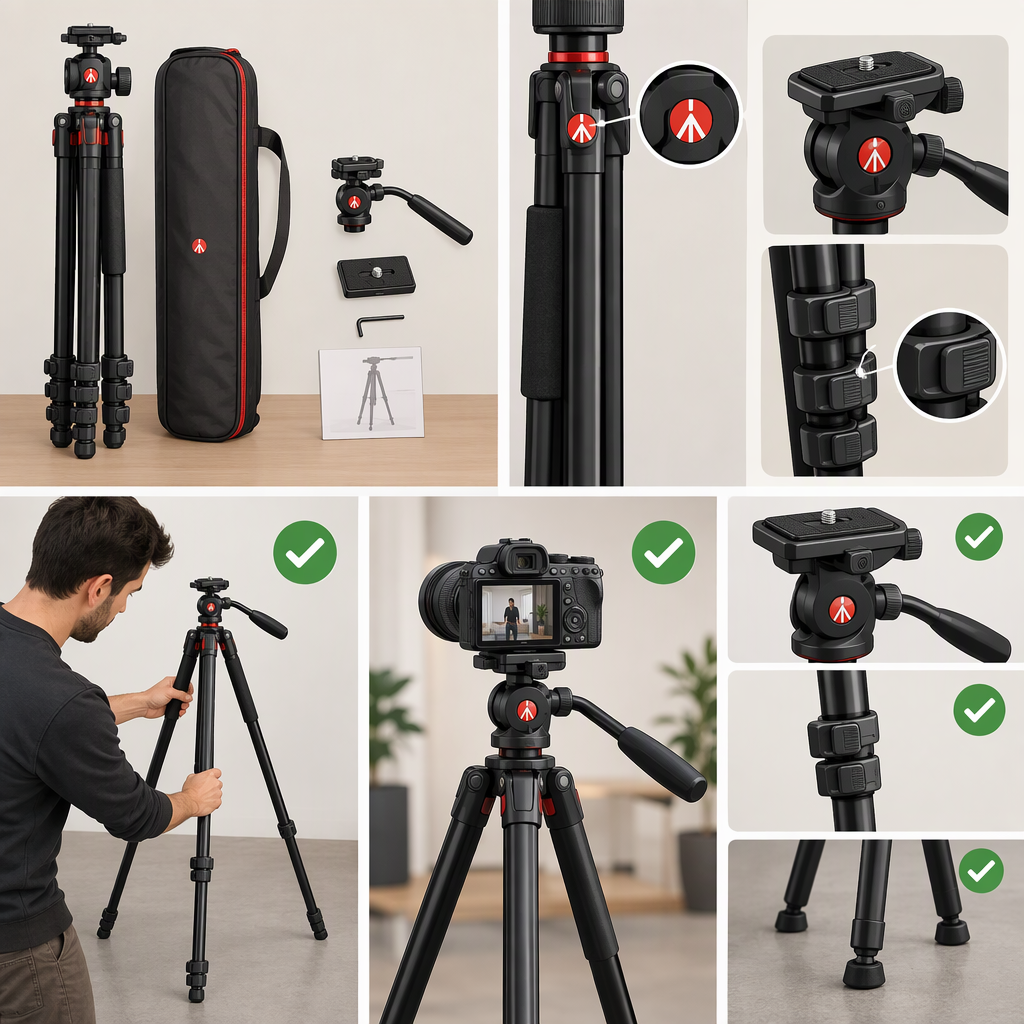
Manfrotto 290 Light: How to Identify a Kit and Check Its Fit for Filming
Short answer: “Manfrotto 290 Light” can refer to tripod kits with different heads. Check the full model code and included head before assessing fit. Manfrotto lists 4 kg (8.82 lb) as the safety payload for its 290 Light ball-head, three-way-head, and Befree Live fluid-video-head kits. That figure is a load check—not proof that a rig will be stable in every setup or that a pan or tilt will look smooth. Compare the complete camera rig with the documented payload, then match the head to the movements you plan to make. (manfrotto.com)
Identify the Exact 290 Light Configuration
Look for the full model code, not just “290 Light.” Manfrotto’s product pages distinguish these examples:
| Example model code | Head listed by Manfrotto | Published kit weight | Maximum height | Closed length | Published safety payload |
|---|---|---|---|---|---|
| MK290LTA3-BHUS | Ball head | 1.63 kg (3.59 lb) | 144 cm (56.69 in) | 56.3 cm (22.17 in) | 4 kg (8.82 lb) |
| MK290LTA3-3WUS | Three-way photo head | 1.87 kg (4.12 lb) | 144 cm (56.69 in) | 55.5 cm (21.85 in) | 4 kg (8.82 lb) |
| MK290LTA3-VUS | Befree Live fluid video head | 1.8 kg (3.97 lb) | 146 cm (57.48 in) | 59.5 cm (23.43 in) | 4 kg (8.82 lb) |
The suffix matters: these are not the same head in three different listings. Manfrotto describes the ball-head kit as using a compact ball head, the three-way kit as using a foldable photo head, and the video kit as including the Befree Live fluid video head. The listed height, folded length, and kit weight also differ. Confirm that the code on the item or its packaging matches the code on the documentation; if buying a used or incomplete setup, verify which head and plate are actually included. (manfrotto.com)
Check Fit Against the Complete Rig
- Identify the kit and head. Match the full model code to Manfrotto’s product information or the manual for that code. A listing that only says “290 Light” does not, by itself, establish which head is included.
- Add up the equipment that will sit on the head. Include the camera, lens, battery, cage, microphone, monitor, receiver, quick-release plate, and other mounted accessories. Compare that total with the relevant documented payload—not just the camera body’s weight.
- Check the working height and folded length. Compare the published maximum height and closed length with where you need to place the camera and how you will carry the tripod. Maximum height is not necessarily the most comfortable operating height for every person or shot.
- Match the head to the shot. Manfrotto describes the video kit’s Befree Live head as a fluid video head for pan and tilt, and the photo kits as ball or three-way heads. If you need repeatable video pans or tilts, the fluid-head configuration is the one whose listed head is explicitly intended for that movement. The product description does not establish how a particular camera-and-lens combination will behave in your hands. (manfrotto.com)
A Payload Example—And What It Does Not Tell You
Suppose your fully built camera rig weighs 2.7 kg (about 6 lb). That is below the 4 kg (8.82 lb) safety-payload figure Manfrotto lists for these kits, so it passes that basic published load comparison. It does not by itself confirm that the rig is balanced on the video head, that every accessory or mounting arrangement is suitable, or that moving footage will look smooth. Check the exact head and plate, balance the setup as its instructions require, and assess the movement requirement separately. (manfrotto.com)
Which Setup May Suit Your Filming?
- Mostly locked-off shots: Start with the complete rig’s weight, the required operating height, and the head’s mounting arrangement. A payload match is necessary to consider, but it is not a substitute for checking that the entire setup is appropriate for the shot.
- Frequent reframing without planned camera moves: The ball-head kit is described for quick framing; the three-way head is described for precise framing on three axes. Which is more convenient depends on how you compose and adjust shots. (manfrotto.com)
- Planned pans or tilts: The video-head kit is the configuration Manfrotto describes with a fluid drag system for pan and tilt. Treat that as the manufacturer’s description of the head, not as an independent test or a guarantee of a particular result with your rig. (manfrotto.com)
- A rig near or above the published payload: Do not assume the same kit is suitable from the model name alone. Recheck the exact product documentation and the complete mounted load; if the rig exceeds the stated figure, this published specification does not support choosing that kit for it.
- A tight height or travel constraint: Compare the configuration’s listed maximum height and folded length with your actual needs. The three listed kits have different figures, so do not transfer one variant’s dimensions to another. (manfrotto.com)
Before Deciding, Verify These Details
- The full model code—not only the “290 Light” name.
- Which head and quick-release plate are included and present.
- The total weight of the complete rig you intend to mount.
- The required operating height and acceptable folded length.
- Whether your main need is a fixed frame, frequent reframing, or deliberate pan-and-tilt movement.
- For a used or incomplete item, whether the components match the product information for that exact configuration.
Bottom line: The 290 Light name alone is not enough to decide filming fit. Identify the exact kit, compare your complete rig with its documented 4 kg safety-payload figure and dimensions, and choose the head based on the movements you need. If any key detail—especially the head, plate, or total rig weight—is unknown, the fit remains unresolved until you verify it.