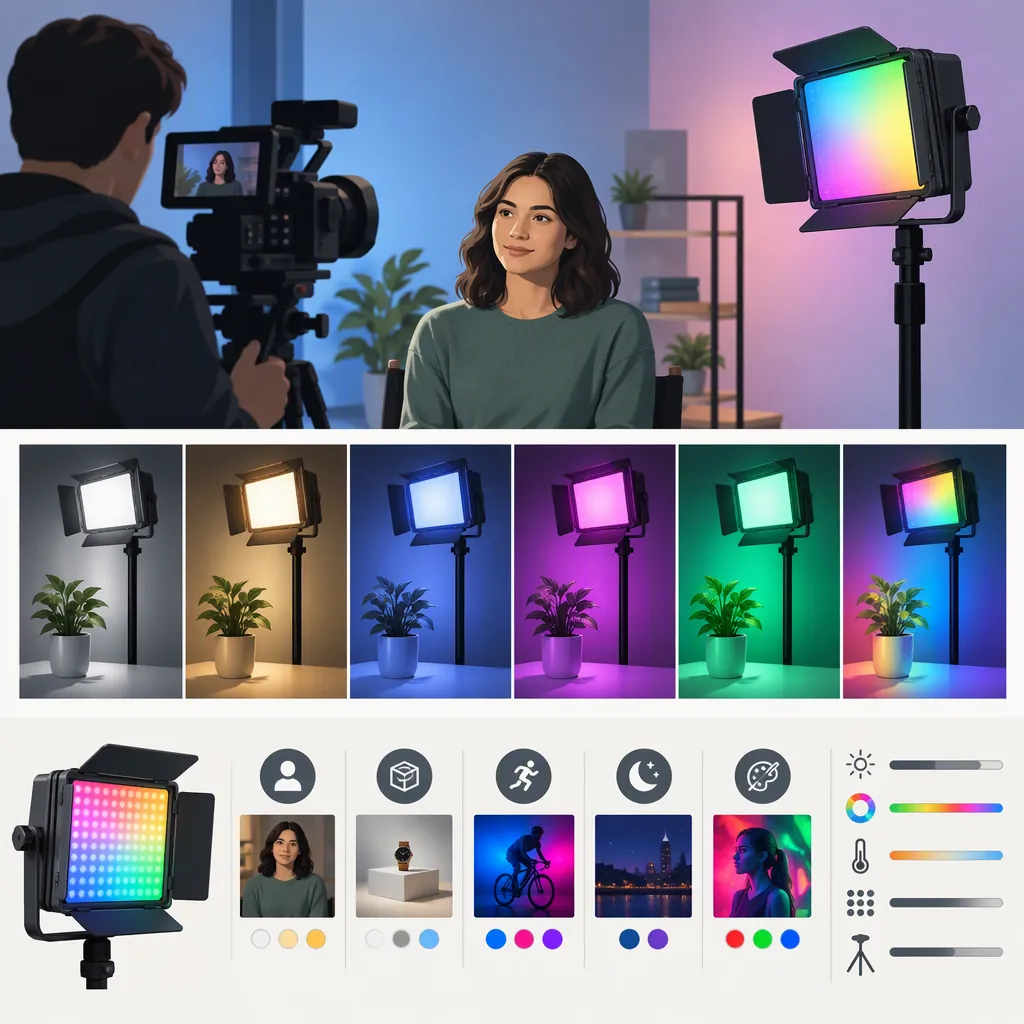
How to Evaluate the Luxceo P7rgb for Filming
Evaluate the LUXCeO P7RGB against the lighting job, not its feature list alone. First confirm the exact version: the supplied listings use both P7RGB and P7RGB Pro names and describe controls differently. Then assess exposure, skin tones, flicker, mounting, and runtime at your intended settings. These sources are commercial listings, not independent performance tests, so they do not establish suitability for a particular shoot. [c1] [c2]
Identify the Exact Version
The name alone is not enough to establish which controls or lighting modes a particular unit supports. Mobspares labels its listing P7RGB Pro and describes Bluetooth app control alongside remote and body controls. Garmade labels its listing P7RGB; although its title mentions app control, its specification lists remote and body controls only. That is a documentation discrepancy, not proof of a reliable distinction between versions. [c1] [c2]
The white-light descriptions also differ. Mobspares describes a 3000K–5750K range, Garmade describes 3000K/5750K dual color temperature, and Alibaba lists 3000K/5700K. Do not assume continuous adjustment or identical endpoints across units from these pages alone. [c1] [c2] [c3]
For an equipment decision, record the exact model marking, applicable manual, control options, and included accessories. Leave any unresolved feature marked unverified rather than merging specifications from different listings.
Define the Lighting Job
Use a shot requirement to organize the comparison. The following are evaluation priorities, not verified P7RGB capabilities.
| Intended Role | What to Evaluate | Decision Criterion |
|---|---|---|
| Main light for a face | Exposure, shadow shape, skin appearance, and coverage | The intended framing looks acceptable without exceeding your camera-setting limits. |
| Fill light | Shadow detail and control at low brightness | The result reduces shadows without flattening the look you want. |
| Background color | Hue, spill onto the subject, and exposure | The background reaches the desired appearance while the subject remains controlled. |
| Edge or detail light | Placement, reflections, and mounting | The highlight stays where intended throughout the shot. |
| Visible light in frame | Highlight clipping and unwanted reflections | The fixture's appearance works at the same exposure as the subject. |
For each role, define the subject distance, framing, ambient light, and acceptable camera settings before comparing fixtures. Treat main-light suitability as an open question until a representative test supports it.
Separate Listing Values from Evidence
The supplied listings advertise 1000LM output and color-rendering values around Ra 95 or higher. The provided text does not include a subject-distance illuminance table, independent color measurements, or camera-based flicker testing. Those listing values therefore do not establish exposure, skin-tone results, or flicker behavior for your setup. [c1] [c2] [c3]
The battery specification needs clarification too. Both retail listings place 10400mAh, 3.7V, and 19.2Wh together. A simple conversion of 10.4Ah × 3.7V gives about 38.5Wh, which does not match the stated watt-hours. This is an internal documentation inconsistency; it does not establish the actual battery capacity. Their advertised 4.5-hour runtime should also remain a listing statement, not a production guarantee. [c1] [c2]
Both retail listings advertise IP68 and use at a depth of two meters, but the supplied text does not give a complete immersion procedure or duration. Do not use these descriptions alone as authorization for underwater operation, wet charging, or exposure to every type of water. Applicable safety documentation is necessary before planning wet-location use. [c1] [c2]
Run a Repeatable Camera Test
If a unit is available for evaluation, compare it with another candidate under the same shot conditions. This is a proposed test procedure, not a report of firsthand testing.
- Fix framing, subject position, camera exposure, and white balance. Record the light's position and distance.
- Test the white-light settings you intend to use, including low brightness. Review skin, neutral objects, shadows, and reflections.
- Record clips at each planned frame rate and shutter setting. Look for banding or brightness variation; a pass applies only to the combinations tested.
- Test the actual color effect required by the scene rather than relying on the number of advertised colors.
- Check mounting stability, access to controls, and whether adjustments disturb the shot. Follow applicable mounting instructions.
- Run a duration test at the intended brightness and mode. Record interruptions, output changes, and usable operating time.
A defensible selection is role-specific: suitable for the tested background effect does not automatically mean suitable as the main interview light.
Filming Light Evaluation Worksheet
Complete one copy per candidate and lighting role.

- Exact model and version:
- Manual or specification used:
- Unverified features:
- Intended lighting role:
- Subject distance and framing:
- Ambient-light conditions:
- Camera, lens, aperture, and ISO:
- Frame rate and shutter setting:
- White balance:
- Light mode and brightness:
- Exposure and coverage result:
- Skin-tone and reflection result:
- Banding or brightness variation observed:
- Mounting and control-access result:
- Duration tested and interruptions:
- Decision: suitable for this setup / unsuitable / unresolved.
- Evidence still needed:
FAQ
Are P7rgb and P7rgb Pro the Same Light?
The supplied sources do not establish that they are identical. Mobspares uses P7RGB Pro, while Garmade uses P7RGB and has differing control descriptions. Confirm the exact unit and its applicable documentation rather than combining the listings. [c1] [c2]
Can the Luxceo P7rgb Be an Interview Key Light?
The supplied evidence is insufficient to confirm that role. The listings advertise 1000LM but do not provide subject-distance illuminance measurements or representative interview tests. Evaluate the intended framing, exposure, shadows, and skin appearance before treating it as a key light. [c1] [c2] [c3]
Should I Plan Around the Advertised 4.5-Hour Runtime?
Not as a guaranteed operating window. The retail listings advertise 4.5 hours, but the supplied evidence contains no independent duration test and includes inconsistent battery-capacity notation. Use a test at your intended settings to establish a workable production allowance. [c1] [c2]