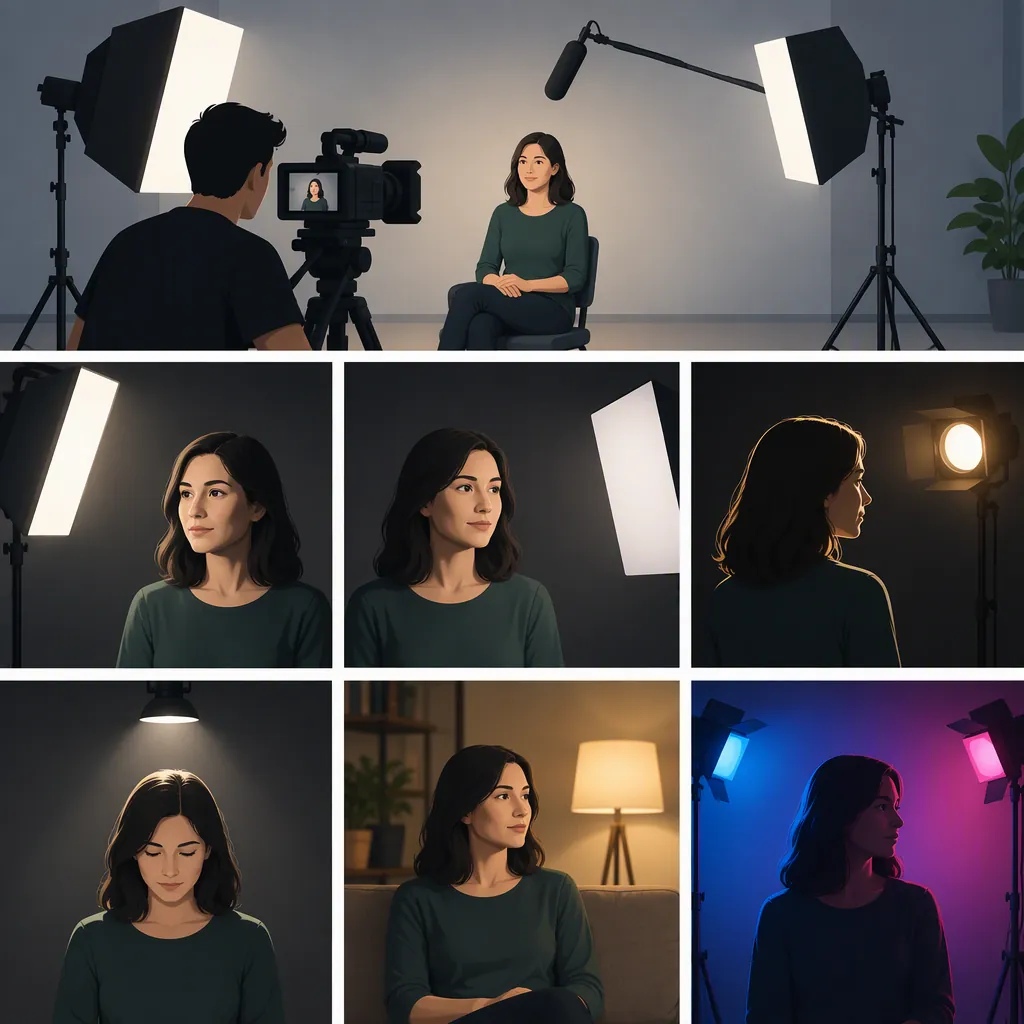
Types of Lighting in Video Production: Roles and Setups
Types of lighting in video production can be understood by their roles and by how they are combined. A key light provides the main illumination, a fill light reduces shadows, and a back light separates the subject from the background. Together, they form a three-point setup. Other approaches include five-point lighting, dedicated green screen lighting, and outdoor lighting shaped with reflectors or diffusion. [lighting-guide]
Lighting Roles: Key, Fill, and Back Light
Start by asking what each light should do, rather than how many lights a scene needs. The supplied guide describes three foundational roles: [lighting-guide]
| Role | Main Purpose | What to Evaluate in the Frame |
|---|---|---|
| Key light | Provides the primary illumination and defines the subject's shape | Whether the direction and intensity suit the subject |
| Fill light | Softens shadows created by the key | Whether shadows retain the desired amount of contrast |
| Back light | Separates the subject from the background | Whether the subject has enough visible separation |
The guide gives a roughly 45-degree key-light position as a typical starting point, not a requirement for every shot. It also describes fill as generally less intense than the key: its purpose is to reduce contrast, not necessarily erase all shadows. [lighting-guide]
Three-Point and Five-Point Lighting
A three-point setup combines key, fill, and back lights. It is a useful starting framework for interviews, educational videos, and similar subject-focused recordings because each light has a distinct job. [lighting-guide]
A five-point setup, as defined in the supplied guide, adds two roles:
- Kicker light: highlights one side of the subject or another important object for added definition.
- Set light: lights the background independently from the subject. [lighting-guide]
Choose between these frameworks by identifying what needs separate control. If the subject is adequately lit but the background needs its own exposure adjustment, background lighting addresses that specific problem. Adding lights should serve the image rather than satisfy a fixed count.
These are setup descriptions, not a comparison of fixture technologies. This article follows the terminology in one supplied guide and does not attempt a complete taxonomy of every film-lighting method.
Light Quality and Color Consistency
A light's role does not fully describe its appearance. The supplied guide recommends softboxes or diffusion panels to soften light and identifies harsh highlights as a possible result of skipping modifiers. For outdoor work, it describes diffusers as a way to soften harsh sunlight. [lighting-guide]
Treat shadow softness and shadow brightness as separate adjustment questions. Diffusion is an option when the illumination looks too harsh; fill is the role used to reduce shadows created by the key. [lighting-guide]
Color consistency also matters. The guide warns that mixing different color temperatures can produce inconsistent footage and recommends matching lights to the same color temperature. For a basic setup, that is a practical starting point rather than a prescription for every creative scene. [lighting-guide]
Green Screen and Outdoor Lighting
Green screen lighting requires attention to both the subject and the backdrop. The supplied guide describes a setup with two lights for the green background plus key, fill, and back lights for the subject. It emphasizes even illumination and avoiding shadows on the screen. Use that arrangement as a starting framework; evaluate the actual backdrop rather than assuming a light count guarantees a clean result. [lighting-guide]
Outdoor lighting starts with changing natural light. The guide lists reflectors for bouncing sunlight onto the subject, diffusers for softening harsh sun, negative fill for increasing contrast, and portable LED lights for balancing natural illumination. [lighting-guide]
For planning, separate two questions: does the subject need a lighting adjustment, and does the surrounding scene need one? This keeps a green screen background or changing outdoor environment from being treated as an afterthought.
A Practical Lighting Check Before Recording
Use the lighting roles to diagnose the frame one adjustment at a time. The supplied guide recommends testing angles, adjusting light intensity, considering background lighting, and maintaining color consistency. The checklist below turns those principles into a basic review routine; it is not a guaranteed setup for every room or subject. [lighting-guide]
Pre-Recording Lighting Checklist
1. Identify the main light and check whether its direction gives the subject the intended shape.
2. Inspect the shadows. Adjust fill if they need to be less pronounced.
3. Check subject-to-background separation and decide whether a back light is useful.
4. Review the background independently. Add or adjust background lighting only if it serves the shot.
5. If illumination looks too harsh, test diffusion and reassess the frame.
6. Check whether different light colors are creating an unintended mismatch.
7. For green screen work, inspect the backdrop for uneven illumination and shadows.
8. For outdoor work, reassess the setup as sunlight changes.
9. Record a short test and review it before the main take.
FAQ
What Is the Difference Between a Lighting Role and a Setup?
A role describes what a light does: key provides primary illumination, fill reduces shadows, and back light creates separation. A setup combines roles. Three-point lighting combines those three, while the supplied guide's five-point setup adds kicker and set lights. [lighting-guide]
Which Lighting Setup Is a Useful Starting Point?
Three-point lighting is a useful starting framework because it separates illumination, shadow control, and background separation into distinct roles. The supplied guide recommends it for beginners and for recordings such as interviews and educational content. Treat it as a framework to adapt, not a mandatory arrangement for every shot. [lighting-guide]
Can Natural Light Be Used for Video Production?
Yes. The supplied guide describes outdoor natural lighting supported by reflectors, diffusers, negative fill, or portable LED lights. Its main planning limitation is that sunlight changes throughout the day, so exposure, shadows, and color need reassessment. [lighting-guide]
Sources
- [lighting-guide] Lighting Techniques: A Complete Guide to Video & Photography