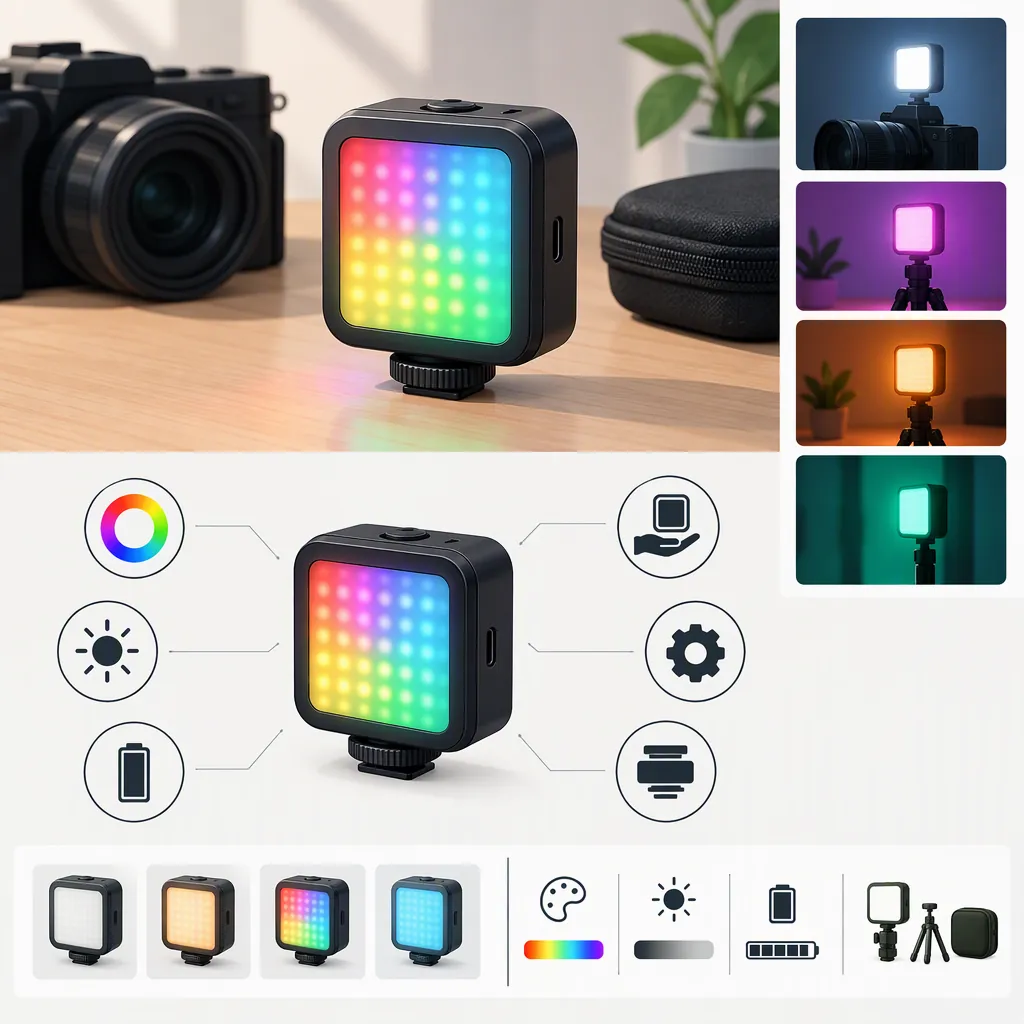
Choosing an Ivisii G2 Pocket RGB Camera Light for Filming
The supplied reference does not establish reliable specifications for an ivisii G2 pocket RGB camera light. Its title identifies an LED light, but its text mixes unrelated listings with conflicting projector and wearable-device descriptions. Treat the model’s specifications as unverified. For filming, evaluate the exact unit against your intended lighting role, camera settings, mounting arrangement, and required operating time before judging its suitability. [source-1]
Verify the Model Before Comparing Specifications
The supplied AliExpress page is a search-results reference, not dependable documentation for a specific camera light. Although its title says “ivisii G2 Pocket RGB LED Light,” the supplied text describes both a projector and a wearable-device concept, alongside unrelated products. Those descriptions do not establish what the filming light supports. [source-1]
Keep the following items marked unverified until documentation tied to the exact model is available:
- Dimensions, weight, and mounting interface.
- White-light adjustment range and RGB controls.
- Light output at a stated distance and setting.
- Color-rendering measurements and their test conditions.
- Battery capacity, runtime, charging requirements, and operation while connected to power.
- Included accessories and environmental protection.
Do not transfer specifications from another light appearing on the same search page. This article does not verify price, availability, performance, or included accessories.
Define the Lighting Role
Instead of starting with the product name, write down what the light must accomplish in your shot. Use these as evaluation scenarios, not as confirmed capabilities of the ivisii G2:
| Intended Role | Question to Resolve | Suggested Check |
|---|---|---|
| Main light for a face | Does the setup produce the exposure and shadow pattern you want? | Record the subject at the intended working distance. |
| Supplemental fill | Can you adjust the light without losing the contrast you want? | Compare clips with the light off and at several settings. |
| Colored background accent | Does the chosen color remain useful in the actual scene? | Test it with the room lighting and background in place. |
| Small-object lighting | Can you control reflections and coverage? | Record the actual object from the planned camera angle. |
| Portable filming setup | Can the unit fit the planned mounting and power arrangement? | Assemble the complete setup and check clearance and stability. |
Define an acceptable result for each required role. A light that meets one scenario should not automatically be assumed suitable for the others.
Use a Repeatable Camera Test
If the exact unit is available for evaluation, use a controlled test rather than relying on the search-page description. The following is a proposed assessment procedure, not a report of testing this product.
- Set up the actual camera, subject, background, and intended light position.
- Record the distance and any diffuser or other modifier used.
- Lock exposure and white balance for comparisons where practical.
- Record a baseline with the light off, then clips at the settings you expect to use.
- Review the clips for unwanted color shifts, uneven coverage, distracting reflections, flicker, or bands.
- Repeat at each frame rate and shutter setting planned for the shoot.
- Run the light for the required session length and note any interruption, output change, or power limitation.
- Check mounting security using compatible hardware and the applicable equipment instructions.
A successful test supports only the tested setup. Keep the camera settings, light settings, distance, and operating duration with the results so the comparison remains interpretable.
Filming-Light Evaluation Worksheet
Exact model and documentation: ____
Intended lighting role: ____
Camera and lens: ____
Frame rate and shutter setting: ____
Exposure and white balance: ____
Light-to-subject distance: ____
Light setting and modifier: ____
Mounting hardware: ____
Required operating duration: ____
Observed exposure and color: ____
Observed flicker or bands: ____
Observed mounting or power issues: ____
Result: meets requirement / does not meet requirement / unverified
Reason: ____
Make a Requirement-Based Decision
Compare candidate lights using the same requirements and test conditions. Separate documented specifications from observations and unresolved questions.
- Meets requirement: Relevant documentation or a controlled test supports the intended use.
- Does not meet requirement: The evaluated setup fails a requirement you identified in advance.
- Unverified: Evidence is missing, ambiguous, or belongs to a different model.
For the ivisii G2 pocket RGB camera light, the supplied reference leaves the technical specification questions unresolved. It does not justify a product ranking or a claim that this light is suitable as a main light, fill light, or background accent. [source-1]
The defensible conclusion is therefore conditional: assess the exact model against the planned shot, and keep suitability unverified wherever documentation or testing is missing.
FAQ
What Specifications Are Verified for the Ivisii G2 Pocket RGB Camera Light?
No technical specifications are reliably established by the supplied reference. Its title names an LED light, but the text includes conflicting descriptions and unrelated listings. Brightness, runtime, color controls, mounting, and charging details remain unverified. [source-1]
Can It Serve as the Main Light for Filming?
That cannot be confirmed from the supplied evidence. Evaluate the exact unit at your intended distance with the actual subject and camera settings. Judge the recorded exposure, shadows, color, and operating duration against your requirements rather than assuming suitability from the product name.
How Should I Compare It with Another Filming Light?
Use the same lighting role, subject distance, camera settings, modifiers, and required operating duration for both candidates. Record documented specifications separately from test observations, and mark missing information as unverified. No comparative performance ranking is supported by the supplied reference. [source-1]
Sources
- [source-1] ivisii G2 Pocket RGB LED Light - AliExpress