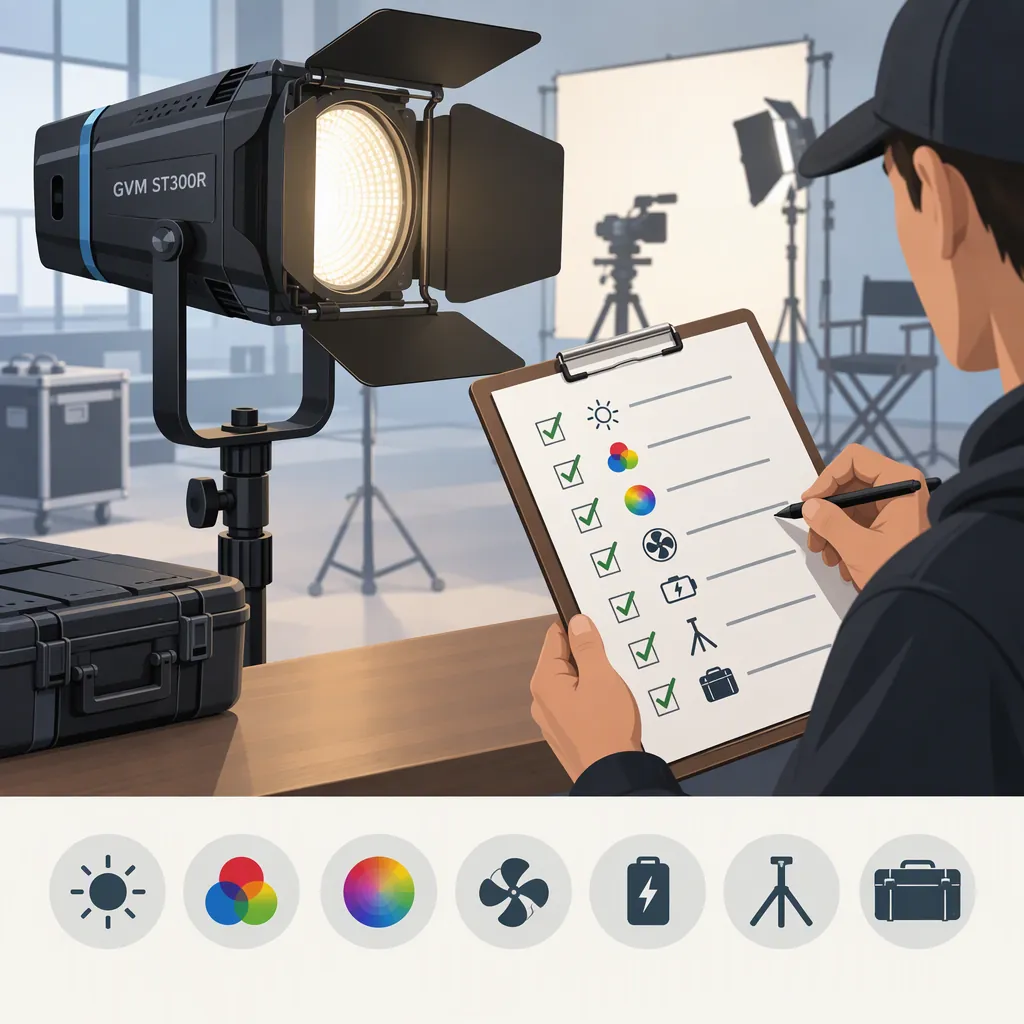
GVM St300r: How to Evaluate a Filming Light
The provided references are not enough to recommend the GVM ST300R or confirm its specifications. They cover the GVM ST200R and GVM-PRO-SD300B, not the requested model. First verify the exact model and its documentation, then evaluate the light for your intended exposure, modifier, sound-recording setup, power source, and controls. Treat this as a selection checklist, not an ST300R review. [c1] [c2]
Verify the Model Before Comparing Features
The supplied GVM product page identifies the ST200R, while the supplied manufacturer-hosted review identifies the GVM-PRO-SD300B. Neither reference establishes specifications for a GVM ST300R. Do not transfer specifications, accessory compatibility, or operating instructions from those models to the requested model. [c1] [c2]
For any listing labeled “GVM ST300R,” use this verification sequence:
- Compare the listing name with the model label on the fixture and power supply.
- Match that label to the exact manual and manufacturer documentation.
- Check whether the offer is a fixture alone or a kit, and record its included components.
- Mark undocumented features as unverified, rather than assuming they match another GVM light.
This article cannot establish whether the requested name is an exact model designation, a listing error, or another naming variation.
Model Verification Record
Listing model name: ___
Fixture label: ___
Power supply label: ___
Matching manual and revision: ___
Exact-model documentation URL: ___
Included components: ___
Unverified features: ___
Status: Verified / Unresolved
Define the Shoot Before Choosing the Light
Start with a filming brief instead of a wattage target. The following are proposed selection criteria, not verified ST300R capabilities.
| Shooting Need | Question to Resolve |
|---|---|
| Interviews or talking-head video | Does the proposed setup produce the desired face exposure and shadow pattern with your chosen modifier? |
| Product filming | Are reflections, labels, and important colors acceptable in footage from your camera? |
| Room or scene lighting | Can the planned placement cover the required area without unwanted spill? |
| Colored backgrounds or effects | Does exact-model documentation confirm the color controls or effects you need? |
| Location work | Is the documented power arrangement suitable for the intended operating conditions? |
| Dialogue recording | Is the fixture acceptable in a recording made with the actual microphone placement? |
Write down the subject distance, framing, camera settings, ambient-light conditions, modifier, and intended light position. Keep those conditions consistent when comparing candidates.
Filming Requirement Brief
Scene type: ___
Light role: Key / Fill / Background / Effect
Subject distance and framing: ___
Camera settings: ___
Ambient-light conditions: ___
Planned modifier: ___
Microphone position: ___
Available power: ___
Required controls: ___
Acceptance criteria: ___
Test the Complete Filming Setup
If the exact fixture is available for evaluation, test it as you intend to use it—not only as an isolated lamp. Follow its matching manual for power, mounting, ventilation, and operating limits.
- Exposure: Record the subject at the intended distance, camera settings, and modifier configuration. Note whether your exposure target is met.
- Color: Include a neutral reference and representative subject materials. Review the footage using your planned white balance and grading workflow.
- Flicker: Record at the frame rates, shutter settings, and dimming levels you expect to use. Inspect the clips for visible banding or brightness variation.
- Sound: Record room tone with the fixture running and the microphone in its production position. Repeat for any documented cooling modes you intend to use.
- Control: Check local adjustments and any documented remote-control method. Record whether settings can be repeated reliably.
- Handling: Assemble the intended modifier and support arrangement according to their instructions. Check cable routing, clearance, and access to controls.
Record observations as results from that specific configuration. Do not treat a successful short test as proof of performance under every condition.
Repeatable Test Log
Verified model: ___
Test date and conditions: ___
Modifier and subject distance: ___
Camera, lens, frame rate, and shutter: ___
Dimming and color settings: ___
Exposure observation: ___
Color observation: ___
Flicker observation: ___
Sound observation: ___
Control and handling observation: ___
Result: Meets Brief / Does Not Meet Brief / Further Testing Needed
Keep Documentation and Observations Separate
Both supplied references are hosted on GVM’s website. The second is titled as a review, but it is still manufacturer-hosted material, not an independent test of the requested ST300R. Use these references only for the models they identify. [c1] [c2]
Organize a comparison into three evidence categories:
- Documented: Supported by a source for the exact model and configuration.
- Observed: Recorded during a clearly described test.
- Unverified: Missing, ambiguous, or borrowed from another model.
A reasonable selection rule is to leave the decision unresolved when a required feature remains unverified. For this article, the evidence does not support an ST300R performance verdict, a compatibility assurance, or a ranking against other fixtures.
FAQ
Can I Use St200r or Sd300b Specifications for the St300r?
Not on the basis of these references. They identify different model names and do not establish that their specifications apply to an ST300R. Keep the requested model’s features unverified until exact-model documentation is available. [c1] [c2]
Is the GVM St300r Suitable for Interviews?
That cannot be confirmed from the supplied evidence. Evaluate the verified fixture with your intended modifier, camera settings, subject distance, and microphone placement. Use acceptable exposure, appearance, and recorded sound as your decision criteria.
What Should I Do If Exact-Model Documentation Is Missing?
Leave the model verification unresolved. Do not assume a power supply, battery arrangement, modifier mount, or control method is compatible because a similarly named fixture supports it. A comparison can still record your requirements, but it should not present undocumented capabilities as facts.