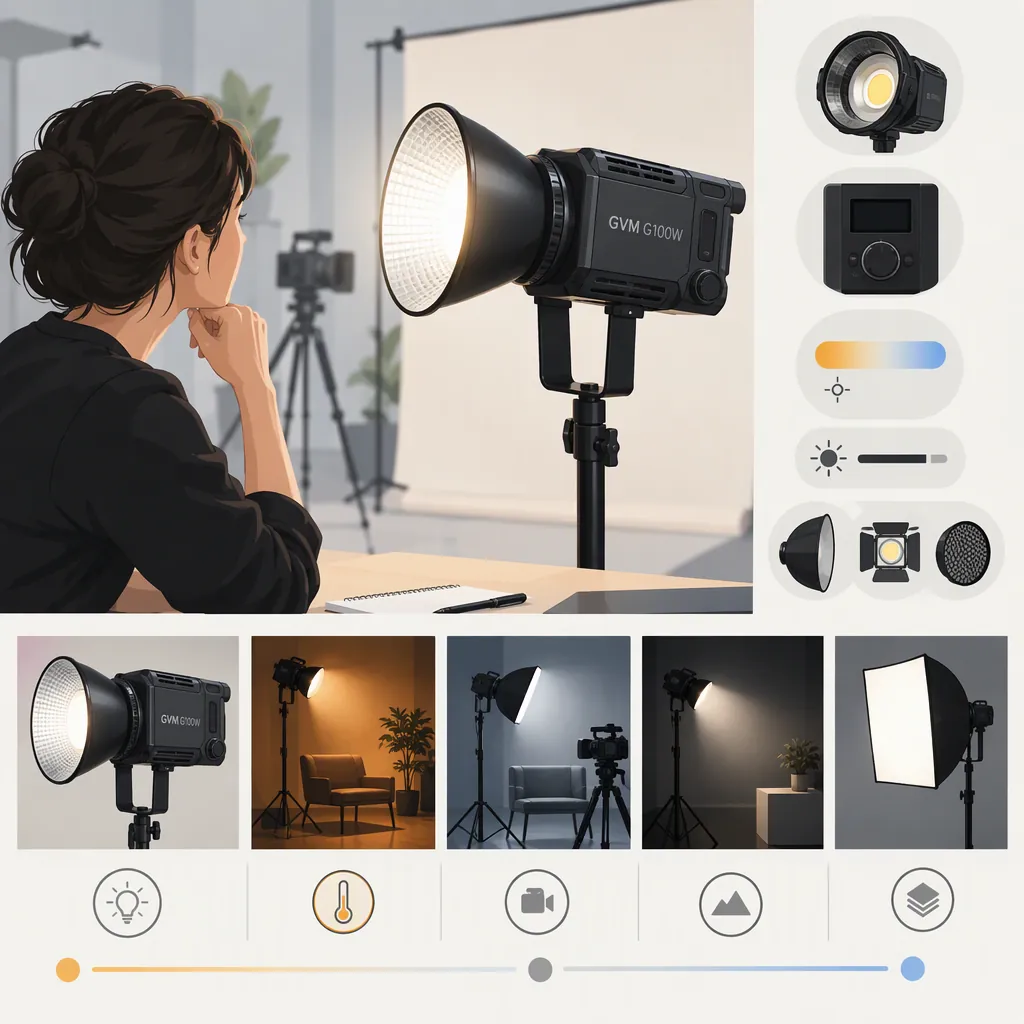
How to Evaluate the GVM G100w for Your Filming Setup
Treat the GVM G100W as a candidate to evaluate against your actual filming setup, not as a proven fit based on its name or a review headline. Unique Photo lists it as the “GVM G100W Bi-Color LED Monolight,” but the supplied listing does not establish its output, sound level, modifier compatibility, or power options. Before selecting it, verify the exact model and assess exposure, recorded sound, mounting, and power requirements. [c1]
What the Sources Establish
The provided sources offer a starting point for research, not a complete technical assessment:
- Model identification: Unique Photo has a listing titled “GVM G100W Bi-Color LED Monolight” and gives the manufacturer number as GVM-G100W. [c1]
- Review coverage: New Layer's review description says it covers build quality, brightness, color accuracy, fan noise, and drawbacks. The supplied text does not include the measurements or detailed findings, so it cannot support a performance verdict. [c2]
- Catalog context: The supplied GVM store page includes a separately named 100W focusing video light. That catalog entry alone does not establish that it is the G100W. Do not transfer its advertised specifications to this model. [c3]
There is no firsthand testing in this article. The evidence supplied is insufficient to rank the G100W against other lights or confirm suitability for a particular shoot.
Define the Shot Before Comparing Lights
Start with a short production brief. This makes the selection about your filming constraints rather than an unsupported claim that one light is universally better.
| Decision Area | What to Write Down | What to Verify |
|---|---|---|
| Subject and framing | Seated interview, tabletop product, or moving subject | Whether the planned setup covers the required frame |
| Placement | Available light-to-subject distance and floor space | Whether the light, stand, and modifier fit safely |
| Exposure | Intended aperture, ISO, frame rate, and shutter setting | Whether the desired exposure is achievable in that arrangement |
| Sound | Microphone position and quietest scene | Whether operating noise is acceptable in the recording |
| Power | Outlet access or location-power requirement | Exact supported power method and required accessories |
| Repeatability | Length of takes and number of setups | Whether settings and placement can be reproduced |
Set your acceptance criteria before a test. For example, specify that a seated subject must remain adequately exposed throughout the planned movement without changing camera settings. This is a proposed test criterion, not a statement about G100W performance.
Filming Requirements Worksheet
Scene:
Subject movement and framing:
Available placement distance:
Camera settings:
Intended modifier:
Microphone type and position:
Power available:
Expected take length:
Required accessories:
Acceptance criteria:
Unverified model details:
Use a Controlled Evaluation
If a demonstration or test unit is available, use a repeatable procedure. Otherwise, keep the unanswered items marked as unverified rather than assuming they will be acceptable.
- Confirm identity. Match the unit label and documentation to the exact model and kit being evaluated.
- Recreate the intended setup. Use your planned camera settings, subject position, distance, and modifier. Record those details with each sample.
- Check exposure. Record the scene at the settings you intend to use. Judge the result against your production brief rather than a wattage label.
- Inspect color. Use a fixed white balance for each comparison and include a neutral reference in the frame. Review the subject and background, not just the reference.
- Record sound. Capture room tone with the light off and then operating, keeping microphone placement and recording gain unchanged. Listen at the level intended for the finished edit.
- Check the intended recording modes. Inspect clips for visible banding or brightness variation at each frame rate and shutter setting you expect to use.
- Evaluate handling. Check setup time, controls, cable routing, mounting security, and repeatability. Follow the equipment's safety instructions and support-load limits.
These steps are a suggested evaluation method. They do not imply that the G100W passes or fails any of these checks.
Test Record Template
Exact model and kit:
Documentation checked:
Camera, frame rate, and shutter setting:
Aperture, ISO, and white balance:
Distance and modifier:
Light settings:
Exposure result:
Color observations:
Recorded operating noise:
Visible banding or brightness variation:
Mounting and cable observations:
Unresolved questions:
Result: meets criteria / does not meet criteria / unverified
Compare Complete Setups, Not Headlines
For each candidate light, use the same worksheet and distinguish three kinds of evidence: documented specifications, observed test results, and unknowns. Do not treat an unknown as either a strength or a defect.
Include any required stand, modifier, mounting adapter, power accessory, and transport equipment in the comparison. Confirm compatibility and package contents instead of assuming that an accessory shown elsewhere is included or supported.
For an interview, prioritize your exposure and sound acceptance criteria. For tabletop filming, prioritize the desired coverage, reflections, and placement. For location work, prioritize verified power arrangements and practical setup constraints. These are decision priorities, not confirmed capabilities of the G100W.
A defensible conclusion may be “suitable for this tested setup,” “does not meet this requirement,” or “insufficient evidence.” The supplied sources support further evaluation, but not a blanket recommendation.
FAQ
Is the GVM G100w a Good Light for Interviews?
The supplied evidence is not enough to confirm that. Evaluate it at your intended subject distance, with the planned modifier and camera settings, and record operating noise using your interview microphone. New Layer's description says fan noise and brightness are covered in its review, but the supplied text does not provide the results. [c2]
Is the GVM Store's 100W Focusing Light the Same as the G100w?
That is not established by the supplied sources. Unique Photo identifies its listing as GVM-G100W, while the GVM store excerpt uses a different descriptive name for the focusing light. Verify the exact model identifier before applying that entry's specifications to the G100W. [c1] [c3]
Which Details Remain Unverified for This Selection?
The supplied material does not establish model-specific output measurements, color-temperature range, color-rendering results, modifier mount, power options, operating sound levels, or included accessories. Keep these items unresolved until exact-model documentation or a controlled evaluation supplies the needed evidence.