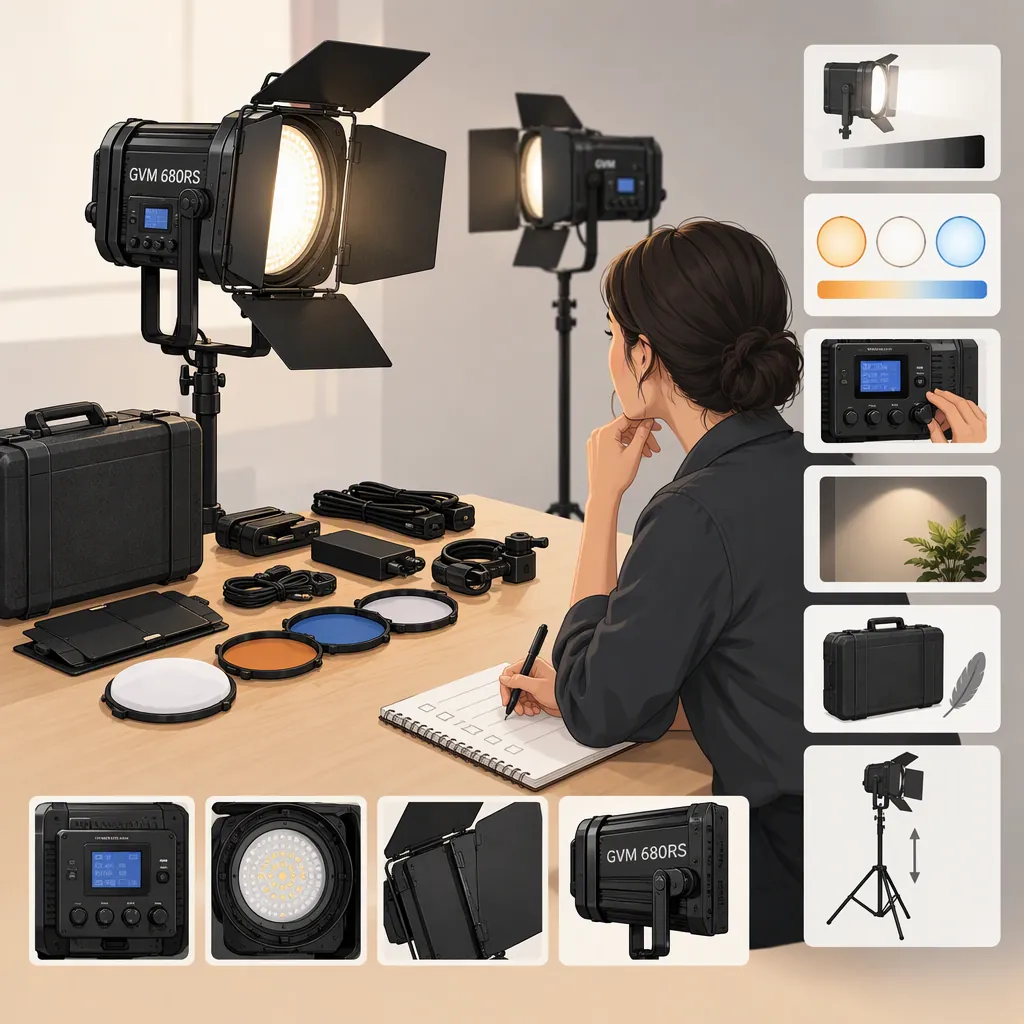
GVM 680Rs: Choosing Lighting for Your Filming Setup
Evaluate the GVM 680RS against your planned shots rather than treating the model name as a recommendation. Define the lighting roles you need, confirm the exact kit contents, and test the setup with your camera. The supplied GVM pages reference different kit configurations and explain key, fill, and backlight placement, but they do not provide independent evidence that this model will suit your production. [c1] [c2]
What the Available Sources Establish
The supplied evidence consists of a GVM store collection page and a GVM lighting tutorial. The collection page references both two-light and three-light GVM 680RS listings; the tutorial discusses a three-light kit. Treat those references as descriptions of particular configurations, not proof that every package with the same model name contains identical accessories. [c1] [c2]
Both sources are manufacturer material. They are useful for identifying what to verify, but they do not constitute independent comparative testing. This guide therefore does not adopt their performance claims, competitor comparisons, or recommendations about value.
Evidence limit: The provided material cannot establish how a particular unit performs with your camera, modifiers, room, or recording settings. No measured brightness, color accuracy, battery runtime, or flicker results are asserted here.
Source Verification Record
- Exact model and kit identifier: ___
- Number of fixtures in the specific package: ___
- Documented accessory list: ___
- Matching manual or specification document available: ___
- Information still unverified: ___
- Date the package details were checked: ___
Start with Lighting Roles, Not Fixture Count
GVM's tutorial describes three-point lighting as a key light, a fill light, and a backlight. It presents the key as the primary source, the fill as a way to soften shadows, and the backlight as a way to separate the subject from the background. Its suggested key-light position is approximately 45 degrees from the subject. Use that as a starting arrangement, not a fixed requirement for every shot. [c2]
For a seated interview, decide first how much facial shadow you want and whether background separation is necessary. Sketch the key position, then decide whether the remaining fixtures should serve as fill, separation, or background lighting.
For product filming, define the intended appearance of the object before choosing positions. The tutorial discusses diffusers and multiple light positions for managing illumination and reflections. Its approach is general guidance, not a guarantee of a reflection-free result. [c2]
For a colored background, write down whether color is essential to the shot or merely optional. Keep that requirement separate from your subject-lighting needs. Do not infer usable output or color quality from the presence of a color-mode label.
Shot Requirement Worksheet
| Requirement | Planned Answer |
| --- | --- |
| Subject and framing | ___ |
| Desired shadow appearance | ___ |
| Key-light position | ___ |
| Fill needed? | ___ |
| Subject separation needed? | ___ |
| Background color needed? | ___ |
| Reflective surfaces to inspect | ___ |
| Available fixture positions | ___ |
Verify the Package and Workflow
Because the supplied collection page references more than one GVM 680RS kit configuration, identify the exact package before planning a setup around its contents. Do not transfer an accessory description from one listing to another. [c1]
Build a verification list for fixtures, stands, power supplies, cables, modifiers, batteries, chargers, and transport storage. Mark each item as documented, separately required, or unresolved. Confirm modifier fit and mounting requirements rather than assuming compatibility.
Also define your workflow constraints: available floor space, access to power, recording duration, setup time, and whether lighting adjustments must be made from the camera position. Treat remote control, runtime, and mounting suitability as questions to resolve for the exact configuration—not established capabilities in this guide.
Package and Workflow Checklist
- [ ] Exact kit configuration identified.
- [ ] Included items recorded from the matching documentation.
- [ ] Required but undocumented accessories marked unresolved.
- [ ] Modifier and mounting compatibility checked.
- [ ] Power plan documented for the recording duration.
- [ ] Fixture positions mapped without obstructing the shot.
- [ ] Required adjustment method identified.
- [ ] No details borrowed from a different kit listing.
Use a Repeatable Camera Test
The supplied references do not establish suitability for your specific camera settings. The following is a proposed evaluation procedure, not a report of testing performed on the GVM 680RS.
- Recreate the intended subject position, framing, background, and ambient lighting.
- Set the camera to the frame rate, shutter setting, exposure, and white balance planned for production.
- Record each intended lighting arrangement, including any modifiers.
- Review the footage for unwanted shadows, reflections, visible brightness variation, and color appearance.
- Record a quiet segment and inspect the audio for unwanted equipment noise.
- Repeat at the brightness settings and operating duration you expect to use.
When comparing another candidate, keep the camera, subject, framing, and intended visual result consistent. Record limitations as well as successful settings. If testing is unavailable, leave performance questions unresolved rather than converting listing language into a recommendation.
Comparison Test Log
| Test Item | GVM 680RS Configuration | Other Candidate |
| --- | --- | --- |
| Exact package tested | ___ | ___ |
| Camera and recording settings | ___ | ___ |
| Distance and modifier | ___ | ___ |
| Desired exposure achieved? | ___ | ___ |
| Shadow and reflection observations | ___ | ___ |
| Visible brightness variation | ___ | ___ |
| Color appearance observations | ___ | ___ |
| Audio observations | ___ | ___ |
| Duration tested | ___ | ___ |
| Unresolved limitations | ___ | ___ |
FAQ
Should I Evaluate a Two-Light or Three-Light GVM 680Rs Kit?
Start by assigning lighting roles to your shot. The supplied collection page references both configurations, and the tutorial explains key, fill, and backlight roles. Choose the configuration to evaluate based on those roles, available space, and verified package contents—not fixture count alone. [c1] [c2]
Can I Assume Every GVM 680Rs Kit Includes the Same Accessories?
No. The supplied material references different configurations, and the tutorial's package description concerns a three-light kit. Verify the accessory list for the exact package rather than applying that description to every listing. [c1] [c2]
Do These Sources Establish That the GVM 680Rs Is the Best Choice?
No. The provided sources are a manufacturer collection page and manufacturer tutorial, not independent comparative tests. They support a verification checklist and basic lighting plan, but not a universal ranking or a prediction of results in your setup. [c1] [c2]