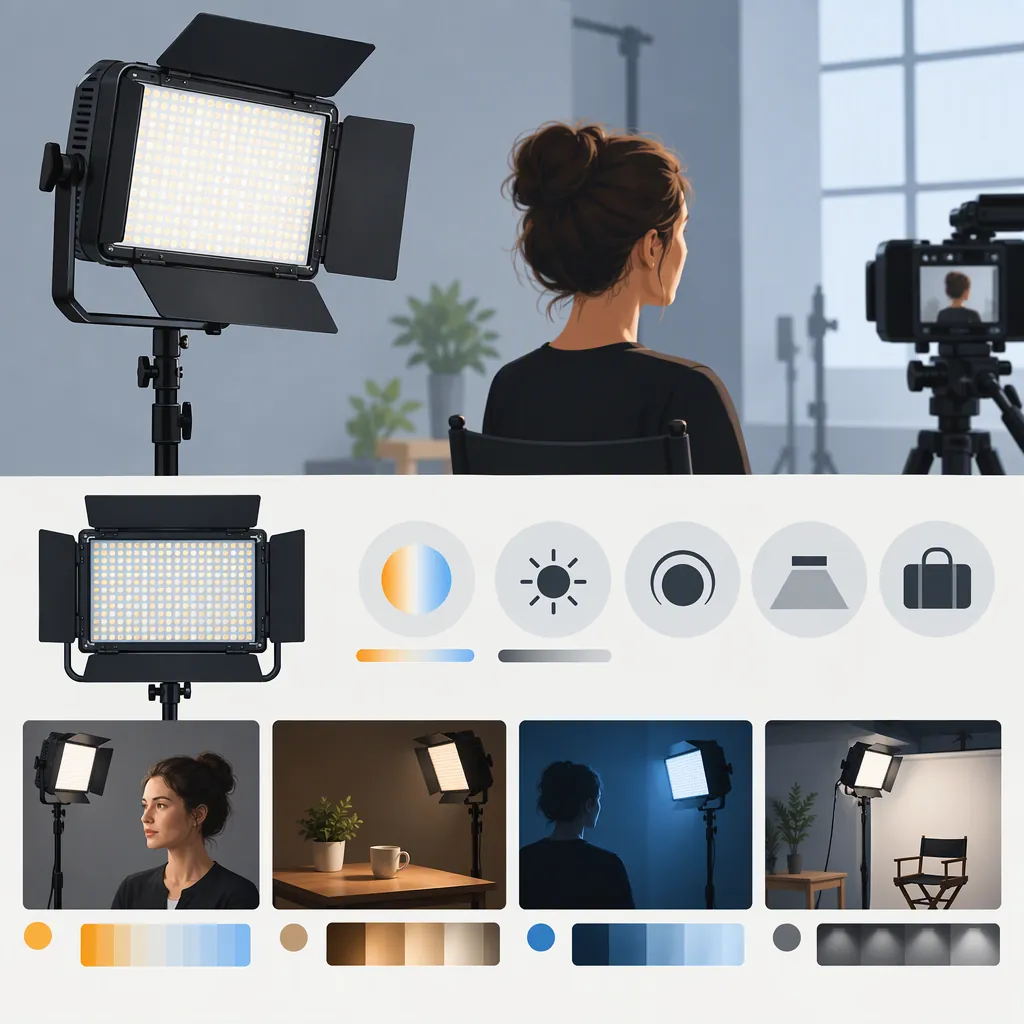
“GVM 672S B” Search Guide: Verify the Model and Choose a Filming Light
For a search such as “gvm 672s b,” verify the exact fixture and its setup requirements before comparing features, then assess picture and sound with a representative recording. Documentation can help screen a candidate before you have access to it; it cannot establish how that light will perform in your intended shot.
The available references cover a GVM 560 light listing, an accessory listing mentioning 672S, and GVM’s SD300B setup guide. They do not verify an exact “672S B” model or explain the trailing “b.” This guide therefore provides a selection process, not a definitive recommendation for or against the searched light. [c1] [c2] [c3]
Confirm the Model Before Comparing Features
Treat “gvm 672s b” as the search term, not a confirmed product designation. Match the model printed on the fixture to the model named in its manual, and record the kit identifier and contents separately.
What the Available Evidence Establishes
| Evidence | What it establishes | What remains unresolved |
|---|---|---|
| GVM 560 light listing | The listing identifies a different GVM light. [c1] | Its specifications do not establish those of the searched fixture. |
| Amazon listing: GVM foldable softbox mentioning 672S | The accessory name includes 672S among several models. [c2] | It does not explain the trailing “b” or verify attachment details for an unidentified “672S B.” |
| GVM SD300B setup guide | The article discusses SD300B equipment and general lighting-kit preparation. [c3] | It is not documentation for the exact searched fixture. |
| Exact model documentation | None of these references supplies a verified specification sheet for “672S B.” [c1] [c2] [c3] | Model identity, the meaning of “b,” and model-specific specifications remain unverified here. |
Do not infer what “b” means. Resolve any difference between the search term, fixture label, manual, and kit name before relying on a specification.
Model Verification Worksheet
| Item | What to record |
|---|---|
| Search term | gvm 672s b |
| Fixture identity | Exact model printed on the light, or a readable label photo if inspecting remotely |
| Matching manual | Model name and document version, if shown |
| Kit identity | Kit identifier and separately listed contents |
| Specifications | Matching document, including stated measurement conditions |
| Naming differences | Any unresolved mismatch among the listing, label, and manual |
Leave light output, color-temperature range, controls, power options, mounting details, and included accessories unverified until documentation for the exact model supports them.
Use a Two-Stage Selection Process
You do not need access to the light to begin screening it. Separate the decision into two stages:
- Before access: Check whether documented identity, kit contents, mounting, space, and power arrangements meet your requirements. An unknown critical condition keeps the candidate unresolved.
- With access: Assemble according to the matching manual and record a representative camera and audio test. Use the results to judge suitability for that shot.
Passing the document check means the candidate is ready for further evaluation—not that its exposure, shadows, reflections, or operating noise will meet your needs.
Stage 1: Screen the Candidate Before Testing
Define the Shot’s Requirements
Start with the production task rather than an overall model ranking. Record targets that you can later evaluate.
| Filming task | Requirements to define |
|---|---|
| Seated interview | Required facial detail, preferred shadow style, framing, subject movement, and acceptable equipment noise during dialogue |
| Tabletop demonstration | Working-area coverage, visibility of labels and small details, typical hand movements, and acceptable reflections |
| Location recording | Expected ambient-light conditions, recording duration, available power, stand space, and cable routes |
There is no single exposure, shadow, reflection, or noise threshold appropriate for every production. For example, an interview may require clean dialogue and a particular facial shadow pattern, while a tabletop recording may prioritize readable labels across the working area.
Check the Documented Setup
| Check | Evidence to establish before proceeding | If it cannot be confirmed |
|---|---|---|
| Exact model | Fixture label and matching manual agree | Keep model-specific comparisons unresolved |
| Kit contents | Required stands, modifiers, cables, and supplies are identified separately | Do not assume a pictured component is included |
| Installation space | Documented fixture, modifier, and stand requirements fit the planned location | Resolve the space or placement constraint before testing |
| Modifier connection | Exact fixture and modifier attachment instructions match | Do not assume compatibility or attempt to force a connection |
| Power | Approved supply and any battery requirements are documented | Do not operate with an assumed compatible supply |
| Operating duration | Available documentation addresses the intended power arrangement and session needs | Leave duration unresolved pending documentation or a permitted test |
The softbox listing’s mention of 672S is a lead for checking an accessory, not a substitute for matching attachment instructions. It is an accessory listing, not the target fixture’s manual. [c2]
If documentation establishes that a critical setup condition cannot be met, the candidate does not meet your current plan. If the condition is merely unknown, record it as unresolved rather than treating it as a failure or a pass.
Stage 2: Test the Complete Filming Setup
This guide reports no firsthand testing or measured performance for the light found through “gvm 672s b.” The following procedure is a way to gather evidence for your own intended arrangement.
Prepare for Safe Operation
Follow the matching fixture, stand, modifier, and power-supply instructions. Before powering on, inspect components, confirm secure mounting, and check the workspace and cable route.
GVM’s SD300B guide recommends inventory inspection, a dry and level workspace, secure mounting, clear walkways, and listening for fan noise. These are general preparation checks; they do not establish the searched fixture’s construction or cooling system. [c3]
Run a Controlled Camera and Audio Test
- Establish a representative baseline. Use the intended subject, framing, ambient lighting, and microphone position. Include the action or dialogue expected in the recording.
- Fix the camera settings for comparisons. Keep camera position, frame rate, shutter setting, ISO, aperture, and white balance unchanged while comparing lighting adjustments. Where available, use manual exposure and fixed white balance for this controlled test.
- Begin with the permitted operating procedure. GVM’s general guide recommends starting continuous-light checks at low brightness and checking available brightness and color controls. Follow the exact fixture’s manual rather than assuming those controls are present. [c3]
- Change one variable at a time. Compare position, angle, distance, or brightness separately. If color-temperature adjustment is available, evaluate it as a separate change. GVM’s guide also recommends comparing changes in light placement. [c3]
- Record picture and sound together. Include typical movement and dialogue or room sound through the planned microphone.
- Review the original clips. Assess the footage captured at the intended frame rate and shutter setting against your stated requirements.
- Retest the final arrangement. If camera settings, power arrangements, or lighting conditions change, record a new baseline.
If automatic exposure or white balance is part of the intended workflow, test that workflow separately after the fixed-settings comparison. Label the clips so the two tests are not confused.
Repeatable Test Log
Use one row or record per clip. Keep requirements in the earlier planning table; use this log for conditions, variables, and observations.
| Field | Record |
|---|---|
| Clip identifier | Filename or test number |
| Fixture and power | Exact model and approved power source used |
| Lighting arrangement | Modifier, position, angle, and distance |
| Light controls | Brightness and color setting, if available |
| Camera | Frame rate, shutter setting, ISO, aperture, and white balance |
| Audio | Microphone position and recording settings |
| Conditions | Ambient lighting, subject action, and test duration |
| Changed variable | The single adjustment being compared |
| Observations | Subject detail, shadows, reflections, visible bands or pulsing, and audible equipment noise |
| Requirement result | Which stated requirements passed, failed, or still need evaluation |
A satisfactory clip supports only the recorded arrangement. It does not establish suitability at every frame rate, distance, power setting, or ambient-light condition.
Turn the Evidence into a Selection Decision
Keep documentation findings separate from test observations. A successful clip does not prove an undocumented specification, and acceptable exposure does not resolve an unsafe mounting arrangement or unverified power compatibility.
| Conclusion | Decision rule | Meaning |
|---|---|---|
| Suitable for this shot | Exact identity and essential setup details are verified, and all critical requirements pass in a representative test | The tested arrangement meets the stated needs under the recorded conditions |
| Unresolved—verify or retest | A critical detail is unknown, a test is unrepresentative, or an adjustment still needs evaluation | There is not enough evidence to make the selection |
| Unsuitable for this shot | A documented setup constraint cannot be met, or a critical requirement fails after practical, permitted adjustments | The candidate or arrangement does not meet this shot’s needs—not a universal judgment about the fixture |
When comparing candidates, use the same requirements and representative review conditions for each. Do not count unknown conditions as passes or rank a light solely by a specification borrowed from another model.
FAQ
Are Specifications for “GVM 672S B” Verified Here?
No. The references do not provide verified documentation for that exact searched designation. The trailing “b” also remains unexplained. [c1] [c2] [c3]
What Can I Decide Before I Have Access to the Light?
You can screen documented model identity, kit contents, space, attachment, and approved power arrangements. Keep any critical unknown unresolved. Actual picture and sound suitability still requires a representative recording; the available SD300B guide offers setup advice, not test results for the searched fixture. [c3]
Does the Softbox Listing Prove Compatibility?
No. It mentions 672S, but it does not resolve the “672S B” identity or confirm a particular fixture’s attachment details. Check matching mounting instructions before assembly. [c2]
What Is a Reasonable Starting Position for an Interview Lighting Test?
GVM’s guide suggests a key light roughly 45 degrees to the subject’s side, slightly above eye level and angled downward. Treat this as an adjustable starting position, then evaluate facial detail and shadows in the recording. It is not a performance claim about the searched model. [c3]
Should I Start at Maximum Brightness?
GVM’s guide recommends beginning continuous-light checks at low brightness and then checking the available controls. Follow the exact fixture’s manual and evaluate the settings required for the shot rather than assuming maximum brightness is necessary. [c3]
Can GVM 560 or Sd300b Specifications Fill the Gaps?
No. Those references identify different lights; their features and power arrangements are not evidence for the fixture found through “gvm 672s b.” [c1] [c3]