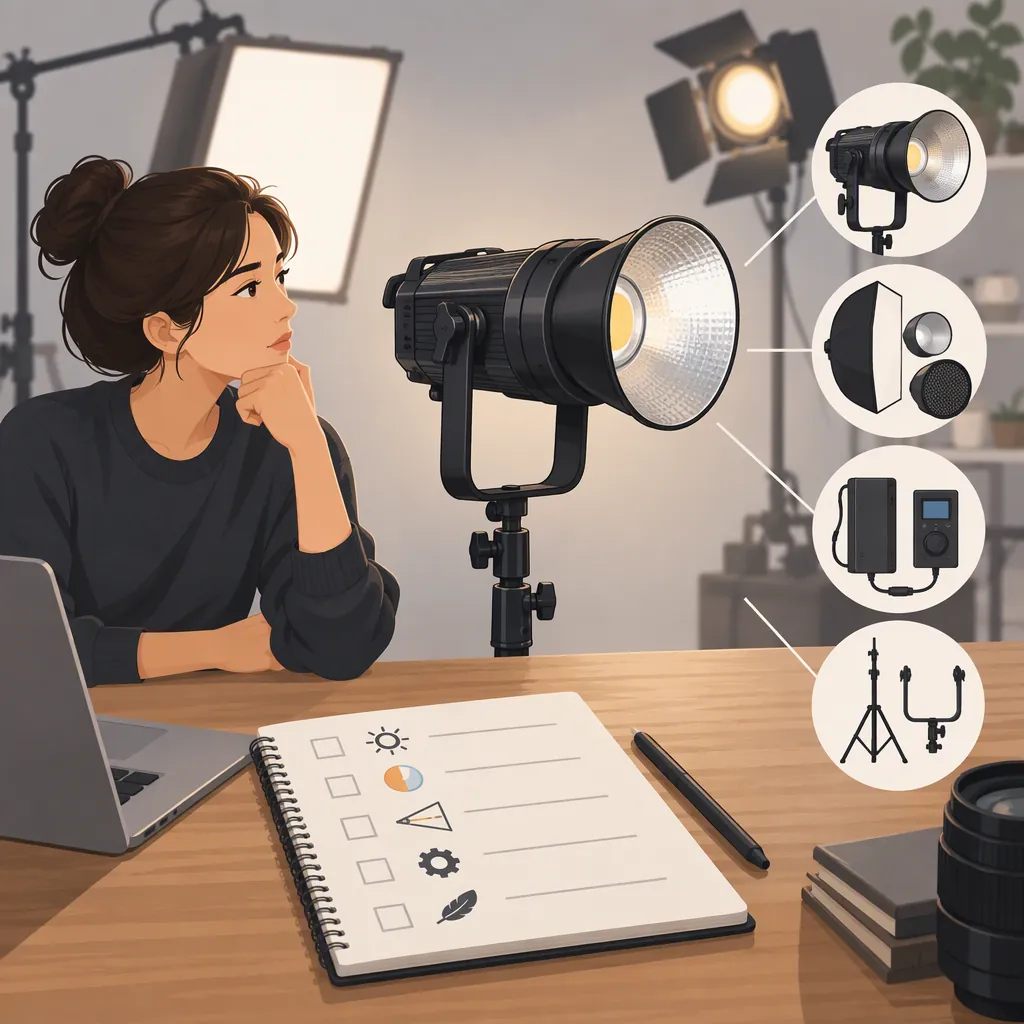
How to Choose a GVM 300W Light for Filming
To evaluate a “GVM 300W” light for filming, first identify the exact model and package, then assess it against your intended camera settings, modifier, working distance, audio setup, and power supply. The provided GVM pages cover several model names, not one interchangeable product. They are manufacturer sources, so they do not establish an independently tested winner. [c1] [c2] [c3]
Start with the Exact Model and Package
Treat GVM 300W as a search term, not a complete equipment specification. The supplied collection page includes SD300D listings and different package descriptions. The other supplied articles discuss Flathead 300B, PRO-SD300B, and SD300B-AIO. Keep those names separate when collecting documentation. [c1] [c2] [c3]
Before comparing candidates, record the full model suffix, package contents, item condition, and source URL. Do not transfer a specification or accessory list from a similarly named light to the model you are evaluating.
This guide does not verify product performance, current prices, inventory, or suitability for a particular production.
Model Identification Worksheet
- Exact model name and suffix: ______
- Package or kit name: ______
- New or pre-owned listing: ______
- Documentation URL: ______
- Confirmed included items: ______
- Unresolved differences between listing and documentation: ______
Define the Shot Before Comparing Specifications
Write down the production requirements before deciding whether a candidate belongs on your shortlist. GVM’s supplied buying guide recommends examining illuminance, color accuracy, color temperature, dimming, controls, fan noise, mounting, power options, and included accessories. These are useful evaluation categories, not proof that a particular light meets your needs. [c2]
For an interview, prioritize a test with the intended microphone and light placement. For a product shot, include representative surfaces and colors. For a wider scene, evaluate the actual area that must be lit rather than only the center of the beam.
Use the planned modifier and camera settings wherever possible. Record any compromises you would accept before the test, rather than adjusting the acceptance criteria afterward.
Filming Requirements Checklist
- Subject and framing: ______
- Required illuminated area: ______
- Light-to-subject distance: ______
- Intended modifier: ______
- Frame rate and shutter setting: ______
- Aperture and ISO: ______
- White balance: ______
- Microphone position: ______
- Available power supply: ______
- Acceptable exposure, color, and noise compromises: ______
Compare Test Conditions, Not Headline Numbers
The supplied manufacturer articles distinguish output figures taken without a reflector from figures taken with a reflector. Do not combine those categories into a single ranking. [c2] [c3]
For a useful comparison, request or record the same distance, color-temperature setting, output setting, modifier, and measurement position for each candidate. Include beam coverage and the intended subject area in your evaluation. If those conditions are missing or different, mark the comparison as unresolved.
The SD300B-AIO article also contains a manufacturer-authored comparison with competing lights. That table is not independent verification of relative performance. This guide therefore does not repeat its superiority claims or select a winner from its numbers. [c3]
Comparable Evidence Log
| Evaluation Field | Candidate A | Candidate B |
| --- | --- | --- |
| Exact model | To record | To record |
| Source and test method | To record | To record |
| Distance and measurement position | To record | To record |
| Color temperature and output setting | To record | To record |
| Reflector or modifier | To record | To record |
| Coverage of intended subject area | To evaluate | To evaluate |
| Conditions match? | Yes / No / Unknown | Yes / No / Unknown |
Use a Filming Test to Resolve Remaining Questions
Treat descriptions such as “silent” or “flicker-free” as items to check in the intended workflow, not guarantees for every recording setup. The supplied articles use these descriptions, but the provided evidence does not independently establish behavior across camera settings, microphone placements, or operating conditions. [c2] [c3]
If evaluation access is available, use this sequence:
- Set the camera to the planned frame rate, shutter, exposure, and white balance.
- Position the light and modifier at the intended working distance.
- Record representative footage at the output and color-temperature settings you expect to use.
- Review for visible banding, exposure variation, unwanted color shifts, and uneven coverage.
- Record room tone with the intended microphone placement and evaluate any audible light noise.
- Check mounting clearance, cable routing, controls, and the documented power requirements.
Record results as pass, fail, or not tested. Without comparable evidence or a practical test, keep the final selection conditional rather than declaring one GVM 300W model best.
Decision Record
- Exposure and coverage: Pass / Fail / Not tested
- Color appearance in representative footage: Pass / Fail / Not tested
- Dimming and visible banding: Pass / Fail / Not tested
- Recorded operating noise: Pass / Fail / Not tested
- Modifier fit and positioning: Pass / Fail / Not tested
- Documented power requirements checked: Yes / No
- Decision: Suitable for tested setup / Unsuitable / More evidence needed
- Test conditions and unresolved questions: ______
FAQ
Does “GVM 300W” Identify One Specific Light?
No. The supplied pages cover multiple model names and package descriptions. Record the exact model suffix and kit contents before using any specification in a comparison. [c1] [c2] [c3]
Is a GVM 300W Light Enough for My Shoot?
The provided sources do not establish that for your setup. Evaluate the exact candidate with your intended modifier, working distance, camera settings, ambient conditions, and subject area. GVM’s buying guide itself recommends looking beyond wattage to illuminance and other operating requirements. [c2]
Which GVM 300W Model Is Best for Interviews?
These references do not support an independently verified winner. For interviews, make recorded operating noise, usable exposure, color appearance, modifier fit, and control access part of the evaluation. Do not treat the manufacturer’s review or silent-operation descriptions as a substitute for testing your audio setup. [c2] [c3]