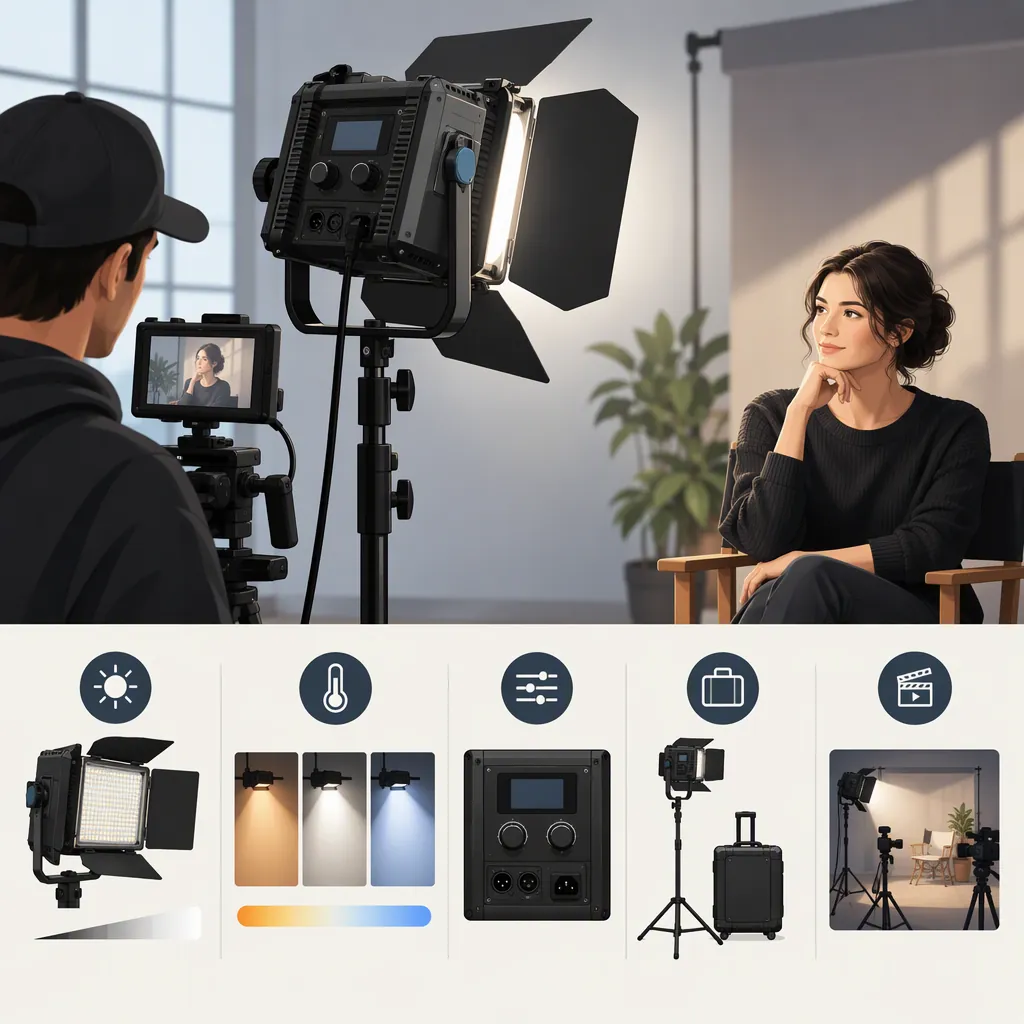
GVM 1200D: How to Choose a Lighting Kit for Your Shoot
Evaluate GVM 1200D lighting against your framing, light placement, camera settings, and audio requirements—not the model name alone. The GVM collection page includes differently named two-light and three-light 1200D kits. Identify the exact package, assign a purpose to each light, and test it against criteria written before the comparison. [c1]
Evidence boundary: This guide uses the collection page’s catalog names for identification only. Those names do not establish a complete package inventory, model revision, or verified brightness, color accuracy, flicker, runtime, operating noise, or accessory compatibility. No firsthand use or controlled performance measurements are presented here. [c1]
Identify the Exact GVM 1200D Kit
The collection page contains these three 1200D listing names. The wording is reproduced for identification; specifications appearing within the names are not treated as verified performance claims. [c1]
| Catalog listing name | Difference indicated by the label | What still needs confirmation |
|---|---|---|
| GVM-1200D 50W Bi-Color+50W RGB Led Video Light(2-Light-Kit) | Labeled as a two-light kit | Actual contents, fixture revision, power equipment, mounting equipment, and modifiers |
| GVM 1200D 50W RGB LED Light Panel (3-Light Kit) | Labeled as a three-light kit | Actual contents and whether the fixtures differ from those in the other listings |
| GVM-1200D 50W Bi-Color+50W RGB Video Light(3-Light kit with softbox) | Labeled as a three-light kit with softbox | Modifier quantity, exact modifier identity, compatibility, and complete package contents |
All three names appear in the supplied collection-page text. Their wording alone does not establish whether the fixtures are identical or whether the listings represent different revisions. [c1]
Record the exact listing name and match it to package-specific documentation. Do not assume that stands, power supplies, batteries, cases, or modifiers are included merely because another 1200D listing mentions them.
Kit Verification Worksheet
- Exact listing name: ______
- Model or revision identifier: ______
- Number of fixtures confirmed: ______
- Included power equipment confirmed: ______
- Included stands and mounting equipment confirmed: ______
- Included modifiers and quantities confirmed: ______
- Documentation used to confirm contents: ______
- Unresolved questions: ______
Keep catalog wording separate from confirmed contents. For example, “with softbox” is a listing label until package documentation establishes what modifier equipment is included.
Define the Shot Before Choosing the Light Count
Start with the image and recording conditions you need, then decide how many independently controlled light positions the plan requires.
- Framing: Specify a seated close-up, standing presenter, tabletop scene, or wider composition.
- Placement: Measure the available distance between the subject and each proposed light position.
- Light appearance: Describe the desired shadow softness, subject separation, and control of light spilling onto unwanted areas.
- Ambient conditions: Identify windows and room lights that will remain during filming.
- Camera settings: Record resolution, frame rate, shutter setting, aperture, ISO, and white balance.
- Audio and logistics: Note microphone placement, available power, transport limits, and setup time.
Hypothetical Two-Light and Three-Light Plans
These examples illustrate planning choices, not fixed lighting recipes or conclusions about GVM 1200D performance.
| Proposed setup | Possible role assignment | Question to resolve |
|---|---|---|
| Seated interview with two fixtures | One main light on the subject and one fill light to adjust shadows | Can the planned positions produce the desired exposure and shadow appearance? |
| Seated interview with a reflector | One main light, a reflector considered for fill, and a second fixture assigned to the background | Does the reflector provide the intended fill in the available space? |
| Interview with three fixtures | Main light, fill light, and a third fixture for either background illumination or subject outline | Is that third role necessary, and can it be achieved without unwanted spill into the shot? |
A third fixture should address a defined requirement. It is not, by itself, evidence that a kit will solve insufficient exposure, unsuitable shadows, or limited placement space. Likewise, a two-light package may leave a planned role unresolved. Test the arrangement rather than treating fixture count as a suitability verdict.
Shoot Requirements Template
- Shot and subject: ______
- Required framing: ______
- Available light-to-subject distances: ______
- Role assigned to each fixture: ______
- Desired shadow and background appearance: ______
- Ambient lights to retain: ______
- Camera settings: ______
- Microphone position: ______
- Power and transport constraints: ______
- Maximum acceptable setup time: ______
Write Acceptance Criteria Before Testing
Decide what would count as a pass, a failure, or an unresolved result before viewing the footage. Use thresholds appropriate to your production; this guide does not supply universal exposure, flicker, or noise limits.
| Check | Example of a criterion you can define |
|---|---|
| Exposure | At the planned light distance, modifier, aperture, and ISO, the subject must reach your chosen exposure target without changing those conditions. |
| Shadows and spill | In the final framing, shadows must match your chosen reference, and designated background areas must remain within your stated lighting limits. |
| Visible bands or brightness changes | At every planned frame-rate, shutter, and dimming combination, reviewed footage must meet your stated tolerance for visible artifacts. |
| Recorded sound | At the actual microphone position and fixed recording gain, any difference between light-on and light-off recordings must fall within your stated noise tolerance. |
| Setup and packing | The documented equipment must fit your transport limits and be ready within your chosen setup-time limit. |
| Package readiness | Required power, mounting, and modifier arrangements must be confirmed for the exact kit. |
Make each standard specific enough to revisit. “Looks good” is difficult to audit; “matches the selected reference at the recorded camera settings” gives the comparison a clearer basis.
Run a Repeatable Filming Test
If a demonstration, rental, or other authorized test is available, compare candidates under documented conditions. This is a proposed procedure, not a report of completed tests.
- Lock the shot. Fix the camera position, subject position, framing, and exposure settings. Disable automatic exposure and automatic white balance for the comparison.
- Document the lighting setup. Record fixture distance, angle, operating mode, dimming setting, and modifier. If candidates require different configurations, document those differences rather than calling the setups equivalent.
- Record a representative subject. Inspect the footage against the exposure, shadow, and background criteria you wrote beforehand.
- Check planned recording combinations. Repeat at the frame rates, shutter settings, operating modes, and dimming levels you expect to use. Review for visible bands or brightness changes. A clean result at one setting does not establish performance at every setting.
- Compare recorded sound. Keep microphone position and recording gain fixed. Record with the light operating, then with it off, and assess the difference against your noise criterion.
- Check practical readiness. Record setup time, packed equipment, cable routing, and unresolved mounting or power questions. Verify compatibility through package-specific documentation before using accessories.
If testing is unavailable, record performance checks as unknown. A catalog description is not a substitute for an observation.
Comparison Log
Replace the placeholders with your criteria and results. Keep footage and audio filenames alongside the notes so the decision can be reviewed.
| Check | Acceptance criterion | GVM 1200D exact kit | Other candidate |
|---|---|---|---|
| Exact package identified | Listing and contents documented | Unresolved | Unresolved |
| Exposure | ______ | Not tested | Not tested |
| Shadows and spill | ______ | Not tested | Not tested |
| Bands or brightness changes | ______ | Not tested | Not tested |
| Recorded sound | ______ | Not tested | Not tested |
| Setup time and transport | ______ | Not tested | Not tested |
| Power, mounting, and modifiers | ______ | Unresolved | Unresolved |
For each completed check, record Pass, Fail, or Unknown, followed by the conditions and evidence. Keep untested settings separate from tested ones.
Make the Selection from Verified Requirements
Separate the decision into three evidence categories:
- Confirmed package details: Contents and compatibility established by documentation for the exact package.
- Observed behavior: Results from your recorded setup, limited to the conditions tested.
- Unknowns: Requirements that neither documentation nor testing has resolved.
Use these categories to reach a practical conclusion:
| Decision | When to use it |
|---|---|
| Suitable for the documented setup | Every must-have requirement is supported by package documentation or representative testing. |
| Unsuitable for the documented setup | At least one must-have requirement fails under the conditions you intend to use. |
| Unresolved | A must-have requirement remains unconfirmed or untested. |
Do not turn a pass in one close-up setup into a conclusion about wider shots, different modifiers, or other recording settings. If both candidates pass, compare your recorded setup time, transport burden, and optional requirements rather than inventing a performance ranking.
Decision Record
- Exact kit evaluated: ______
- Confirmed package details: ______
- Must-have requirements passed: ______
- Requirements failed: ______
- Requirements still unknown: ______
- Evidence needed to resolve unknowns: ______
- Decision: Suitable / Unsuitable / Unresolved
- Conditions and reasoning: ______
FAQ
Does GVM 1200D Identify One Complete Kit?
Not on the supplied collection page. It includes two-light and three-light 1200D listings, including a three-light listing whose name mentions a softbox. Confirm the exact listing and its package contents rather than assuming all 1200D entries are identical. [c1]
Is the GVM 1200D Bright Enough for My Filming Setup?
The collection-page evidence does not establish that. [c1] Set your intended framing, fixture distance, modifier, ambient conditions, aperture, and ISO, then test whether the exact kit reaches your predefined exposure target.
Should I Evaluate a Two-Light or Three-Light Kit?
Assign a job to each light first. In a hypothetical interview plan, two fixtures could serve as main and fill lights. If you also need separate background or outline lighting, evaluate a third position. Alternatively, test whether a reflector can serve the planned fill role. These are planning options, not evidence that either GVM 1200D kit meets those requirements.
Does the Softbox Listing Confirm Which Modifiers Are Included?
It confirms only that one catalog name says “3-Light kit with softbox.” It does not establish the complete modifier inventory, quantities, or compatibility. Verify those details in documentation for the exact package. [c1]
Can One Clean Test Establish Flicker-Free Operation?
No universal conclusion follows from this proposed test. Record the frame rates, shutter settings, operating modes, and dimming levels used, and limit your conclusion to the combinations checked. Mark other combinations as untested.
What If I Cannot Test the Kit Before Selecting It?
Confirm what you can through package-specific documentation, then leave performance-dependent requirements unresolved. The collection page identifies listings but does not provide the controlled evidence needed for a verified performance verdict. [c1]
Sources
- [c1] GVM Lighting Deal