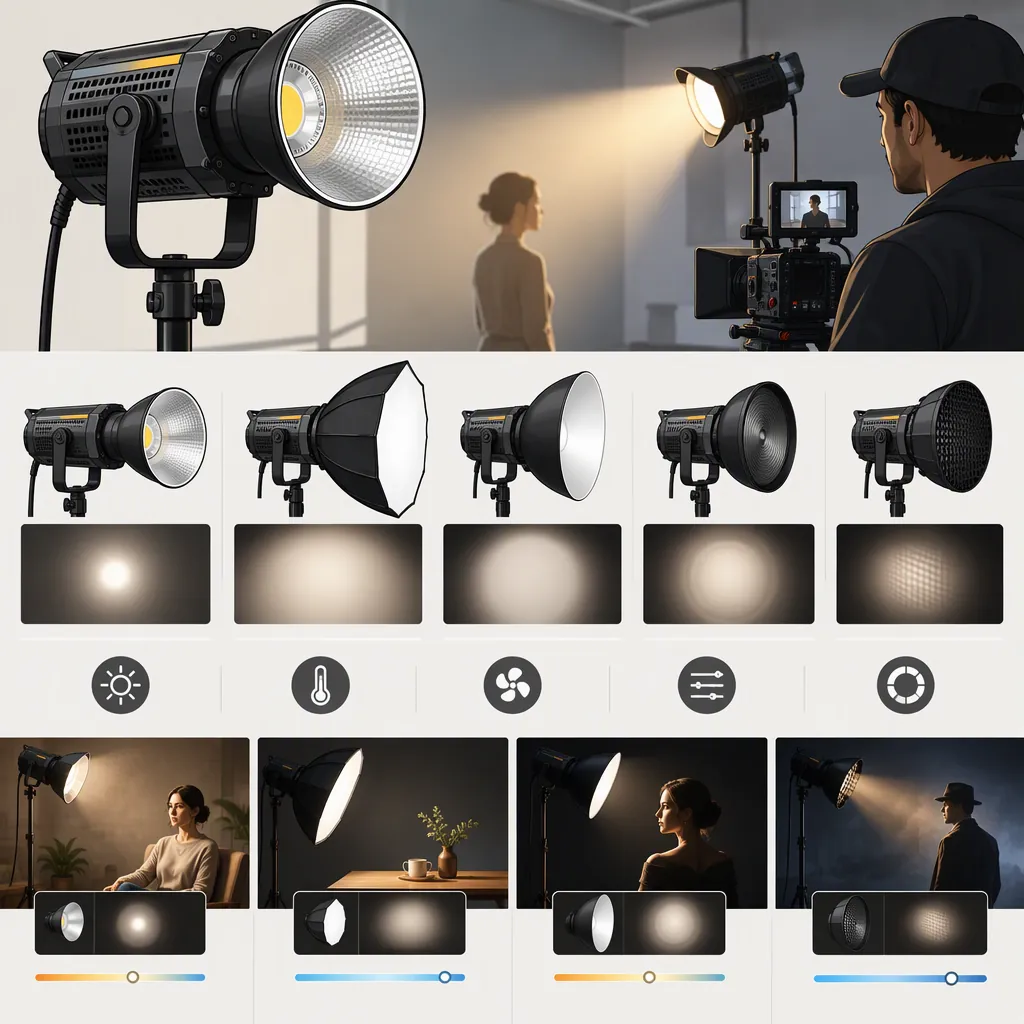
Godox Vlc300: Verify the Model Before Choosing a Filming Light
For a godox vlc300 search, the first selection question is model identity—not brightness or price. The available source identifies a Godox VL300 LED Video Light (Head Only). It does not establish whether “VLC300” is a typo, a different model, or another naming variation. Do not treat the names as interchangeable or transfer specifications between them. [source_1]
1. What Can—And Cannot—Be Confirmed
The available evidence is one GearFocus marketplace listing, not exact-model documentation or an independent performance test. Its usefulness is limited to identifying the listed item and the seller’s description of its condition. [source_1]
| Selection question | Current evidence |
|---|---|
| What model does the source identify? | A Godox VL300 head-only item, not a confirmed VLC300. [source_1] |
| Is that listing a complete kit? | The seller says a battery pack, “a/c unit,” and controller are not included. [source_1] |
| Has the listed unit been tested? | The seller states that it was tested and works; this is not an independent inspection. [source_1] |
| What product does “VLC300” identify? | Unresolved by this source. [source_1] |
| Does the source establish filming suitability? | It does not independently establish exposure, color, sound, flicker, or handling performance for your shoot. [source_1] |
The next useful evidence is the actual fixture’s model label and documentation for that exact model. Until those match, keep model-specific output, color performance, cooling noise, modifier compatibility, and power requirements unverified.
This guide therefore provides a selection method, not a recommendation for or against a confirmed VLC300. The listing above is a limited example of why model identity and package completeness need separate checks; it is not the basis for a broader product assessment.
Model Verification Record
- Search term: godox vlc300
- Model printed on the fixture: to verify
- Controller model, if applicable: to verify
- Matching exact-model documentation: to verify
- Naming or compatibility discrepancies: to document
- Status: confirmed / unresolved
Decision rule: If the label and documentation do not match, pause model-specific comparisons. You can record observations about an individual setup, but do not attribute those results to an unconfirmed model.
2. Check the Configuration Against the Shoot
Once identity is resolved, distinguish the fixture from the complete configuration you need. A light head, operating accessories, modifier, and support arrangement should be evaluated together—not as interchangeable parts.
For the listing example above, clarify what the seller means by “a/c unit” before drawing conclusions about the missing accessory. Then use exact-model documentation to determine which components are required and which are optional.
Component Review Checklist
For each item, record whether it is required, included, compatible, and condition-verified.
| Component | What to resolve | Why it matters to selection |
|---|---|---|
| Light head | Exact model and condition | Establishes which documentation and test results apply |
| Controller, if required | Correct model and availability | Resolves whether the intended operating configuration is complete |
| Power supply and cables | Documented requirements and included equipment | Determines whether the setup can be operated as intended |
| Battery equipment, if intended | Whether the configuration is supported and complete | Connects the candidate to the planned location-power arrangement |
| Connection cables | Required types and condition | Avoids judging a package with unresolved connections |
| Mounting hardware | Compatibility and documented support limits | Connects the fixture to the planned position and support |
| Modifier and attachment hardware | Compatibility with the verified fixture | Allows testing the intended coverage and light quality |
Leave unresolved entries marked unverified. For used or incomplete equipment, seek a demonstration of the actual unit with the components required for your intended configuration.
Use these decision rules:
- Required equipment is missing or compatibility is unresolved: Do not conclude that the package is ready for filming.
- Required components are verified and available: Proceed to a scene-specific test.
- A complete configuration cannot be established: Keep the decision unresolved or set the candidate aside for the current shoot. Uncertainty is not proof of either suitability or failure.
3. Define Your Shooting Requirements
Write down acceptance criteria before comparing lights. Otherwise, changing the setup to obtain a better result can obscure whether it meets the actual brief.
Record the following:
- Scene and look: Subject position, framing, coverage, intended shadows, and background treatment.
- Camera requirements: Lens, ISO, aperture, frame rate, shutter setting, and white balance.
- Lighting arrangement: Fixture position, distance, modifier, and other lights.
- Audio requirements: Microphone position, recording gain, and what equipment noise would be unacceptable.
- Practical constraints: Available space, power arrangement, support equipment, cable routes, and setup time.
- Permitted adjustments: Which settings, positions, or accessories can change during the real shoot.
A test at a closer light position does not establish suitability at a required longer distance. Likewise, a different frame rate or microphone position only answers the selection question if that change is permitted for the production.
4. Run Repeatable Filming Tests
Test the verified, complete configuration under the conditions you intend to use. Change one variable at a time where practical, and label every sample with its settings.
These are general evaluation steps—not verified capabilities or faults of a VLC300 or the listed VL300.
| Test | Repeatable procedure | Selection consequence |
|---|---|---|
| Exposure and look | Use the planned camera settings, subject position, light distance, and modifier. Check exposure, coverage, and shadow pattern against your criteria. | If the result falls short, make only permitted changes and retest. Set aside a configuration that cannot achieve the required result within those constraints. |
| Color | Keep white balance, exposure settings, reference target, and target position consistent between comparisons. Document the other lights in use and review recorded results under the same viewing conditions. | If color is unacceptable, test permitted adjustments. Do not treat footage recorded under different comparison conditions as an equivalent result. |
| Sound | Record light-off and light-on samples with the same microphone position, recording gain, and otherwise comparable room conditions. Note other audible equipment. | If noise is unacceptable, try a permitted placement change, then retest both audio and lighting. If neither can meet its requirements together, consider another configuration. |
| Flicker | Record each planned combination of frame rate, shutter setting, and dimming level. Label each clip with that combination and inspect the footage. | If visible flicker appears, test alternative settings only if the shoot allows them. A passing combination does not establish performance at untested settings. |
| Handling | Rehearse positioning, adjustment access, and cable routing with the intended support equipment, within documented limits. | Revise an unsuitable arrangement before further testing. Do not accept an unsafe setup because its image result is satisfactory. |
For sound comparisons, note interruptions or changes in background noise that could make the samples inconclusive. For every test, distinguish not observed under these conditions from absent in all conditions.
Filming Test Log
- Scene and intended look:
- Verified fixture model:
- Controller and power configuration:
- Modifier, position, and distance:
- Camera, lens, ISO, aperture, and white balance:
- Frame rate, shutter setting, and dimming level for each clip:
- Reference target and other lights:
- Microphone position and recording gain:
- Light-off and light-on audio sample labels:
- Acceptance criteria:
- Observed exposure, color, sound, and flicker:
- Support or handling concerns:
- Adjustment made and retest result:
- Unresolved items:
If components are unidentified or substituted, state that in the log. Results from that configuration do not establish suitability for a different package.
5. Make a Conditions-Based Selection Decision
Summarize what was verified, what was tested, and what remains unknown.
| Decision | When to use it |
|---|---|
| Suitable for tested conditions | The verified configuration meets all stated shooting requirements |
| Adjust and retest | A permitted change may address an unmet criterion |
| Unresolved | Model identity, required components, compatibility, or meaningful test evidence is missing |
| Set aside for this shoot | The configuration cannot meet a required criterion within the production’s constraints |
Include the exact fixture, operating components, modifier, support arrangement, and test settings in the decision record. “Suitable for tested conditions” is a conclusion about that setup and scene—not a claim of universal suitability.
For the godox vlc300 search, a model-specific selection remains unresolved until the naming question is answered. Do not fill that evidence gap with specifications from a similarly named light.
FAQ
Is Godox Vlc300 the Same as Godox Vl300?
The available source does not establish that they are the same. It identifies a VL300 head-only item. Confirm the actual fixture label and exact-model documentation before treating the names as interchangeable. [source_1]
Can the Available Listing Establish Readiness for Filming?
No. The listing describes missing components and includes a seller statement that the unit was tested and works. It does not independently demonstrate a complete configuration meeting your filming requirements. [source_1]
What Should I Verify Before Comparing Filming Lights?
Verify the exact model, required operating components, intended modifier, and support arrangement. Then define the scene, camera settings, audio requirements, and practical constraints. Compare configurations against those requirements rather than comparing isolated specification figures.
How Should I Check Sound and Flicker for Dialogue Recording?
Record light-off and light-on audio samples at the same microphone position and gain, with comparable room conditions. For flicker, record and label each planned frame-rate, shutter, and dimming combination. These checks support a decision only for the configuration and conditions tested.
What If a Candidate Fails One Test?
Make only adjustments the shoot permits, record each change, and retest the affected criteria. Keep the decision unresolved if required information is missing. If the verified configuration still cannot meet a required criterion, set it aside for that shoot. This is a general evaluation method, not a model-specific performance conclusion.