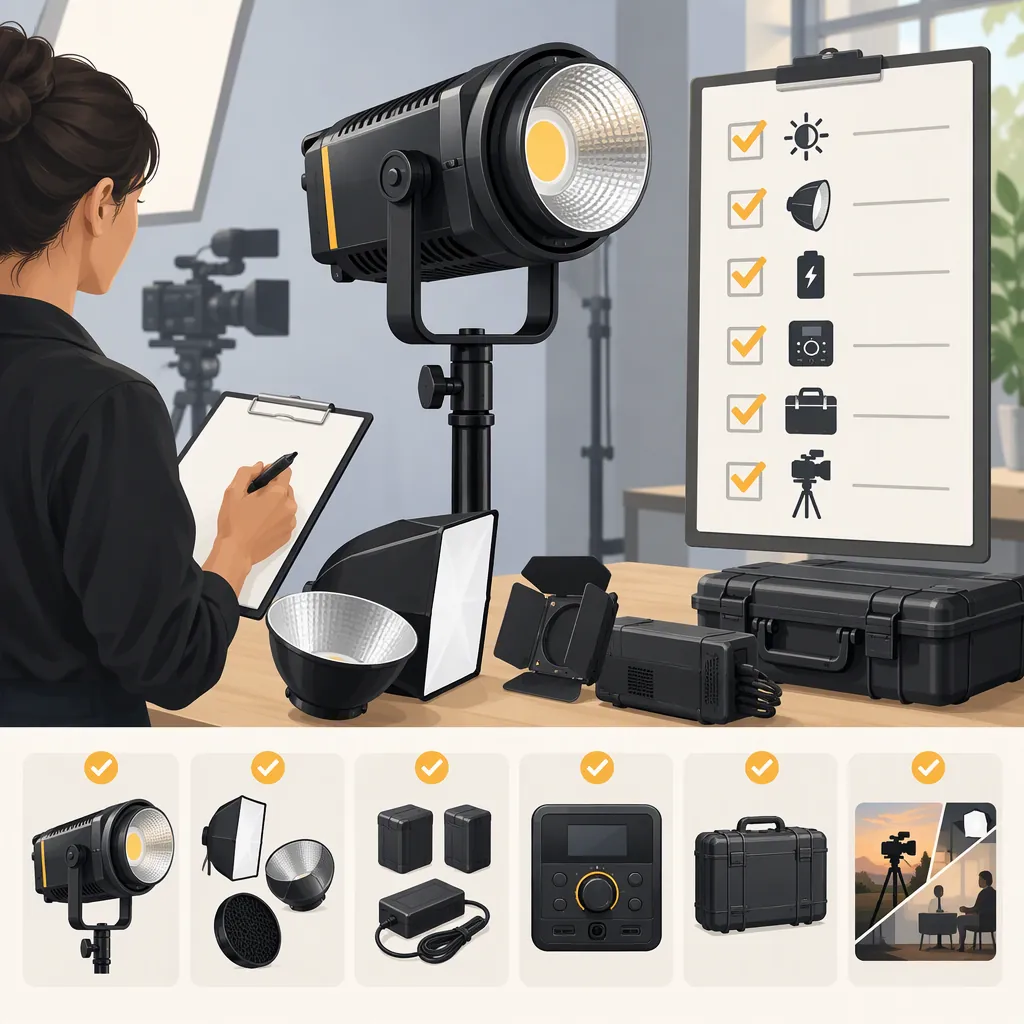
Godox Vlc150 Search: Verify the Model Before Choosing a Filming Light
If you searched for “godox vlc 150,” first confirm the model you intend to evaluate. The available Studio Depot reference identifies Godox VL150, not VLC150, and contains conflicting color-temperature descriptions. It does not establish specifications for a separate VLC150 model. [source_1]
For filming-light selection, use two gates: verify the exact equipment, then test whether the complete setup meets your shot requirements. If a necessary capability remains undocumented or fails your test, leave the decision unresolved or rule out that setup for the intended scene—not for every possible use.
Verify the Model and Resolve Essential Specification Gaps
The Studio Depot page is titled “Godox VL150 LED Video Light” and lists manufacturer part number GOVL150. Its URL contains “vl300,” but the displayed product information identifies VL150. Neither the search spelling nor the URL establishes that VLC150 and VL150 are the same model. [source_1]
The same page describes adjustable color temperature from 3200K to 5600K in its feature text, while its specification table lists 5600K ± 200K. That conflict leaves color-temperature adjustment unresolved. The page also describes quiet operation, accessory compatibility, and power options, but those retailer descriptions are not filming-test results in the supplied material. [source_1]
Before comparing a particular unit, obtain its model-label information and matching manual. Keep the light head, controller, power supply, and accessories tied to that identification rather than transferring specifications between similar names.
Model Verification Record
- Search term: godox vlc 150
- Model printed on the fixture: __________
- Manufacturer part number: __________
- Matching manual title and revision: __________
- Controller and power supply identifiers: __________
- Unresolved naming differences: __________
Specification Verification Log
| Requirement | Evidence to check | Initial status |
|---|---|---|
| Exact model identity | Fixture label and matching documentation | Needs verification |
| Color-temperature adjustment, if required | Matching manual and control demonstration | Needs verification |
| Intended modifier fit | Exact mount and accessory documentation | Needs verification |
| Power arrangement | Documentation for the approved supply or battery setup | Needs verification |
| Dialogue sound suitability | Recording with the intended microphone placement | Needs testing |
Mark each requirement confirmed, needs verification, or not required. A feature that is unnecessary for your shot need not determine the selection; an unresolved essential feature should.
Define What the Light Must Do for Your Shot
Set acceptance conditions before testing. This makes “suitable” mean suitable for a defined production setup rather than a general impression.
Start with the planned subject position, working distance, modifier, camera settings, microphone position, and available power. Then distinguish must-have conditions from preferences.
| Area | Define before testing | Suggested acceptance question |
|---|---|---|
| Exposure | Planned distance, modifier, frame rate, shutter setting, ISO, and aperture | Can the setup produce the intended subject exposure without changing settings you need to preserve? |
| Image behavior | Recording modes and light settings you expect to use | Are the recorded samples free of brightness variation or banding you would reject in the finished footage? |
| Color | Desired subject appearance and any lighting that must be matched | Does the recorded result meet your project’s color requirements? |
| Audio | Microphone placement, recording settings, and dialogue conditions | Is sound from the operating setup acceptable in the intended recording? |
| Modifier and placement | Intended modifier, available space, and adjustment needs | Can the documented combination be positioned and operated as planned? |
| Power | Available supply, required recording duration, and cable route | Can the approved power arrangement support the planned session? |
These are proposed evaluation criteria, not verified capabilities of VL150 or VLC150. Set project-specific conditions rather than adopting an unsupported universal exposure, noise, or runtime threshold.
Let the Scene Determine the Priorities
- Dialogue or interview: Make audio acceptance a must-have alongside exposure and subject appearance. Test with the microphone where it will actually be used.
- Silent product footage: If production audio is not needed, mark dialogue noise as not required. Concentrate on the planned lighting shape, exposure, and recorded image.
- A scene with existing lights: Decide whether matching those lights is essential. If your plan requires adjustable color temperature, resolve that documentation gap before accepting the fixture.
- A location with limited power or space: Treat the documented power arrangement, equipment footprint, and cable routing as selection gates—not details to address after choosing a light.
These examples describe how to organize a decision; they do not establish how any particular fixture performs.
Test the Complete Setup
Use the intended modifier, support equipment, and documented power arrangement. The following workflow is a proposed acceptance test, not a report of hands-on experience.
- Recreate the planned shot. Position the subject, camera, light, and microphone at the intended distances.
- Check exposure. Keep essential camera settings fixed and record whether the setup reaches your chosen subject exposure.
- Record image samples. Test the frame rates, shutter settings, and dimming levels you expect to use. Review the footage for unacceptable brightness variation or banding.
- Review color. Record a neutral reference and the subject under the planned lighting arrangement. Compare the result with your stated matching requirements.
- Check sound when relevant. Record room tone and dialogue with the light operating at the intended settings. Keep microphone placement and recording settings consistent.
- Check practical operation. Confirm adjustment access, controller placement, cable routing, and available space. Follow the documented support and power requirements.
Record each test’s conditions. A successful sample supports a decision about that tested setup; it does not establish performance under every recording condition.
Filming Test Worksheet
- Exact fixture model: __________
- Shot and subject position: __________
- Camera and lens: __________
- Frame rate and shutter setting: __________
- ISO and aperture: __________
- Modifier and working distance: __________
- Light settings and approved power source: __________
- Microphone position and recording settings: __________
- Must-have acceptance conditions: __________
- Image observations: __________
- Audio observations, if required: __________
- Practical setup observations: __________
- Untested conditions or documentation gaps: __________
Turn the Results into a Selection Decision
Compare candidates under the same shot requirements wherever possible. Evaluate the complete arrangement—including modifiers, support, power, and transport needs—not the model name alone.
Use this decision sequence:
- Is the equipment identity confirmed? If not, pause model-specific conclusions.
- Are all essential capabilities documented or tested? If not, mark the decision more evidence needed.
- Does any must-have condition fail? If yes, mark the setup unsuitable for this scene as tested.
- Do all must-have conditions pass? If yes, mark it suitable for the tested setup, then compare secondary preferences.
- Would a proposed change solve a failure? Record the change and retest; do not count an untested adjustment as a pass.
Hypothetical Example: Seated Interview
Suppose an interview requires a particular aperture, a fixed light position, a chosen modifier, and a microphone near the subject. The location provides an appropriate documented power supply.
If exposure passes but the recorded operating sound is unacceptable, the setup fails a necessary condition for that interview. If no audio test has been completed, the result is unresolved—not a pass. If all required tests pass, the setup can be considered suitable for those conditions without claiming it is suitable for every interview.
Selection Decision Record
| Requirement | Must-have or preference? | Acceptance condition | Evidence or test result | Status |
|---|---|---|---|---|
| __________ | __________ | __________ | __________ | Pass / Fail / Unresolved |
| __________ | __________ | __________ | __________ | Pass / Fail / Unresolved |
| __________ | __________ | __________ | __________ | Pass / Fail / Unresolved |
Decision: Suitable for the tested setup / Unsuitable as tested / More evidence needed
Reason: __________
Changes requiring a retest: __________
FAQ
Does “Godox Vlc150” Mean the Same Thing as Vl150?
That cannot be established from the supplied material. The reference names VL150 and lists MPN GOVL150. Confirm the intended fixture’s label and matching documentation rather than assuming the search spelling identifies the same product. [source_1]
Does the Reference Confirm Adjustable Color Temperature?
No. Its feature text gives an adjustable 3200K–5600K range, while its specification table lists 5600K ± 200K. Resolve the discrepancy before relying on adjustable color temperature as a selection requirement. [source_1]
Is the Listing Enough to Judge Suitability for Dialogue?
No. It describes quiet operation but provides no measured noise result in the supplied material. Test room tone and dialogue using your intended microphone placement and operating settings before deciding. [source_1]
Can This Reference Establish That Vlc150 Is the Best Light for Filming?
No. It identifies a VL150 listing; it does not establish a separate VLC150 specification sheet or a supported performance ranking. Use verified equipment information and consistent shot-specific tests to make a selection. [source_1]
Sources
- [source_1] Godox VL150 LED Video Light - Studio Depot