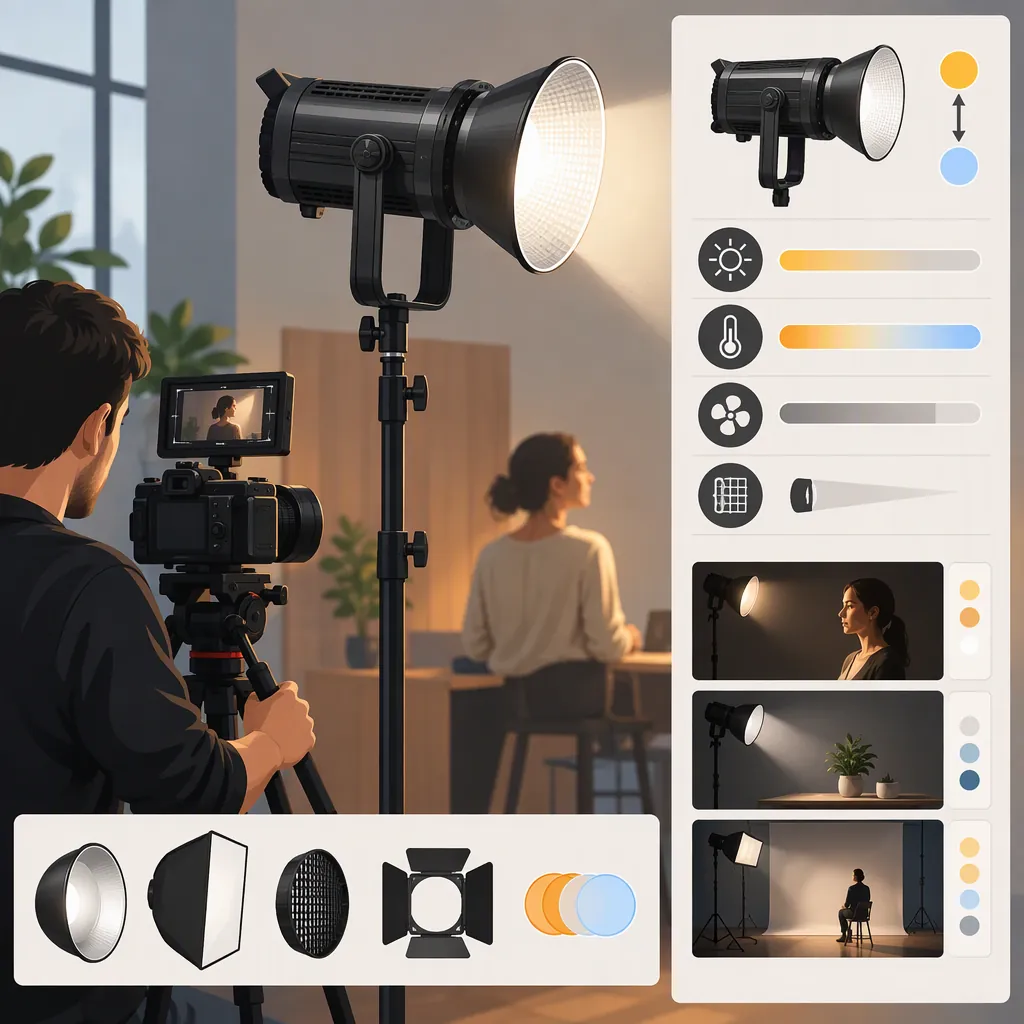
Choosing a Filming Light When Searching for Godox Sl150ii Bi
For a search such as “godox sl150ii bi,” start by confirming the exact model, then evaluate it against your filming setup. The provided retailer page uses several model-name variants and conflicting color-temperature ranges, so it does not establish a definitive specification. Use it as a starting point for questions about power, modifiers, fan noise and controls—not as proof of suitability for your shoot. [ref_1]
Confirm the Model Before Comparing Specifications
The available reference is a retailer listing titled “Godox SL150BII Bi-Color LED Video Light (2500-6500K, 150W).” Its body also uses SL150II and other model-name variants. The title and box description state 2500–6500K, while the descriptive copy and specification field state 2800–6500K. These discrepancies leave both the exact model identity and the lower color-temperature limit unresolved. [ref_1]
Before treating a specification as applicable, check the exact model marking on the fixture, packaging and corresponding manual. Do not assume that differently written names identify the same revision. This article does not independently verify the model, output, electrical consumption or color performance.
Model Verification Worksheet
- Exact model printed on the fixture: ______
- Exact model printed on the packaging: ______
- Matching manual title and revision: ______
- Stated color-temperature range in that manual: ______
- Differences from the retailer listing: ______
- Unresolved details to verify before selection: ______
Define the Shoot Before Choosing the Light
Write down the conditions the light must meet rather than selecting from a model name alone. For an interview, prioritize the intended face exposure, modifier placement and recorded sound. For a tabletop scene, include the working area, reflections and room available for stands. For a location shoot, include the power source and transport requirements.
Use a representative test scene with your intended camera settings. Position the light where it would actually be used, attach the intended modifier, and judge the resulting image. This is a proposed evaluation method, not a report of testing this Godox model.
The provided listing supplies no measured illuminance at a defined distance, beam angle or modifier configuration. It therefore does not establish whether the fixture will provide enough usable light for your particular scene. [ref_1]
Filming Requirements Checklist
- Scene type and subject: ______
- Camera frame rate, shutter setting, aperture and ISO: ______
- Intended light-to-subject distance: ______
- Modifier type and size: ______
- Available placement space: ______
- Ambient light to retain or control: ______
- Required exposure achieved in a representative test: yes / no / untested
Check Power, Modifiers and Recorded Sound
The retailer lists AC power, a Bowens mount and a silent mode described as turning off the fan. These are listing statements, not independently verified findings. [ref_1]
Power: Confirm the exact fixture’s electrical requirements and the power arrangements at the filming location. If battery operation is necessary, leave that requirement unresolved until you have documentation for the specific configuration; the supplied page does not establish a battery-powered workflow.
Modifiers: Confirm compatibility with the exact modifier you intend to use. Include its mounting hardware, clearance, weight and stand arrangement in the setup check. A mount label alone is not a complete assessment of the assembled rig.
Sound: Record a short dialogue sample with the intended microphone position and light setting. Compare normal operation with any documented fan-off mode. The supplied listing does not quantify fan noise or explain whether silent mode changes available output or operating limits. [ref_1]
Setup and Sound Test
1. Verify the fixture model and its power requirements.
2. Assemble the intended stand and modifier according to their instructions.
3. Set the light to the level needed for the scene.
4. Record room tone and a short spoken passage with the intended microphone placement.
5. If the exact model documents a fan-off mode, repeat the recording in that mode.
6. Note audible differences, exposure changes and any documented operating restrictions.
7. Mark untested requirements as unresolved rather than passed.
Make a Requirement-Based Selection
Treat selection as a set of checks rather than a general verdict. Keep the candidate under consideration only if its exact identity is clear and your required setup can be verified. Mark unresolved requirements explicitly, especially exposure with the intended modifier, power availability and sound at the microphone.
If comparing alternatives, apply the same camera settings, light distance, modifier goals and recording conditions. Record what was tested separately from what a listing says.
The available evidence is limited to one retailer page with internal inconsistencies. It does not support a model-to-model ranking, a color-accuracy judgment or a claim that this light is suitable for every interview, stream or location shoot. [ref_1]
Selection Record
| Requirement | Evidence or test | Status |
|---|---|---|
| Exact model identity | Fixture label and matching documentation | Pass / fail / unresolved |
| Required scene exposure | Representative camera test | Pass / fail / unresolved |
| Modifier and placement | Assembled setup check | Pass / fail / unresolved |
| Available power | Model requirements and location check | Pass / fail / unresolved |
| Acceptable recorded sound | Microphone test at working settings | Pass / fail / unresolved |
| Required controls | Exact-model documentation or test | Pass / fail / unresolved |
FAQ
Are Sl150ii Bi and Sl150bii Definitely the Same Model?
The supplied reference does not establish that conclusively. It uses multiple model-name forms, so confirm the fixture label and matching documentation before applying its specifications. [ref_1]
Which Color-Temperature Range Should I Rely On?
Neither range is conclusively verified here. The retailer title states 2500–6500K, while its descriptive copy and specification field state 2800–6500K. Resolve the discrepancy using documentation for the exact model. [ref_1]
Does the Listing Prove That the Light Is Suitable for Quiet Dialogue?
No. It describes a fan-off silent mode but provides no measured noise level or explanation of that mode’s operating limits. Assess recorded sound with your intended microphone placement and working light setting. [ref_1]