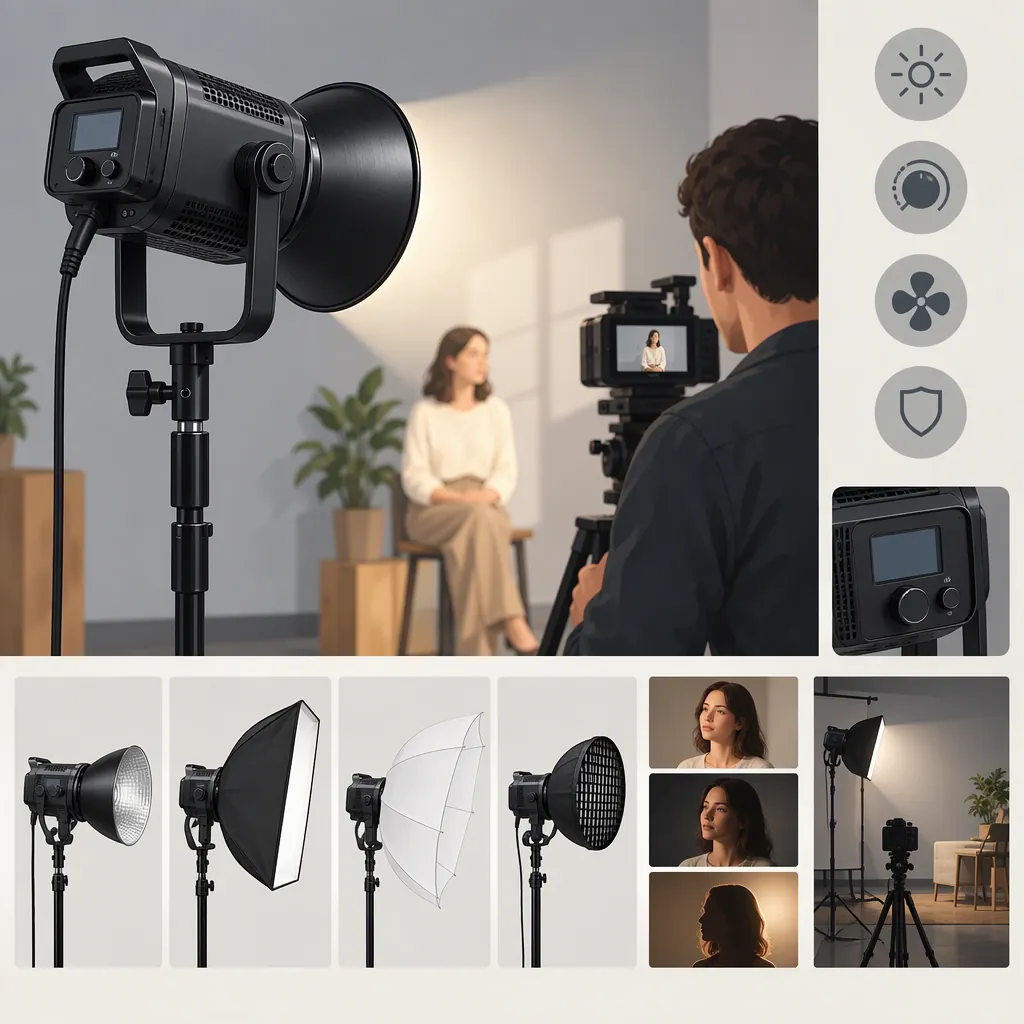
Godox Sl150ii: How to Choose a Light for Filming
To evaluate a “Godox SL150II” listing, first confirm the exact model, then check your non-negotiable setup constraints, and finally test picture and sound together. Fstoppers names its subject Godox SL150W II LED Video Light, while Mac Star lists Godox SL150 II Bi-Color LED Video Light. Keep information from those pages attached to their respective model names rather than treating them as interchangeable specifications. [c1] [c2]
Use this decision order:
- Resolve identity and compatibility. Confirm that the documentation matches the unit and intended accessories. If a critical model, mounting, or support question remains unresolved, defer the suitability judgment.
- Check fixed production constraints. Establish whether the complete setup can accommodate the available space, power arrangement, cable routes, and microphone placement.
- Test the filming result. Evaluate exposure, light quality, color, recorded noise, and brightness behavior under your planned shooting conditions.
Placement or modifier changes may resolve some problems, but they count as solutions only if the revised setup meets the full brief. Use the decision table to distinguish a pass from a change that still needs testing.
Confirm the Model Before Comparing Lights
The search term “godox sl150ii” alone does not resolve the naming difference between the Fstoppers review and the Mac Star retailer page. Record the complete model name from the listing and, where available, check it against the unit label and matching manual. [c1] [c2]
For each candidate, establish:
- The complete model name.
- The page or document supporting each specification.
- Whether that document matches the unit being evaluated.
- The documented compatibility and support requirements for the intended modifier, stand, and power arrangement.
Do not fill gaps by combining specifications from similarly named pages.
Evidence limit: The cited material is a review article and a retailer listing, not a matching manufacturer manual or a controlled comparison under the same filming conditions. This guide does not independently verify specifications, current availability, or performance, and does not establish that either named product is suitable for your production. [c1] [c2]
Define the Shot and Your Acceptance Criteria
Create one filming brief for all candidates. It should describe what the production requires—not what a particular light appears to offer. The questions below are general selection criteria, not claims about either Godox model.
Separate fixed requirements from permitted adjustments. For example, microphone placement may be fixed by the shot, while light placement may be adjustable within a defined area. Make that distinction before testing so an apparent improvement does not conceal an unusable compromise.
Shared Filming Brief
Complete this once, then use it for every candidate.
| Requirement | Record for the planned shoot |
|---|---|
| Scene and framing | Interview, tabletop scene, or wider shot; subject position and movement. |
| Available space | Permitted fixture and modifier positions, including areas that must stay clear of the frame. |
| Exposure | Intended aperture, shutter setting, ISO, and acceptable subject exposure. |
| Light quality | Required coverage and acceptable shadows and reflections. |
| Color | Surrounding light conditions, white balance approach, and acceptable subject appearance. |
| Sound | Microphone position, recording settings, and acceptable recorded background noise. |
| Logistics | Available power, support requirements, cable routes, and transport limits. |
| Take length | The duration over which picture and sound must remain acceptable. |
| Permitted adjustments | Settings, placement, modifiers, or room-lighting changes the production allows. |
| Critical requirements | Conditions that must pass before the setup can remain under consideration. |
Set acceptance criteria appropriate to the production rather than adopting an unsupported universal brightness or noise threshold. Define what you will inspect or listen for before interpreting the results.
Test Picture and Sound Together
If you can access the exact unit, test it in a configuration that represents the planned shoot.
- Build the intended setup. Use the planned camera, microphone, light position, and modifier. Follow the equipment’s operating and support instructions.
- Record the conditions. Note fixture settings and distances, along with any differences from the shared filming brief.
- Film a representative subject. Inspect exposure, shadows, reflections, coverage, and color consistency against your acceptance criteria.
- Record speech and a quiet passage. Review the recorded audio with the microphone in its intended position, not just the sound you hear in the room.
- Check brightness behavior. Inspect footage for visible banding or brightness changes at the frame rates and shutter settings you plan to use.
- Repeat over a representative take length. Check whether picture and sound remain acceptable while following the unit’s operating instructions.
When adjusting the setup, record what changed. Where practical, change one variable at a time so the next result is easier to interpret. Treat any successful result as evidence for that configuration, not for every possible use of the light.
Turn Observations into a Decision
These are general evaluation rules, not performance judgments about the Godox SL150II. “Acceptable” means meeting the criteria in your shared filming brief.
| Observation | Next step | Selection implication |
|---|---|---|
| Exposure does not meet the requirement | Adjust placement, fixture settings, or the lighting arrangement within permitted limits, then retest. | If no configuration meets the brief, rule out that setup for the shot. |
| Shadows, reflections, or coverage are unsuitable | Revise placement or use a verified compatible modifier, then repeat the picture test. | The revised setup must also fit the available space. |
| Color appearance is unacceptable | Check white balance and surrounding lighting; make permitted changes and retest. | A solution that requires unavailable room-lighting control does not meet the brief. |
| Recorded audio contains unacceptable equipment noise | Check its source, then adjust placement or permitted operating settings and retest picture and sound. | An audio improvement is not a pass if it creates an unacceptable image. |
| Footage shows banding or brightness changes | Retest with permitted fixture settings at the required frame rate and shutter setting. | If unresolved in the required configuration, mark the requirement as failed. |
| All critical criteria are met | Save the test conditions and results. | Keep the setup under consideration for that configuration. |
| A critical requirement cannot be verified | Record the missing evidence and seek matching documentation or a relevant test. | Defer judgment; an unknown is not a pass. |
Hypothetical Example: Better Sound, Unusable Placement
This example illustrates the method; it does not describe a test of any Godox model.
- Acceptance conditions: The recorded speech must meet the production’s noise criterion, and the fixture and modifier must remain outside the required frame.
- Observation: Moving the light farther from the microphone makes the recorded audio acceptable, but the new position puts the modifier in frame.
- Selection conclusion: Record adjust and retest, not pass. The revised position resolves one requirement but fails another. If no permitted arrangement meets both, rule out that setup for the shot.
Compare Complete Setups, Not Just Fixtures
Compare the fixture together with its modifier, stand, power arrangement, cable routing, and transport needs. Keep each candidate tied to the same shared brief.
Documentation and testing answer different questions: documentation records what a source states about the exact model; testing records what happened in a particular configuration. A documented feature does not automatically satisfy a filming requirement, and a completed test does not necessarily mean a pass.
Candidate Comparison Record
Use this record for each candidate’s evidence and results. Refer to the shared brief instead of copying all production requirements into every record.
| Field | What to record |
|---|---|
| Candidate identity | Exact model and intended accessories. |
| Evidence | Matching document or page, relevant information, and limitations. |
| Requirement assessed | The corresponding requirement from the shared brief. |
| Test status | Not tested, tested as planned, or tested in a different configuration. |
| Configuration differences | Settings, placement, accessories, or conditions that differ from the brief. |
| Observed result | What the footage, audio, or setup check showed. |
| Requirement outcome | Pass, fail, or cannot determine. |
| Remaining issue and next action | Missing evidence, permitted adjustment, or necessary retest. |
Before comparing results, identify any differences in test conditions. Do not treat results from different configurations as a matched comparison.
Use three final outcomes:
- Keep under consideration: Critical requirements pass in the intended setup, and compatibility and support questions are resolved.
- Adjust and retest: A possible solution remains within the production’s constraints but has not yet passed the complete brief.
- Defer or rule out for this shot: Defer when critical evidence is missing; rule out the evaluated setup when it fails a requirement and no acceptable adjustment is available.
The Fstoppers review and Mac Star listing identify their named products, but they are not a matched comparison of complete filming setups. They do not support a universal ranking or suitability conclusion. [c1] [c2]
FAQ
Can I Use Sl150w Ii and Sl150 Ii Bi-Color Information Interchangeably?
Do not assume so. Fstoppers uses SL150W II, while Mac Star uses SL150 II Bi-Color. Keep each page’s information attached to its named product and follow the model-confirmation checks. [c1] [c2]
Is the Godox Sl150ii Suitable for Interviews?
The cited pages do not establish suitability for your interview configuration. [c1] [c2] Evaluate the exact unit against your framing, exposure, modifier, microphone placement, and take-length requirements using the picture-and-sound test.
What Should I Do If I Cannot Test the Light?
Confirm the exact model and seek matching documentation. When reviewing performance evidence, look for the model, modifier, fixture settings, subject distance, camera settings, microphone placement, and test duration.
Compare those conditions with your shared brief. Evidence from another configuration can help identify questions, but keep critical requirements marked as unverified when the evidence does not address them.
Does a Documented Feature Count as a Passed Requirement?
No. Record documentary support and the requirement’s pass, fail, or unknown status separately in the candidate comparison record.
Should I Change Camera Settings to Make a Lighting Test Pass?
Only if the revised settings are acceptable for the production. Record the change and evaluate the footage against the full brief. If the solution depends on a compromise you cannot use during the shoot, the original requirement has not passed.