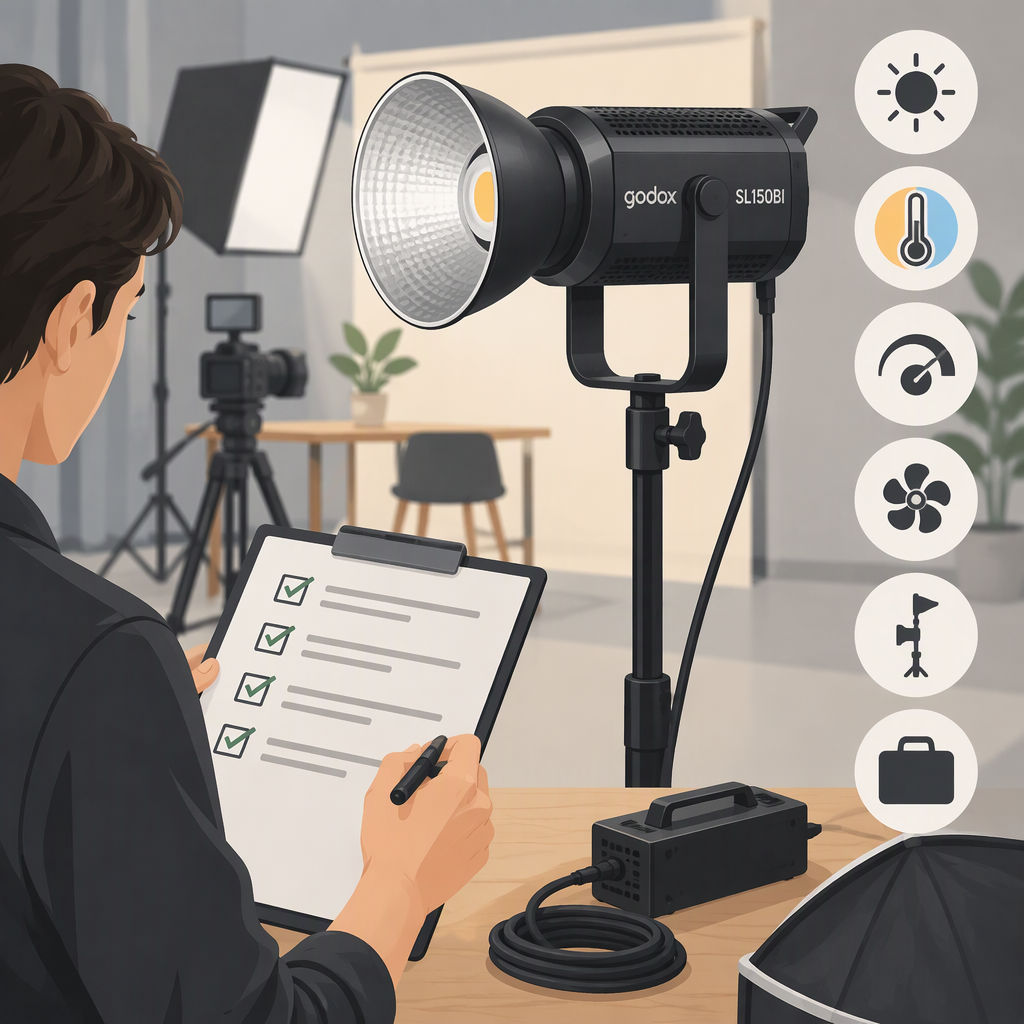
Godox Sl150bi: A Neutral Checklist for Choosing a Filming Light
Start with the scene, not the model name. To decide whether the Godox SL150BI belongs on your shortlist, first write down what your filming setup requires, then compare those requirements with product information you verify independently. This guide offers a selection method—not a review or a verdict. It makes no claims about the SL150BI’s specifications, performance, compatibility, accessories, or suitability.
1. Define the Filming Scene First
Record the conditions in which you expect to use a light. The same candidate can be worth investigating for one setup and a poor match for another, depending on the requirements.
- Subject distance: How far will the light be from the person or object? Note your typical distance and any minimum or maximum you need to accommodate.
- Ambient conditions: Will you film in a controlled, dim room, or alongside daylight or other lights? Note whether you need the light to balance with existing sources.
- Desired light quality: Describe the result you want—for example, soft or more defined light, and the direction it should come from. List any diffusion or other modifiers you expect to use.
- Light level: Identify how bright the scene needs to be at the subject, with your intended distance and modifiers in mind. A specification measured under different conditions may not answer that question directly.
- Color needs: Consider whether you need a particular color appearance or to coordinate with other lights. Check what information is available about color and how it was measured.
- Power and duration: Note where the light will be used, what power access is available, and how long a session typically lasts. Verify the candidate’s power requirements and operating limits in reliable documentation.
- Setup constraints: Check the space available, how the light must be mounted, how often you will move it, and any noise, control, or workflow requirements that matter to your recording.
Mark each item as a must-have, preference, or not relevant. This keeps a secondary convenience from outweighing a requirement that would prevent the light from working in your actual setup.
2. Check Evidence Against Each Requirement
For every must-have, identify what evidence would answer the question—and whether you have found it. Product documents can clarify listed specifications and operating requirements; independent tests may help when they describe the test conditions. Neither should be treated as a substitute for the other when your decision depends on both stated specifications and real-world results.
Use this checklist for the SL150BI or any other candidate, without assuming the answer in advance:
| Requirement | What to look for | If the answer is unclear |
|---|---|---|
| Light level in your setup | Output information, measurement distance and method, and any test conditions | Look for evidence matching your distance and intended modifiers; do not treat results from unlike setups as directly comparable. |
| Desired light quality | Information or examples that address the intended modifier or diffusion setup | Confirm whether the evidence reflects the setup you plan to use. |
| Color needs | Relevant color information and how it was assessed | Compare against the color requirements of your project and other lights. |
| Mounting and placement | Documented mounting details and the arrangement your setup requires | Verify the exact mounting needs before relying on an assumed fit. |
| Power and session length | Power requirements and documented operating limits | Check that these suit the location and duration of your sessions. |
| Portability and operation | Dimensions, weight, controls, or other details relevant to your workflow, when documented | Decide which details are essential to your setup and seek reliable confirmation. |
If a must-have cannot be confirmed, mark it unresolved rather than assuming the candidate meets it. The information available here does not establish any SL150BI-specific answer; each product-specific detail needs independent verification.
3. Apply the Checklist to Your Setup
These examples are hypothetical. They illustrate how filming conditions can change what you need to investigate; they are not tests or claims about the Godox SL150BI.
Hypothetical: close, controlled indoor recording. You might prioritize whether the candidate can deliver your required light level at close range with the diffusion you plan to use, and whether its placement and operation suit the room. Look for evidence that matches those conditions.
Hypothetical: a subject farther from the light, with ambient light present. You might give more weight to light level at the intended distance and how the candidate would fit alongside existing light sources. Check comparable evidence rather than assuming a result measured in another setup will answer this question.
Hypothetical: frequent location changes. You might treat portability, power access, setup time, and mounting as must-haves. A candidate that appears suitable on one technical criterion still needs to satisfy those practical constraints.
A simple worksheet makes the decision concrete:
| My requirement | Priority | Evidence needed | Verified? |
|---|---|---|---|
| Example: required light level at my planned distance and diffusion | Must-have | A measurement or test with relevant conditions | Yes / No / Unresolved |
| My actual scene requirement | Must-have / Preference | Documentation or a comparable independent test | Yes / No / Unresolved |
| Another scene requirement | Must-have / Preference | Documentation or a comparable independent test | Yes / No / Unresolved |
Fill in the actual details for your setup. Avoid replacing missing evidence with an assumption based on a model name, a headline specification, or a test conducted under conditions unlike yours.
4. Compare Candidates on Equal Terms
If you are comparing the SL150BI with another option, use the same scene requirements for both and compare evidence collected under similar conditions. Focus on the criteria that affect your decision: required light level, color needs, mounting, power, portability, and operational constraints.
For each candidate, record:
- Whether each must-have is supported by information you have verified.
- Whether the evidence reflects your intended distance, modifiers, and filming conditions.
- Which preferences each option may satisfy, based on the available evidence.
- What remains unknown and whether that unknown matters enough to delay a decision.
Do not treat unlike measurements as a fair head-to-head comparison. If one source reports a result at a different distance or with a different setup, note the difference rather than drawing a simple winner-and-loser conclusion.
Decision Summary
The practical answer to “Should I consider the Godox SL150BI?” is: define your scene and must-haves first, then assess the model only against product information you verify independently. This guide does not establish whether the SL150BI meets any particular requirement.
If the evidence supports your must-haves, you can keep the candidate under consideration. If an essential requirement remains unconfirmed, investigate it before deciding—or consider another candidate whose relevant information you can verify. Either way, base the choice on your filming conditions and comparable evidence, not an assumed fit.